How Much Does App Development Cost in Dubai 2026?
How Much Does App Development Cost in Dubai 2026?
Short Answer: Mobile app development in Dubai costs between AED 25,000 for a basic MVP and AED 500,000+ for a complex enterprise platform. The most common investment for a mid-level business app is AED 75,000–200,000.
But that range is almost useless without context. A AED 80,000 app and a AED 350,000 app can both be the right answer — depending on what you are building, who your users are, and how fast you need to move.
At TechSolutionor, we have scoped and built apps for Dubai businesses across retail, real estate, healthcare, F&B, and professional services. This guide gives you the real numbers, the factors that move the price up or down, what the different platforms cost, and the hidden expenses that blindside most first-time app buyers in the UAE.
App Development Cost in Dubai 2026 — Pricing by Complexity
| App Type | Cost Range (AED) | Timeline | What’s Included |
|---|---|---|---|
| Basic MVP / Simple App | AED 25,000 – 75,000 | 6–12 weeks | Core feature set, basic UI, user auth, single platform |
| Standard Business App | AED 75,000 – 200,000 | 12–20 weeks | Custom UI/UX, payment gateway, push notifications, Arabic/English, both platforms |
| Complex / Feature-Rich App | AED 200,000 – 400,000 | 20–36 weeks | Real-time features, third-party integrations, admin dashboard, AI features |
| Enterprise Platform | AED 400,000 – 1,000,000+ | 36–52+ weeks | Custom architecture, PDPL compliance, multi-role, high security, scalable infrastructure |
The UAE mobile app market is expected to reach AED 800 million by 2027, growing at 10.3% CAGR — and development costs are rising roughly 4% annually. Businesses building apps now are entering a market where the bar for quality is higher than it was two years ago, but the return on a well-built app is also significantly stronger.
What Actually Drives App Development Cost in Dubai
Most businesses focus on the headline quote. The quote is determined by these factors — and understanding them helps you scope smarter before approaching any agency.

1. App Complexity and Feature Set
This is the single biggest cost driver. Each additional feature means more development time, more testing, and more backend infrastructure. The jump from a basic app to a standard business app is usually driven by three features alone: payment gateway integration, real-time notifications, and a user dashboard. Adding all three can move a AED 40,000 project to AED 120,000+.
2. Platform Choice — iOS, Android, or Cross-Platform
| Platform | Cost Multiplier | Best For | Key Consideration |
|---|---|---|---|
| iOS Only | Base cost | Premium consumer apps, banking, luxury retail | Higher spend users in UAE are predominantly iOS |
| Android Only | Base cost | Mass-market, delivery, transport | Wider reach, lower-ticket audience in UAE |
| Native Both (iOS + Android) | 1.7–2x base cost | When performance is critical at scale | Two separate codebases — expensive to build and maintain |
| Flutter (Cross-Platform) | Base cost + 15–25% | Most business apps — best cost-to-quality ratio | Single codebase, iOS and Android from one build |
| React Native (Cross-Platform) | Base cost + 15–25% | Apps needing deep JavaScript ecosystem | Strong community, slightly larger performance gap than Flutter |
Over 60% of new Dubai apps in 2026 are built cross-platform, primarily on Flutter. The 25–40% cost saving over native development is significant — and for most commercial use cases in the UAE, the performance difference from native is imperceptible to the end user. Our Flutter development team builds cross-platform apps that run natively on both iOS and Android from a single codebase.
3. UI/UX Design and Arabic Localization
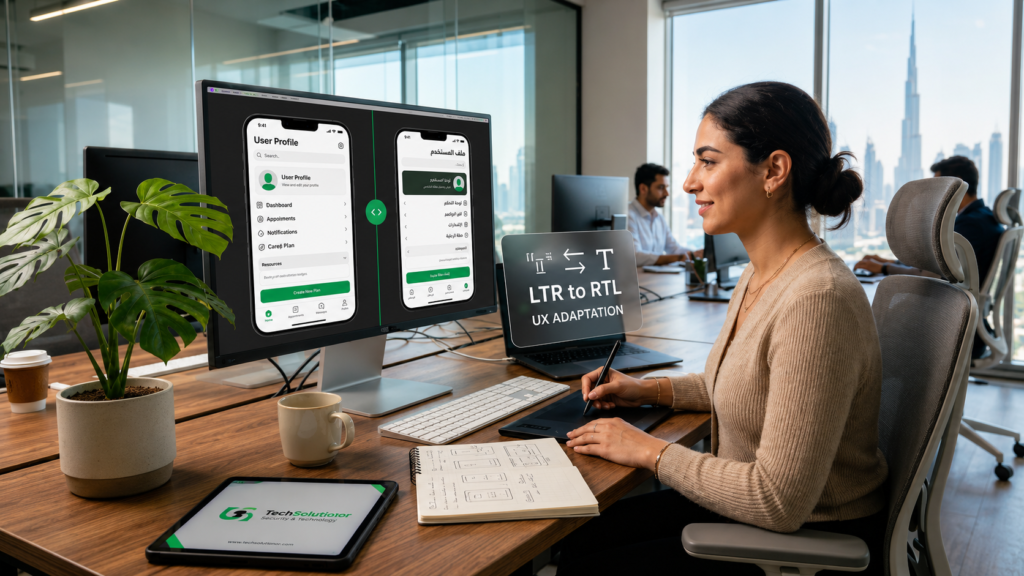
Basic apps with standard screens and minimal animations are significantly cheaper to design than fully custom, brand-driven experiences. In the UAE specifically, Arabic language support with proper RTL layout and bilingual navigation is not optional for most consumer apps — it is expected. A high-end custom design with full Arabic localization can add AED 20,000–50,000 to the design budget alone. UAE users have high digital expectations, and cutting corners on design consistently shows up in poor retention rates and low engagement metrics post-launch.
4. Backend Infrastructure and APIs
Every app feature that involves storing or retrieving data, processing payments, sending notifications, or communicating with third-party services requires backend infrastructure. Apps with high user loads, real-time syncing, or heavy media content require more powerful — and more expensive — server architecture. Cloud hosting on AWS, Google Cloud, or Azure adds AED 500–5,000+/month depending on usage. This is a recurring operational cost that most cost guides omit entirely.
5. UAE Regulatory Compliance
Apps that handle personal data in the UAE are subject to the Personal Data Protection Law (PDPL). Fintech apps require UAE Central Bank and DIFC compliance. Healthcare apps require DHA (Dubai Health Authority) compliance. Building compliance into the architecture from day one is significantly cheaper than retrofitting it later. Non-compliant apps face rejection from UAE government procurement, App Store review issues, and legal risk. Budget AED 15,000–50,000 for compliance work depending on your industry.
6. Team Structure — Local Agency vs Offshore
| Team Model | Hourly Rate (AED) | Pros | Cons |
|---|---|---|---|
| Dubai Local Agency | AED 300–600/hour | UAE compliance knowledge, time-zone alignment, Arabic UX expertise | Higher cost |
| UAE-based Freelancer | AED 150–350/hour | Lower cost, direct communication | Single point of failure, limited to 1–2 skills |
| Offshore Team (India/EE) | AED 50–150/hour | Significantly cheaper on paper | Communication gaps, no UAE regulatory experience, revision cycles add real cost |
| Hybrid (Local PM + Offshore Dev) | AED 150–300/hour blended | Balance of cost and quality control | Requires strong project management |
Labor costs represent 50–70% of any mobile app build. Offshore looks cheaper on paper — but communication gaps, misunderstood UAE market requirements, and revision cycles routinely eliminate the cost saving by the time the project closes.
App Development Cost by App Type — Dubai 2026
| App Type | Cost Range (AED) | Key Complexity Drivers |
|---|---|---|
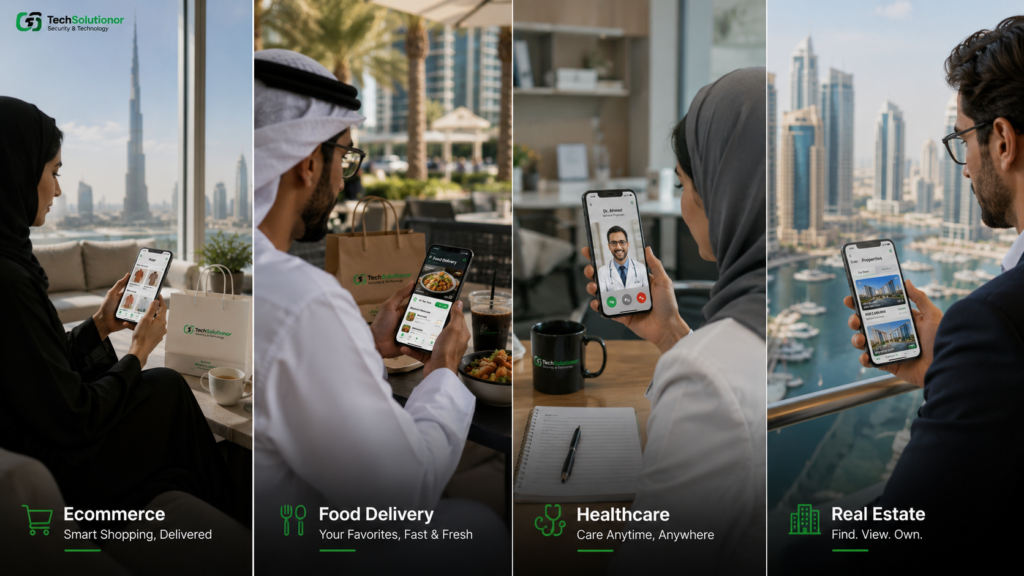
| E-commerce App | AED 75,000 – 200,000 | Payment gateway, product catalogue, cart, Arabic/English |
| Food Delivery App | AED 100,000 – 350,000 | Real-time tracking, restaurant dashboard, rider app, GPS, PDPL |
| Real Estate App | AED 150,000 – 350,000 | Property listings, agent CRM, lead gen, map integration |
| Healthcare / Telemedicine | AED 200,000 – 500,000+ | DHA compliance, EMR, video consultations, secure patient data |
| Fintech / Payment App | AED 250,000 – 500,000+ | Central Bank compliance, KYC, AML, digital wallet, encryption |
| On-Demand Service App | AED 120,000 – 300,000 | Multi-role (customer/provider), booking engine, payments, notifications |
| Basic Business / Utility App | AED 25,000 – 75,000 | Simple features, standard UI, single platform, minimal backend |
Hidden Costs Most Dubai App Quotes Leave Out
The quote your agency gives you is the build cost. Your actual year-one cost is typically 1.5–2x that number. Here is what gets missed:
- App Store fees: Apple Developer account AED 365/year. Google Play one-time AED 92. Small individually, but year-on-year recurring.
- Cloud hosting: AED 500–5,000+/month depending on user load — this is an ongoing operational cost that starts on launch day
- Annual maintenance: 18–25% of build cost per year covers OS updates, security patches, SDK updates, and bug fixes. A AED 200,000 app typically needs AED 40,000–50,000/year in maintenance. Apps without active maintenance break within 12–18 months due to iOS and Android OS deprecations.
- Marketing budget: Building the app is half the investment. Getting users costs 30–50% of development cost in the first year for most consumer apps.
- Compliance work: PDPL, DHA, or Central Bank compliance — not included in standard development quotes and can add AED 15,000–50,000
- Revision cycles: Scope changes mid-project are the most expensive line item in any app build. Every week of scope change typically costs AED 8,000–20,000 in rework. A clear, signed specification document before development starts is the single best investment you can make.
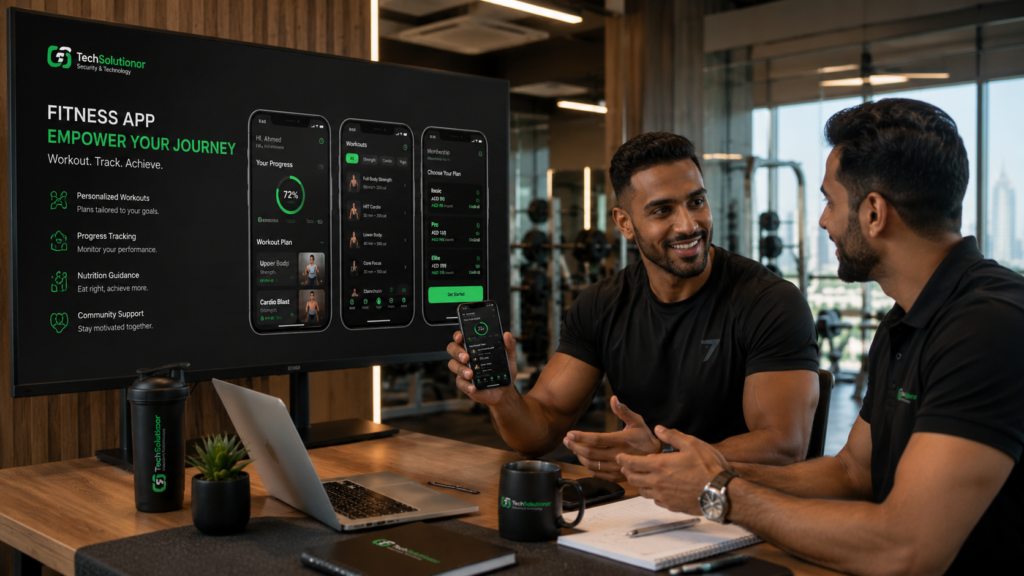
Real-World Case Study — AED 40,000 Budget, Launched in 10 Weeks
A Dubai-based fitness trainer came to TechSolutionor wanting a full-featured app — membership plans, video content library, booking system, in-app payments, push notifications, and a custom trainer dashboard. Initial scope estimate: AED 180,000. Timeline: 6 months.
We recommended a different approach: build a tight MVP first. Validate the market. Fund the next phase from revenue.
MVP scope we agreed on:
- Membership sign-up and payment (Stripe integration)
- Workout plan delivery — PDF and video links
- Push notifications for new content
- Basic trainer dashboard to manage clients
- English only — Arabic added in phase two
Result: Built on Flutter for iOS and Android. Launched in 10 weeks at AED 42,000. The client had 85 paying subscribers within 60 days of launch — generating enough recurring revenue to fully fund phase two development, including the video library, booking system, and Arabic localization, without additional external investment.
The lesson: budget does not determine outcome. Clarity does. Starting with a focused MVP almost always beats trying to build everything at once — and the UAE market will tell you within 60 days which features actually matter to your users.
You can view more of our app and web development results or contact our team to scope your project and get a no-commitment estimate.
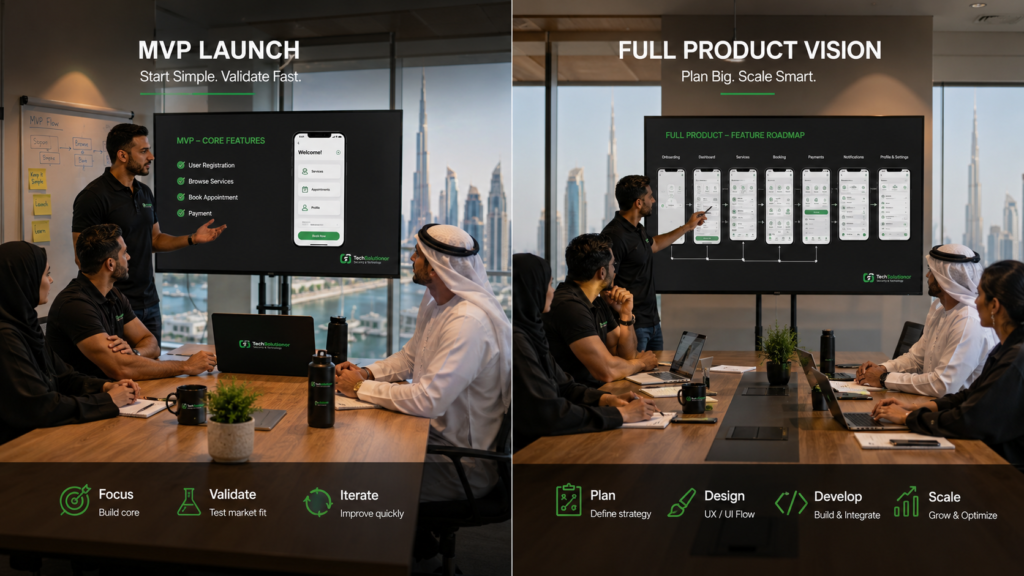
MVP vs Full App — Which Should You Build First in Dubai?
An MVP (Minimum Viable Product) is a version of your app with only the core features needed to deliver the primary value to your first users. It is not a cheap, cut-corner version — it is a strategically focused one.
- MVP reduces initial investment by 30–50% compared to a full-feature build
- MVP launches 2–3x faster — critical in Dubai’s fast-moving market where first-mover advantage is real
- MVP generates real user feedback — the features your users actually use versus the features you assumed they would want are almost never identical
- MVP funds phase two — like our case study above, revenue from an MVP consistently funds the next development phase without additional capital raise
The only scenario where you should build the full app immediately is when you have a regulatory requirement (fintech, healthcare) that mandates a complete feature set at launch, or when you are building for enterprise procurement where a full product demonstration is required.
2026 Trends Affecting App Development Cost in Dubai
AI Features Are Becoming Baseline Expectations
AI is no longer a premium add-on in UAE apps — it is becoming a competitive baseline in fintech, ecommerce, real estate, and customer service. Basic AI features via API integration (chatbots, recommendation engines, content personalization) add AED 20,000–60,000 to a standard app build. Custom machine learning models built from the ground up start at AED 200,000+. Most Dubai businesses get the best early ROI from API-based AI features — they are faster to ship, cheaper to build, and deliver immediate user value.
Flutter Dominates Cross-Platform in the UAE
Over 60% of new Dubai apps in 2026 are built cross-platform, with Flutter as the dominant choice. Google’s continued investment in Flutter, its near-native performance, and the 25–40% cost saving over native development have made it the default recommendation for most UAE business apps. Our Flutter development team builds production apps for iOS and Android simultaneously — reducing both build cost and ongoing maintenance overhead.
PDPL Compliance Is Non-Negotiable in 2026
The UAE Personal Data Protection Law is actively enforced in 2026. Apps handling user data — which is virtually every commercial app — must implement proper data residency, consent management, and deletion workflows. Building PDPL compliance into architecture from day one costs AED 15,000–30,000. Retrofitting it into an existing non-compliant app costs significantly more and often requires partial rebuilds.
Arabic-First Design Is Growing
As the UAE’s digital economy matures, more apps are being designed Arabic-first rather than treating Arabic as a translation afterthought. RTL-native interfaces, Arabic-first onboarding flows, and dialect-aware content are producing measurably better retention among UAE national audiences. This adds design complexity and cost — but also delivers stronger product-market fit in the UAE’s most commercially powerful demographic.
How to Choose an App Development Company in Dubai
The UAE has hundreds of agencies claiming app development expertise. Here is how to separate genuine capability from over-promised portfolios:
- Ask for live apps in UAE app stores — not mockups, not wireframes, not client logos. Actual downloadable apps they built for UAE clients.
- Check for PDPL and regulatory experience — if you are in fintech, healthcare, or any data-sensitive category, this is non-negotiable.
- Confirm bilingual development capability — Arabic RTL implementation in apps is a specific technical skill. Ask to see examples of Arabic-language apps they have shipped.
- Request a specification document before pricing — any agency quoting a price without a detailed feature specification is guessing. The spec document is where real scope clarity lives.
- Ask about post-launch maintenance — if there is no maintenance plan in the proposal, your app will break within 12–18 months when Apple or Google release OS updates that deprecate SDKs your app depends on.
At TechSolutionor, our app development service covers strategy, UI/UX, development, Arabic localization, App Store submission, and post-launch maintenance — built specifically for the Dubai and UAE market. We work across Flutter, React Native, and Swift for iOS-native builds.
Frequently Asked Questions — App Development Cost Dubai
How much does it cost to build an app in Dubai in 2026?
Short Answer: AED 25,000 for a basic MVP to AED 500,000+ for a complex enterprise platform. The most common mid-range business app investment is AED 75,000–200,000.
Cost is determined primarily by feature complexity, platform choice (iOS, Android, or cross-platform), design quality, Arabic localization, and UAE regulatory compliance requirements. Getting a detailed specification document from your agency before agreeing to any price is essential — vague quotes produce budget surprises.
Is Flutter or React Native cheaper for app development in Dubai?
Short Answer: Both are comparable in cost — 25–40% cheaper than building separate native iOS and Android apps.
Flutter is currently the preferred choice for most Dubai agencies in 2026 due to stronger performance, a more consistent cross-platform UI, and Google’s ongoing investment in the framework. React Native remains strong for apps that need deep JavaScript ecosystem integration. For most UAE business apps, Flutter is the right default. See our full comparison: Flutter Development Dubai.
How long does app development take in Dubai?
Short Answer: 6–12 weeks for a basic MVP, 12–20 weeks for a standard business app, 20–36 weeks for a complex app, and 36–52+ weeks for enterprise platforms.
Add 2–4 weeks for App Store submission and review — Apple’s review typically takes 2–3 days but rejections extend the timeline. Most projects benefit from a 1–2 week scoping phase before development begins, which reduces costly scope changes mid-build.
What are the hidden costs of app development in Dubai?
Short Answer: Annual maintenance (18–25% of build cost), cloud hosting (AED 500–5,000+/month), App Store fees, compliance work, and marketing budget are the most commonly missed costs.
Total cost of ownership in year one is typically 1.5–2x the initial development quote. Annual maintenance alone on a AED 200,000 app runs AED 40,000–50,000/year. Apps that skip maintenance break within 12–18 months when OS updates deprecate the SDKs they depend on.
Should I build an MVP or a full app first in Dubai?
Short Answer: Build an MVP first in almost every case — it reduces initial cost by 30–50%, launches 2–3x faster, and generates real user data before you invest in full feature development.
The exception is regulated industries — fintech and healthcare — where compliance requirements mandate a minimum feature set at launch. For all other business apps in Dubai, an MVP that launches and earns real user feedback is almost always a better investment than a fully featured app that takes 12 months to build.
What is the cheapest way to build an app in Dubai?
Short Answer: Cross-platform Flutter MVP with a focused core feature set — typically AED 25,000–50,000 — is the most cost-efficient path to a live, production-quality app in the UAE.
No-code tools like FlutterFlow or Bubble can reduce cost further to AED 15,000–30,000 but with significant limitations on customization and scalability. They work for proof-of-concept validation but most Dubai businesses outgrow them within 12 months as user expectations and feature demands increase.

Ready to Build Your App in Dubai?
The first step is not a quote — it is a conversation about what you are actually building, who your users are, and what the right scope looks like for your budget and timeline.
At TechSolutionor, we scope every project with a detailed specification document before we price it. No guessing, no vague ranges, no budget surprises six months in.
Contact our team to scope your app →
Already have a spec and want a direct quote? Hire us directly and we will turn around a detailed estimate within 48 hours.