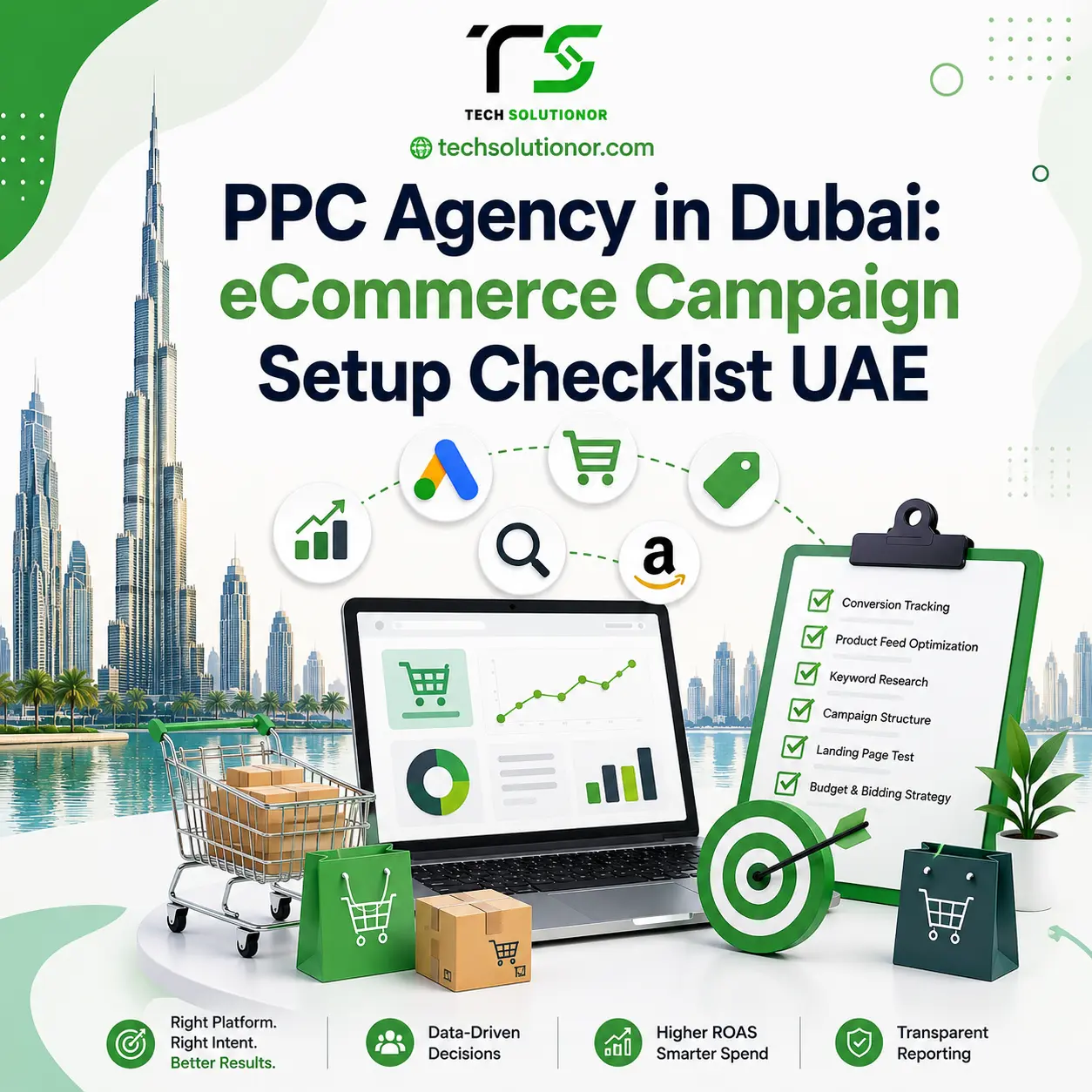
PPC Agency in Dubai: eCommerce Campaign Setup Checklist UAE
PPC Agency in Dubai: eCommerce Campaign Setup Checklist UAE
Most ecommerce sellers in the UAE launch a Google Ads campaign, watch the budget disappear in a week, and walk away convinced PPC just doesn’t work for their store. It usually isn’t the platform’s fault. It’s the setup. A campaign built without a proper checklist, without conversion tracking actually wired correctly, without a clear answer for which platform should be doing what, burns money fast and proves nothing useful in the process.
As a PPC agency in Dubai working primarily with ecommerce brands, we see this pattern constantly, and it’s almost never about the products being wrong or the market being too competitive. It’s about skipping steps that feel optional but absolutely aren’t. This guide lays out the actual setup checklist we use before any paid advertising campaign for a UAE store goes live, plus a part most agencies skip entirely: where Amazon Ads UAE fits into the picture, because for a lot of UAE sellers, it shouldn’t be an afterthought.
What a PPC Agency in Dubai Actually Does for an Ecommerce Store
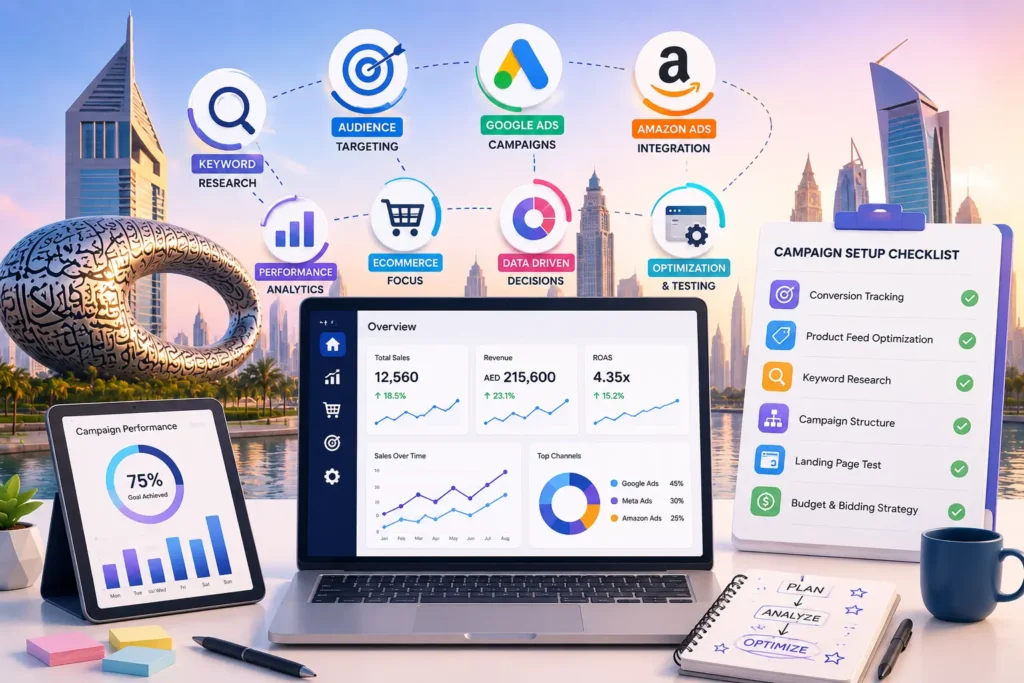
Strip away the jargon and the job is fairly simple. A PPC agency builds and manages paid campaigns across platforms like Google, Meta, and increasingly Amazon, with the goal of getting the right product in front of the right buyer at a cost that still leaves room for profit. For ecommerce specifically, that means shopping campaigns, product feed management, retargeting, and constant attention to which SKUs are actually worth the ad spend versus which ones are quietly draining it.
Good PPC management isn’t just turning campaigns on and watching a dashboard. It’s catching a product feed disapproval before it tanks visibility for half your catalog. It’s noticing that one campaign is eating sixty percent of the budget while converting at half the rate of a smaller one nobody’s been paying attention to.
The eCommerce Campaign Setup Checklist
This is the part most competitor blogs gloss over with vague advice like “set clear goals” and “know your audience.” Here’s what an actual setup sequence looks like before a UAE ecommerce campaign goes live.
Conversion tracking, configured and tested. Before a single dirham gets spent, every purchase, add-to-cart, and checkout step needs to fire correctly in Google Ads and Meta’s pixel. Skipping this step means flying blind for the first few weeks, optimizing toward numbers that might not even reflect real sales.
Product feed cleaned and structured properly. For Google Shopping campaigns specifically, your feed needs accurate GTINs, correct categorization, and pricing that matches your live site exactly. Mismatched pricing between your feed and your actual checkout is one of the fastest ways to get products disapproved.
Audience and keyword research grounded in UAE search behavior, not assumptions borrowed from a US market guide. Search volume, intent, and even how people phrase product searches differ here, especially across English and Arabic queries, and pairing this with organic search insight often reveals keyword opportunities a paid-only approach would miss entirely.
Campaign structure split by intent, not just by product category. Branded search, generic high-intent search, and cold prospecting traffic behave completely differently and deserve separate budgets and bidding strategies rather than being lumped into one campaign.
Landing pages tested for mobile speed and checkout flow. Sending paid traffic to a slow page or a clunky checkout is the single most common way UAE ecommerce sellers waste ad spend, and it’s almost always fixable before launch rather than after.
Budget allocated with a testing phase built in. The first two to four weeks should be treated as data collection, not a performance benchmark. Pulling the plug on a campaign after three days because ROAS looks weak usually means killing it before it had a real chance to learn.
Google Ads vs Meta Ads vs Amazon Ads: An Honest Comparison
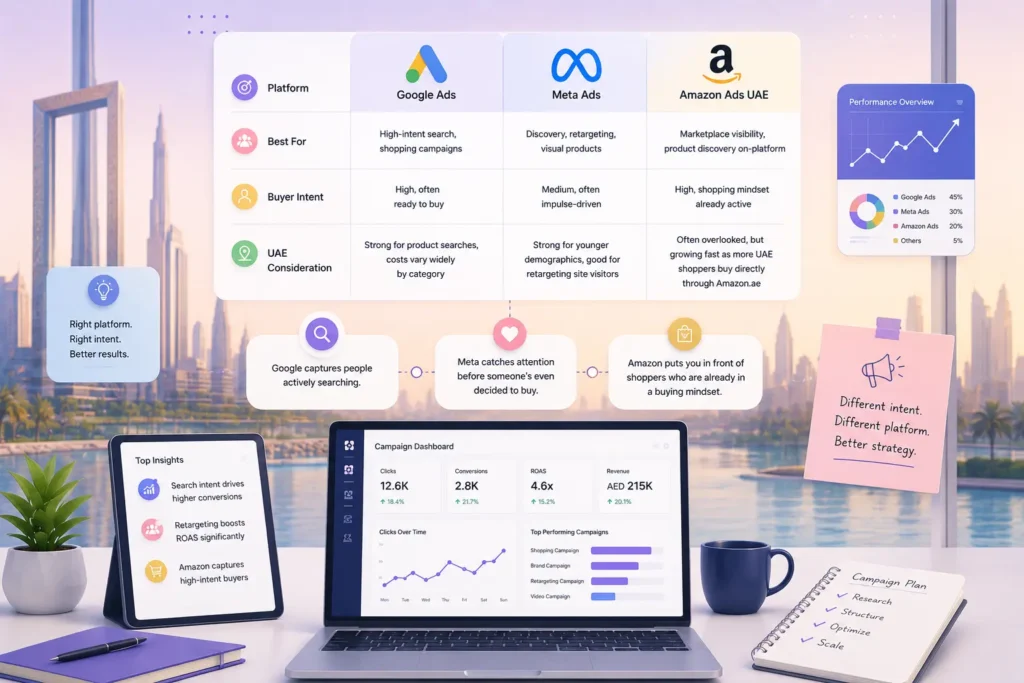
Every platform claims to be essential, and a lot of generic advice just lists all three without explaining when each one actually earns its budget.
| Platform | Best For | Buyer Intent | UAE Consideration |
| Google Ads | High-intent search, shopping campaigns | High, often ready to buy | Strong for product searches, costs vary widely by category |
| Meta Ads | Discovery, retargeting, visual products | Medium, often impulse-driven | Strong for younger demographics, good for retargeting site visitors |
| Amazon Ads UAE | Marketplace visibility, product discovery on-platform | High, shopping mindset already active | Often overlooked, but growing fast as more UAE shoppers buy directly through Amazon.ae |
The honest answer for most ecommerce sellers is that these platforms aren’t really competing with each other. Google captures people actively searching. Meta catches attention before someone’s even decided to buy, and that same content often gets a second life across organic social channels once you know which creative is actually working.
Amazon puts you in front of shoppers who are already in a buying mindset on a platform they trust, which is a fundamentally different kind of intent than a cold social ad.
Why Amazon Ads UAE Deserves More Attention Than It Gets
This is the piece almost every other PPC agency blog in this market skips entirely, and it’s a genuine gap worth filling.
Amazon.ae has grown substantially as a shopping destination in the UAE, and a meaningful share of sellers running Google and Meta campaigns haven’t touched Amazon Sponsored Products at all. That’s a missed opportunity, particularly for categories like electronics, home goods, and beauty where UAE shoppers increasingly check Amazon before deciding where to actually purchase.
Sponsored Products campaigns on Amazon work differently from Google or Meta. You’re not building awareness from scratch, you’re competing for visibility among shoppers who already have their wallet out. That changes the entire strategy: keyword bidding tends to be more about defending product page real estate than generating cold traffic, and a well-optimized Amazon listing combined with even a modest ad budget can outperform a much larger Google campaign for certain product categories.
For sellers running their own ecommerce store alongside an Amazon presence, the two channels should inform each other. Amazon search term data often reveals exactly what language and keywords convert, which can sharpen Google Ads targeting on your own site, and vice versa.
What PPC Actually Costs for Ecommerce in the UAE
Pricing here gets thrown around vaguely across most agency websites, so here’s a more grounded breakdown.
Management fees for a PPC agency in Dubai typically run somewhere between 10 and 20 percent of monthly ad spend, separate from the ad budget itself. A small ecommerce store testing the waters might run AED 5,000 to AED 15,000 monthly in actual ad spend across Google and Meta combined. A growing mid-size store with an established product catalog often sits between AED 15,000 and AED 50,000, while larger or highly competitive categories, fashion, electronics, beauty, can climb well beyond that.
Amazon Ads typically requires a separate, smaller test budget initially, often AED 2,000 to AED 5,000 to start, since the platform rewards iterative optimization based on actual sales data rather than large upfront spend.
These ranges shift heavily by category, competition, and how clean your existing conversion funnel already is. A store with a fast, well-optimized website generally needs less ad spend to hit the same revenue target than one sending traffic to a slow or confusing site.
Common Mistakes That Quietly Drain Ad Budgets
A handful of patterns repeat across UAE ecommerce sellers who end up disappointed with their PPC results.
- Launching without conversion tracking properly tested, which means weeks of “optimization” based on inaccurate data
- Treating ROAS as the only metric that matters, ignoring customer lifetime value and repeat purchase behavior that often makes a slightly lower ROAS campaign more valuable long term
- Ignoring Amazon entirely while competitors quietly capture marketplace visibility for the same product categories
- Killing campaigns too early, before the platform’s algorithm has had enough data to actually optimize
- Running the same generic ad copy across Google, Meta, and Amazon instead of writing for each platform’s specific buyer mindset
Best Practices and Expert Tips
A few habits consistently separate ecommerce sellers who get strong, sustainable ROAS from those stuck restarting their strategy every few months.
Set a clear testing budget before launch and commit to it for at least two to three weeks, regardless of early performance jitters. Early data is noisy. Decisions made on day three are usually decisions made on bad information.
Segment campaigns by product margin, not just product popularity. A high-volume, low-margin product can look like a star performer on a traffic report while actually losing money once ad spend is factored against the real margin.
Build retargeting into the budget from day one rather than treating it as a later add-on. Shoppers who visited but didn’t buy are dramatically cheaper to convert than cold traffic, and skipping this step on a first campaign wastes that opportunity entirely. For stores with more complex catalogs or custom checkout logic, this sometimes means working with a development team to make sure tracking pixels and customer data sync correctly across every platform rather than leaking data at the handoff points.
Review product-level performance weekly, not just campaign-level numbers. A campaign can look profitable overall while three underperforming products quietly eat the budget that should be going toward your actual winners.
UAE-Specific Considerations Worth Planning Around
A few realities of this specific market change how PPC campaigns should actually be built here.
Bilingual targeting matters for a large share of categories. Arabic-language search behavior differs meaningfully from English, and running English-only keyword targeting in a market with this much Arabic-speaking purchase intent leaves real traffic on the table.
Seasonal spikes need dedicated budget planning, not last-minute scrambling. Ramadan, Eid, and the Dubai Shopping Festival all create sharp shifts in both search volume and buyer behavior, and campaigns that aren’t restructured ahead of these periods underperform against competitors who planned weeks in advance.
Mobile optimization isn’t optional. A significant majority of UAE ecommerce traffic happens on mobile, and a campaign sending traffic to a desktop-optimized landing page is starting at a real disadvantage before the click even lands.
Local trust signals influence conversion more than international ad creative assumes. UAE shoppers respond to visible trade license details, local payment gateways like Telr and PayTabs, and clear delivery timelines more than generic global trust badges borrowed from a US template.
How to Choose the Right PPC Partner

A few questions separate a genuinely capable PPC agency in Dubai from one that’s mainly good at the sales pitch.
- Do they ask detailed questions about your margins and product catalog before recommending a budget, or pitch the same package regardless of your business?
- Can they show real campaign data from UAE ecommerce clients specifically, not generic global benchmarks? Ask to see a portfolio of past work rather than relying on a sales deck alone.
- Do they have actual experience running Amazon Ads UAE, or does their expertise stop at Google and Meta?
- Is their reporting transparent enough that you understand what’s working at the product level, not just a vague overall summary? Reading about who’s actually behind the agency tells you more about their real expertise than a polished homepage ever will.
- Will they tell you honestly when a campaign isn’t working, or keep recommending more budget regardless of performance?
Where This Is Heading
A few shifts are worth watching through the rest of 2026. AI-driven bidding tools like Google’s Performance Max and Meta’s Advantage+ campaigns are handling more optimization automatically, which raises the floor for average campaigns but also makes genuine strategic input from an experienced team matter more, not less, since the platforms now reward clean inputs (good creative, accurate feeds, solid tracking) more heavily than manual bid tweaking ever did.
Amazon’s advertising ecosystem in the UAE is still maturing relative to more established markets, which means sellers building a presence there now have a real window before competition catches up. And first-party data is becoming more valuable across every platform as privacy changes continue to limit how much third-party tracking agencies can rely on, which puts more weight on a brand’s own customer list and retargeting pools than it used to carry.
FAQs
Q: How much does a PPC agency cost in Dubai?
Most agencies charge 10 to 20 percent of monthly ad spend as a management fee, separate from the actual ad budget. Total investment depends heavily on industry competition and how many platforms you’re running campaigns across.
Q: Is Amazon advertising worth it for UAE sellers?
For many product categories, yes. Amazon.ae has grown significantly, and shoppers there already have purchase intent. Sponsored Products campaigns often convert efficiently since you’re reaching buyers actively comparing options, not building awareness from scratch.
Q: Should I run Google Ads or Meta Ads first for my ecommerce store?
It depends on your product. Google Ads suits products people actively search for, while Meta Ads suits visually appealing products that benefit from discovery-based browsing. Most successful UAE stores eventually run both together.
Q: How long before a PPC campaign starts showing real results?
Expect two to four weeks before data becomes genuinely reliable, since platforms need time to optimize. Judging performance within the first few days usually means making decisions based on incomplete, misleading early data.
Q: What’s the biggest reason ecommerce PPC campaigns fail in the UAE?
Broken or untested conversion tracking combined with sending paid traffic to a slow or poorly optimized website. Both issues waste ad spend before the campaign ever gets a fair chance to actually perform.
Conclusion
Running paid ads for an ecommerce business in the UAE isn’t about picking the flashiest platform or throwing the biggest budget at Google Ads and hoping for the best. It’s about a proper setup checklist, honest platform comparison, and genuinely understanding where Amazon Ads UAE fits into a strategy that most competitors are still ignoring. The sellers seeing real, sustainable ROAS are the ones treating PPC as a system to refine constantly, not a switch to flip once and forget.
Looking for a PPC agency in Dubai that actually understands ecommerce, including the parts of paid advertising most agencies skip? Get a free campaign audit from Tech Solutionor and see exactly where your current ad spend is working and where it’s quietly leaking budget.