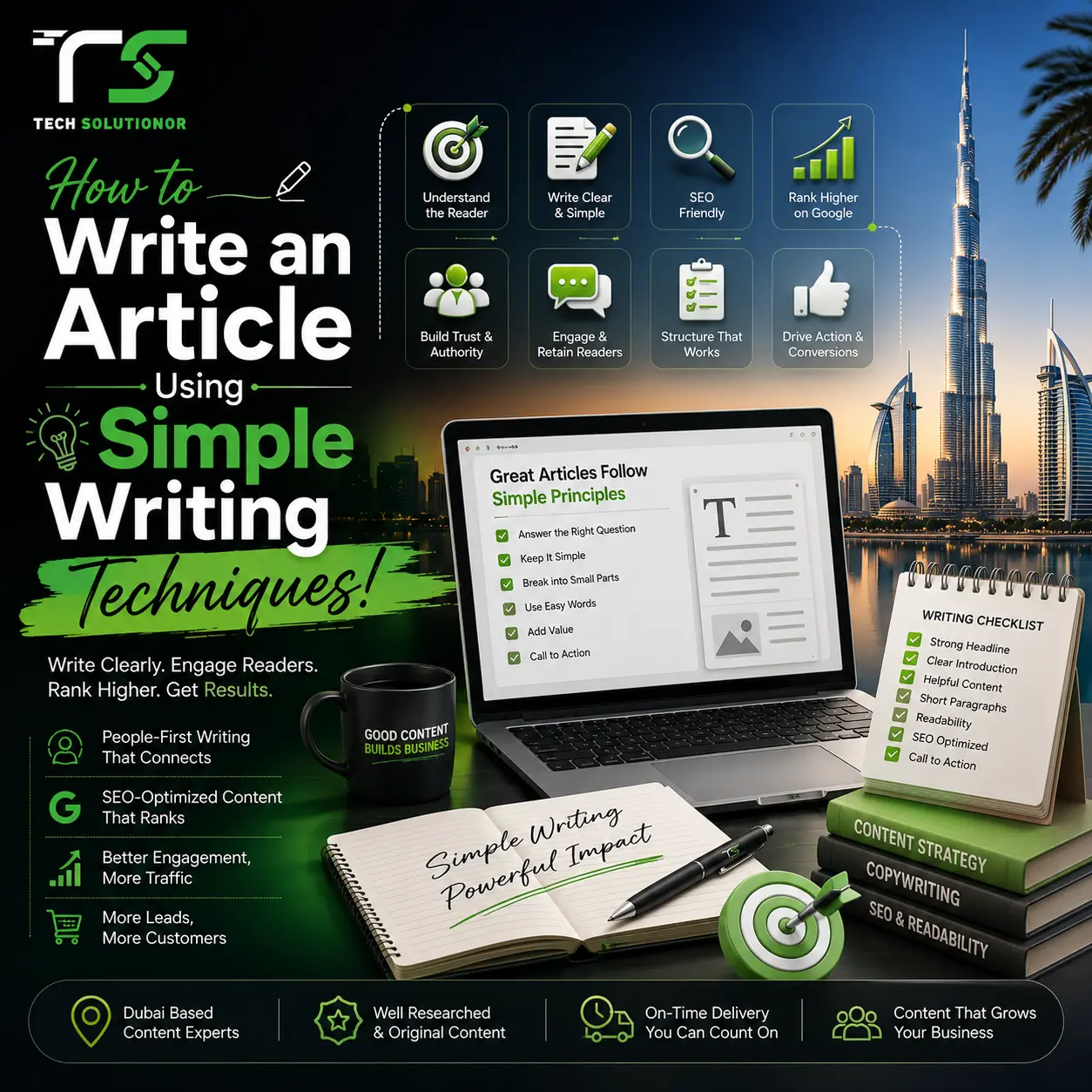
How to Write an Article Using Simple Writing Techniques!
How to Write an Article Using Simple Writing Techniques!
A few years back, I sat with a client who’d paid good money for a “content expert” to write his blog. Twelve polished, grammatically perfect articles and every single one got maybe fifteen visits a month. We read a couple out loud together. Halfway through the first paragraph, he stopped me and said, “wait, what is this even about?” That was the problem. Not the grammar. The writing just never got to the point.
That moment stuck with me more than any writing course I’ve taken. Learning how to write an article isn’t really about vocabulary, not at first. It’s about respecting the reader’s time enough to tell them what they came for, quickly. I’ve spent fifteen years bouncing between design work and content strategy and honestly, the writing that performs best usually isn’t the writing that sounds smartest.
If your business leans on content to bring people in, pairing that writing with solid content writing support is often what turns a decent article into one that actually converts. So here’s what I’ve picked up, the techniques that hold up in practice, not just in theory.
What Actually Makes an Article Work
Here’s a test I use constantly: read the first two sentences of an article out loud to someone unfamiliar with the topic. If they can’t tell you what the piece is about, it’s not ready.
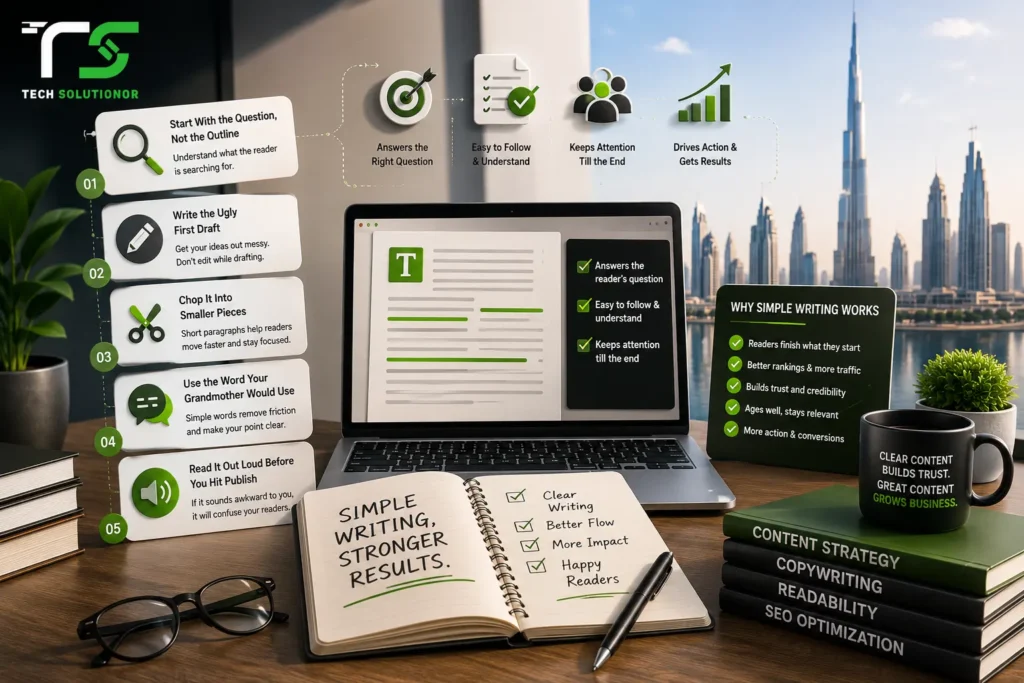
A working article does three things reasonably well. It answers the reader’s actual question, not the question the writer wanted to answer. It’s easy to follow without re-reading sentences twice. And it holds attention long enough for the reader to reach the part that matters most, whether that’s an answer, a decision or a next step.
Miss any one of these and the piece falls flat, no matter how well-researched it is underneath. I used to think good writing meant sounding polished. These days I think it means sounding like a person who actually knows the answer and isn’t afraid to just say it plainly.
How to Write an Article, Step by Step
There’s no single “correct” process, but here’s the version that’s worked for me and for most writers I’ve coached over the years.
Start With the Question, Not the Outline
Before typing a word, figure out what the reader typed into Google to land here. What are they actually stuck on? If your opening paragraph doesn’t touch that within a few lines, most people won’t stick around to find it later.
Write the Ugly First Draft
This step gets skipped constantly and it’s probably the most important one. Get the ideas out messy. Don’t fix typos, don’t second-guess word choice, don’t stop to look up a better synonym. Editing while drafting is like driving with one foot on the brake, you’ll get there eventually, but it’ll take twice as long and feel exhausting.
Chop It Into Smaller Pieces
Big blocks of text are where people bail. I aim for two, maybe three sentences per paragraph on web content, sometimes even one if it makes a strong point. It looks a bit sparse on the page at first, but readers move through it far faster.
Use the Word Your Grandmother Would Use
“Use” instead of “utilize.” “Help” instead of “facilitate.” “Start” instead of “commence.” This isn’t about dumbing anything down, it’s about removing friction between your idea and the reader’s understanding. Fancy words don’t make you sound smarter, they just add a small tax the reader has to pay before they get your point.
Read It Out Loud Before You Hit Publish
I still do this with everything I write, including this article. If a sentence trips you up when you say it, it’ll trip up the reader too, they just won’t tell you why they stopped reading.
Why Bother With Simple Writing Techniques

- Readers actually finish what they start, instead of bouncing three lines in
- Google tends to reward content that people stick with, which quietly helps your rankings
- Clear writing builds trust faster than clever writing does
- It ages better. Trendy phrasing dates itself; plain language rarely does
- More people take action, because confused readers almost never become customers
Where This Approach Falls Short
I’d be lying if I said simple writing solves everything. A few honest limitations worth knowing before you go trimming every sentence you write:
Highly technical or specialized topics sometimes need the complexity. Strip too much out and you lose accuracy, not just polish. Writing simply is also, weirdly, harder than writing complicated sentences, it takes more editing passes, not fewer.
And even the clearest writing in the world won’t rank if nobody structured the content around what people are actually searching for, which is where a proper search engine optimization strategy has to come in alongside the writing itself.
Mistakes I See Constantly
The point shows up in paragraph six. By then, most readers have already left. Say the important thing first, explain it after. Sentences that need a map to follow. If you’re counting three commas before hitting a period, that sentence probably wants to be two sentences instead.
No formatting at all. Even good writing gets skipped on a phone screen if it’s one unbroken wall of text. Headings and short paragraphs are how people actually read online now. Publishing the first draft. Deadlines are real, I get it. But a second pass, ideally after stepping away for an hour, catches things you’re too close to see the first time.
Writing for yourself instead of the reader. Sometimes writers chase what interests them rather than what the reader is stuck on. It reads fine, it just doesn’t help anyone.
A Few Things I Tell Every Client, Design Hat On
Design and writing overlap more than people expect and after years of building pages around content, a few habits have stuck with me.
Break content into sections people can skim before they commit to reading properly, most visitors decide in seconds whether to stay. Keep the answer near the top, don’t make anyone scroll to find out if your article is even relevant to them.
Use bullet points once a list creeps past three items, dense paragraphs bury information that should be easy to scan. And keep your tone consistent with your graphic design and branding, mismatched voice and visuals quietly chip away at trust without the reader ever quite knowing why.
What It Costs: Writing It Yourself vs Getting Help

| Option | Typical Cost | Best For |
| Writing it yourself | Free, but eats your time | Small businesses on a tight budget |
| Freelance writer | $30 – $150 per article | One-off or occasional content |
| Copywriting services in Dubai (agency) | $200 – $800 per article or a monthly retainer | Businesses wanting consistent, SEO-ready content |
| Full content marketing package | $1,000 – $3,000+ per month | Companies scaling content across several channels |
Most UAE businesses I’ve worked with start out writing things themselves, then quietly move to professional copywriting services in Dubai once the volume gets too much for someone to squeeze in between actual job duties.
DIY Writing vs Bringing In Professional Help
| Factor | Writing It Yourself | Hiring Copywriting Services |
| Time investment | High, especially early on | Low, it’s handed off |
| SEO optimization | You’ll need to learn it separately | Usually already built into the process |
| Consistency | Depends entirely on your schedule | Reliable, on a set cadence |
| Quality control | Varies with your own skill level | Edited and reviewed professionally |
| Cost | Free, but not really free | Paid, but time-saving |
Neither route is objectively better. It really comes down to how much content your business actually needs and whether you have the hours to give it the attention it deserves.
Writing for a UAE Audience
A few things worth knowing if you’re writing content for readers here specifically.
Bilingual readers are the norm here, plenty of your audience reads comfortably in both English and Arabic and content built for only one misses real reach. We go into this more in our piece on multilingual SEO in the UAE.
Tone matters too, phrasing that lands well in a Western market sometimes needs softening for a UAE audience that values relationship and respect in communication. Most reading here happens on a phone, which reinforces everything already said about short paragraphs and scannable formatting.
UAE readers also tend to look for credibility markers before trusting content: real author names, specific examples, evidence someone actually knows the topic. Timing helps too, publishing around Ramadan or major shopping seasons lands better when planned ahead rather than scrambled together last minute.
Where Article Writing Is Headed
Search engines are leaning harder into rewarding content with real, first-hand experience behind it and pulling back from generic, templated writing that reads like it came from nowhere in particular. That actually makes simple, human writing more valuable right now, not less, even with AI tools everywhere in content production.
We cover this shift in more depth in how AI is changing SEO and Google rankings, particularly how Google’s systems are weighing genuine expertise more heavily than sheer content volume these days.
Voice search and AI-generated summaries are changing how people find answers too, which means content written to directly and plainly answer a real question has a genuine edge going forward. Businesses that put real effort into fewer, better-researched pieces tend to hold their ground through these shifts better than the ones churning out content just to fill a calendar.
If the content budget is part of a bigger marketing conversation for you, our breakdown of SEO pricing in Dubai is worth a look too, since writing and search visibility rarely move independently of each other.
Pros and Cons, Honestly
Pros:
- Easier for a wider range of readers to actually understand and act on
- Tends to perform better in search results and holds attention longer
- Gets faster to write once it becomes a habit, not a chore
- Works across blogs, emails, ads, product pages, pretty much everywhere
Cons:
- Can start to feel repetitive if you don’t vary your sentence rhythm
- Takes real discipline to avoid sliding into jargon when you’re rushed
- Not always the right fit for deeply technical or academic writing
- Looks easy on the page, takes longer to genuinely master than people expect
What Usually Tips the Decision

When businesses are weighing whether to keep writing in-house or bring in outside help, these are the things that usually decide it: how much content actually needs producing on a consistent basis, whether the current writer understands SEO basics or is just guessing, what the budget realistically allows for ongoing content, how fast the business needs to grow its online presence and whether weak writing is already quietly costing trust or conversions.
FAQs
1. What is the easiest way to start writing an article?
Write the reader’s exact question in one sentence, then answer it directly in your opening paragraph. Draft first without editing, revise afterward. This takes the pressure off trying to write perfectly on the first attempt.
2. How long should a good article be?
It depends on the topic, but most strong-performing articles land between 1,000 and 2,500 words. Focus on covering the topic fully rather than chasing a specific word count, thin content rarely ranks well regardless of length.
3. Should I hire copywriting services in Dubai or write content myself?
It comes down to your time and content volume. Occasional, small content needs often suit DIY writing fine, while businesses needing consistent, SEO-ready output usually get more value from professional copywriting services.
4. How do I make my writing sound less robotic?
Read the draft out loud, swap complicated words for simple ones and vary your sentence length on purpose. Robotic writing usually comes from overly uniform sentences and formal vocabulary that doesn’t match how people actually talk.
5. Does writing simply hurt my credibility as an expert?
Not usually, it tends to strengthen it. Clear writing shows you understand your topic well enough to explain it plainly. Overly complex language often hides gaps in understanding more than it proves any real expertise.
Conclusion
Learning how to write an article well really isn’t about raw talent, it’s technique and technique is something you can build. Start with the reader’s actual question, keep the language plain and format it for how people genuinely read online, in short bursts, scanning for whatever part matters to them.
If keeping this up consistently isn’t realistic for your team right now, our content writing team can take it off your plate, so your message stays sharp and consistent while you focus on running the actual business.
Want help turning your ideas into content that actually converts? Reach out to our team and we’ll walk you through what a steady content strategy could realistically look like for your business.