Multilingual SEO in UAE: Rank in Arabic & English (2026)
Multilingual SEO in UAE: Rank in Arabic & English (2026)
Most Dubai businesses invest in English SEO and leave 40–60% of their addressable market untouched. Arabic is the language UAE audiences trust when they are ready to buy — and Arabic organic search is still dramatically underserved compared to English. Businesses moving first are earning first-page Arabic rankings with fewer backlinks, faster timelines, and higher conversion rates than equivalent English keywords deliver. At TechSolutionor, this guide covers exactly how to build that bilingual presence correctly in 2026.
Why Multilingual SEO in the UAE Cannot Be Ignored in 2026
The UAE has 11.1 million internet users at 99% internet penetration. Arabic is the primary language of the country’s most economically powerful decision-makers — yet the majority of digital marketing spend in Dubai still targets English-only search. The data from live UAE campaigns is unambiguous:
- Arabic queries convert at higher rates than English across real estate, legal, healthcare, and retail
- Page-one Arabic rankings require fewer than 10 backlinks on a six-month-old page — virtually impossible for equivalent English keywords
- Arabic voice search is growing faster than English — over half of Middle East searches are predicted to be voice-based
- Google’s AI Overviews are starved of quality Arabic content — businesses producing structured Arabic content are being cited in AI summaries their competitors cannot reach
- Bilingual local SEO delivers 3.5x the ROI of single-language advertising in UAE markets
The window is open — but narrowing. Businesses acting in 2026 will own the Arabic rankings their competitors spend years trying to catch up to.
Translation vs Arabic SEO — The Mistake Costing UAE Businesses Rankings
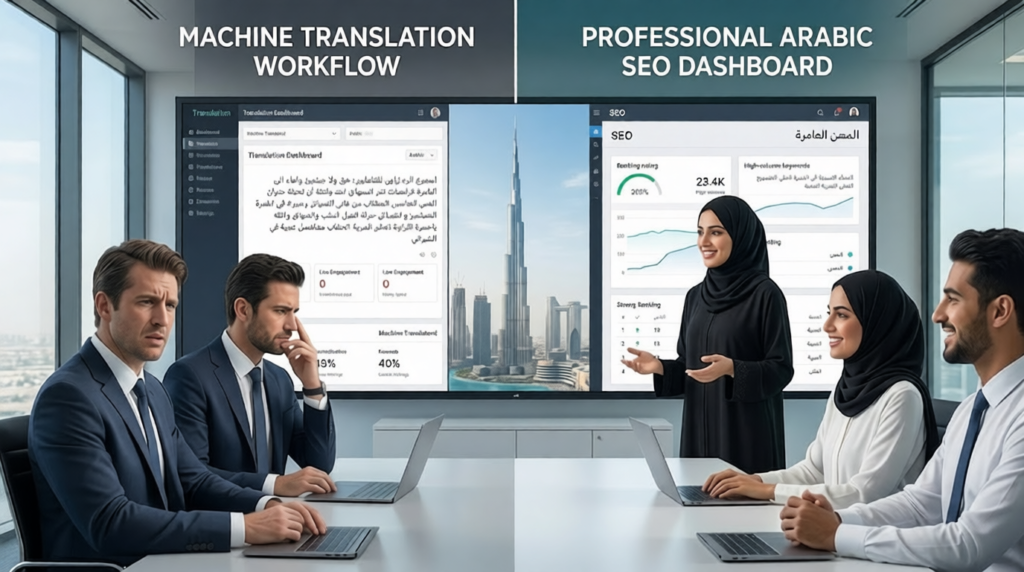
The most common bilingual SEO failure we audit: a business translates English pages into Arabic and wonders why they do not rank. Translation and Arabic SEO are fundamentally different disciplines. Machine-translated or directly converted Arabic pages produce no independent keyword research, duplicate content signals that suppress both versions, zero cultural adaptation for UAE nationals, and broken RTL layouts that spike mobile bounce rates. Genuine Arabic SEO is a parallel campaign — independent keyword research, native copywriting, proper technical implementation, and a separate link building strategy. Not a translation project.
Technical Foundation for Bilingual SEO in the UAE
Technical architecture determines whether Google can correctly understand, index, and rank both language versions. Content investment delivers a fraction of its potential if the structure underneath is wrong.
URL Structure — Use Subdirectories
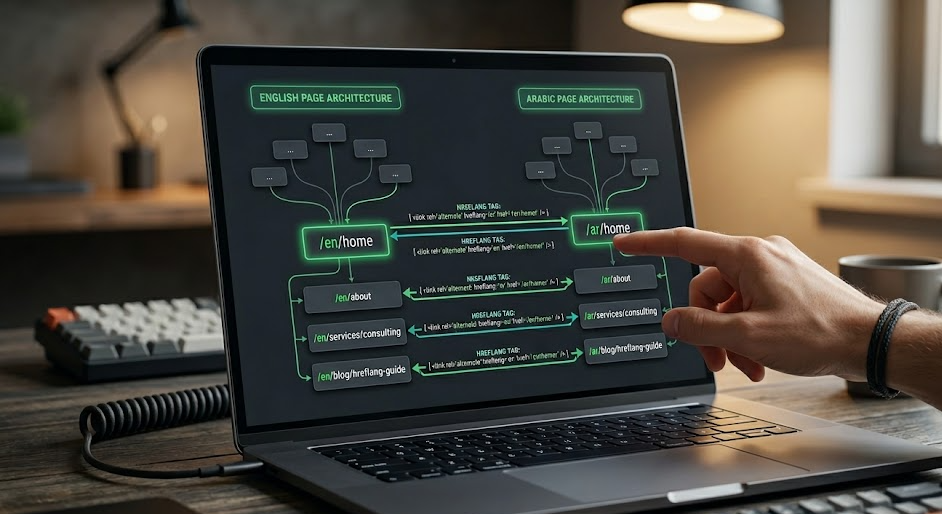
For UAE bilingual sites, subdirectories consolidate domain authority most effectively:
- yoursite.ae/en/ — English version
- yoursite.ae/ar/ — Arabic version
Every backlink your English content earns strengthens your Arabic pages and vice versa. Separate domains split authority. Subdomains are treated as independent sites — harder to build authority on and not recommended for UAE businesses.
Hreflang — Non-Negotiable for Every Page
Without correct hreflang, your Arabic and English pages cannibalise each other in search results — both versions underperform. For UAE bilingual sites, implement three tags bidirectionally in the HTML head of every page: hreflang=”en-AE” for English, hreflang=”ar-AE” for Arabic, and hreflang=”x-default” for the fallback. The bidirectional requirement — English page points to Arabic, Arabic page points back to English — is the most commonly missed implementation step we fix during audits.
RTL Layout and Arabic Font Rendering
Arabic requires right-to-left CSS — adjusting padding, margins, text alignment, and navigation direction. Standard system fonts render Arabic script poorly, directly increasing bounce rates. Web-optimized Arabic fonts loaded via Google Fonts or a self-hosted stack are essential for dwell time and Core Web Vitals performance on Arabic pages.
Schema Markup for Bilingual UAE Pages
Three schema types are critical in JSON-LD format: FAQPage to surface Arabic Q&A in AI Overviews and PAA boxes, LocalBusiness with Arabic name, address, and hours for local Arabic search, and HowTo for step-by-step content eligible for direct SERP display. Schema works identically for Arabic and English — Google processes structure, not just language.
If your site needs a technical rebuild to support bilingual architecture properly, our web development team builds SEO-first bilingual structures from the ground up — URL architecture, RTL CSS, and schema included.
Arabic Keyword Research — Why It Is Not a Translation Exercise
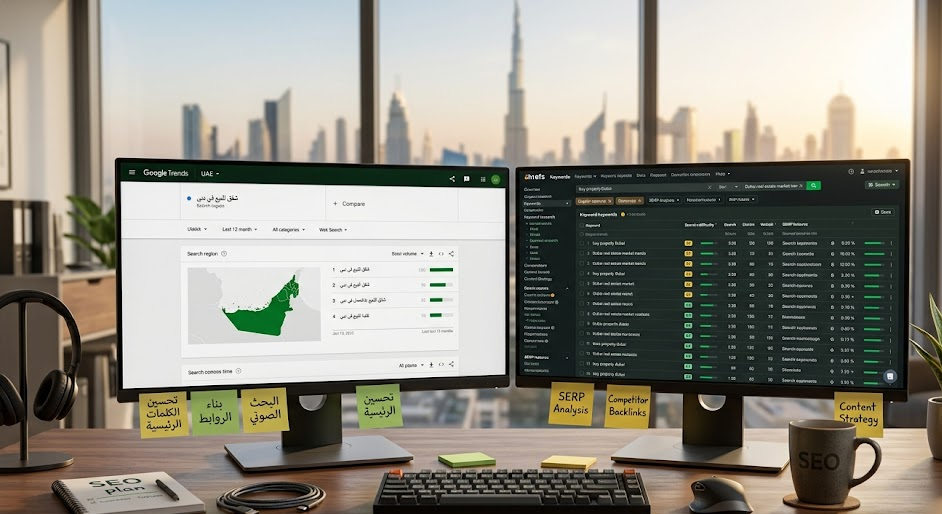
Arabic search behavior follows different patterns than English — different query structures, different intent signals, different dialects. Effective Arabic keyword research in the UAE covers three layers:
- Modern Standard Arabic (MSA): Correct for formal written content and the primary layer for most service pages
- Khaleeji dialect terms: Gulf Arabic expressions that UAE nationals actually use in search — often absent from MSA keyword lists
- Arabizi: Arabic words spelled phonetically in English characters — increasingly common in typed and voice queries among younger UAE demographics
Supplement Ahrefs and Semrush Arabic data — which is thinner than English — with Google Search Console Arabic query data from your existing site, Google Trends filtered to UAE and Arabic language, and manual PAA research on Google.ae in Arabic. The PAA boxes on Google.ae for Arabic queries are one of the most underused research sources for bilingual SEO in the UAE market.
Arabic Content Strategy — Writing for Rankings and Conversions
Native Writing, Not Translation
Arabic content must be written by native Arabic speakers with SEO training. Machine translation produces content that misses keyword intent, dialect nuance, and cultural context — and Google’s quality systems identify it. Trust signals differ for Arabic audiences: credentials, certifications, and UAE-specific social proof carry more weight than generic testimonials. CTAs need cultural adaptation — direct English-style CTAs often require softening for Arabic pages where relationship precedes transaction.
Structure Content for AI Overviews
Google’s AI Overviews are heavily underserved in Arabic. Place the direct answer to the main query within the first 50 words of every Arabic page. Use clear, definitive statements — not hedged language. Implement FAQPage schema. Use consistent entity language (always name your brand, location, and services identically). The Arabic web’s underrepresentation in AI training data means well-structured Arabic content has a disproportionately high chance of being cited in AI-generated summaries right now. This is the single highest-leverage Arabic SEO opportunity available in 2026.
Build Topical Authority with a Hub and Spoke Model
Create one Arabic pillar page per core service supported by focused Arabic subpages — interlinked tightly. Run the same structure in English independently. This signals topical depth to Google in both languages separately, building ranking authority faster than isolated pages. Our content writing team produces Arabic and English clusters built specifically for topical authority across UAE industries.
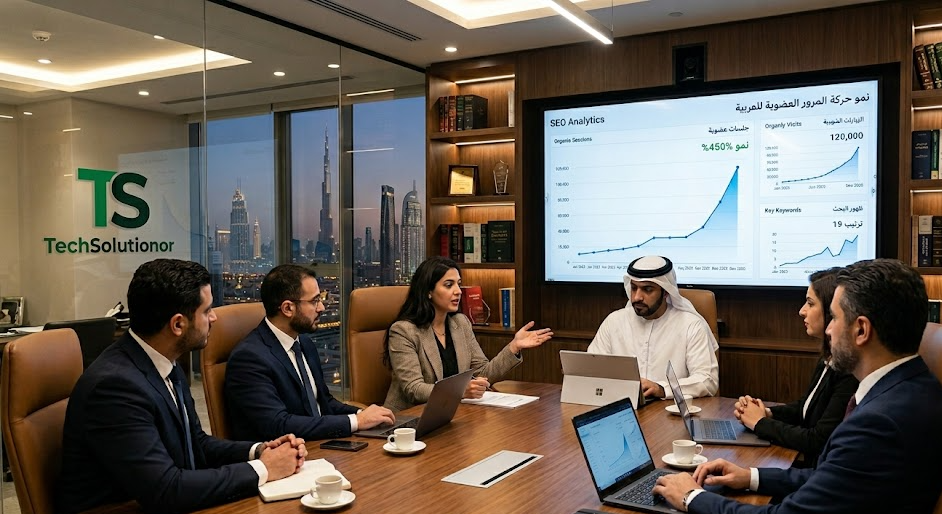
Real-World Case Study — 210% Arabic Organic Traffic in 8 Months
A Dubai legal services firm came to TechSolutionor with strong English rankings and zero Arabic organic presence. Their primary clients — UAE nationals — were not being reached through organic search at all. Every Arabic lead came through paid channels at margins-compressing cost.
What the audit found: Arabic content was JavaScript-rendered and uncrawlable. No hreflang implemented. All Arabic pages were machine-translated English copy. No schema. Mobile RTL layout broken — 78% mobile bounce rate on Arabic pages.
Month 1–2: Technical rebuild — server-side rendered Arabic pages, correct bidirectional hreflang, RTL CSS fixed, subdirectory URL structure implemented.
Month 3–4: 12 Arabic service pages rewritten by native copywriters with independent keyword research. FAQPage and LocalBusiness schema live. First Arabic pages indexing and ranking for long-tail queries.
Month 5–6: 8 Arabic blog articles published. First-page rankings for 11 Arabic keywords. Arabic organic sessions: zero to 800/month.
Month 7–8: Arabic sessions reached 2,900/month — 210% growth from month five. 6 keywords ranking positions 1–3 on Google.ae. Three Arabic pages appearing in Google AI Overview summaries. Organic Arabic leads exceeded paid Arabic channel leads at zero incremental cost.
View more results in our portfolio, or start with a free multilingual SEO audit to see your Arabic gap today.
2026 Trends Reshaping Multilingual SEO in the UAE
Google SGE in 86% of UAE Search Queries
Google’s Search Generative Experience now appears in 86.83% of UAE search queries. Appearing in AI-generated summaries requires structured content, FAQ schema, and direct factual statements — not traditional keyword density. This applies to both Arabic and English, but the Arabic opportunity is larger because competition for AI citation in Arabic is near zero for most industries.
Arabic Voice Search
Voice queries are conversational and question-structured. Arabic voice search is growing faster than English across the UAE. Arabic content must include natural-language Q&A sections that mirror spoken Arabic queries — distinct from standard keyword optimization and essential for capturing voice traffic in 2026.
Dubai D33 and National Vision Alignment
Arabic content that speaks to UAE national vision narratives — innovation, quality of life, sustainability — ranks more strongly for local intent queries. Google’s 2026 algorithms assess whether content aligns with local cultural and economic context. Arabic pages written with UAE-specific framing outperform generic Arabic content translated from English-market originals. Read how AI is reshaping broader UAE search: How AI Is Changing SEO & Google Rankings in 2026.
Multilingual SEO Pricing and Performance by Industry — UAE 2026
| Service Tier | Monthly Retainer (AED) | What’s Included |
|---|---|---|
| Bilingual Starter | AED 3,500 – 6,000 | Technical setup, hreflang, 4–6 Arabic pages/month, schema |
| Full Bilingual Campaign | AED 6,000 – 14,000 | Technical audit, Arabic + English content, link building, reporting |
| Enterprise Multilingual | AED 14,000 – 30,000+ | Full bilingual team, PR-level Arabic links, AI Overview optimization |
| Industry | Arabic Search Volume | Arabic Competition | Time to Page 1 (Arabic) |
|---|---|---|---|
| Real Estate | Very High | Medium | 3–5 months |
| Legal Services | High | Low–Medium | 3–4 months |
| Healthcare | High | Low–Medium | 4–6 months |
| E-commerce | Very High | Medium | 3–5 months |
| Education | Medium–High | Low | 2–4 months |
| Professional Services | Medium | Low | 2–3 months |
For a full breakdown of SEO pricing across service types in Dubai, see our complete SEO cost guide for 2026.
Choosing a Multilingual SEO Partner in Dubai
Most UAE agencies claim bilingual SEO capability. Few deliver it. Ask these questions before committing:
- In-house native Arabic writers or outsourced translation? The difference in ranking performance is measurable and significant.
- Can they show hreflang and RTL implementation examples? Technical multilingual SEO is a specialist discipline — ask for proof.
- Do they have Arabic-specific ranking case studies? General SEO results do not demonstrate Arabic campaign capability.
- Are they structuring content for AI Overviews in Arabic? In 2026 this is table stakes for any serious bilingual SEO partner.
At TechSolutionor, our multilingual SEO integrates in-house Arabic content, technical web development, and digital marketing under one team — no outsourcing, no gaps between language versions. For Arabic website architecture specifics, read: Arabic Website Design & Multi-Language Guide for Dubai 2026.
Frequently Asked Questions — Multilingual SEO UAE
What is multilingual SEO and why does my UAE business need it?
Short Answer: Multilingual SEO optimizes your website to rank in Arabic and English independently on Google UAE — not through translation, but through separate keyword research, native content, and correct technical implementation.
Arabic-speaking users drive the majority of high-value conversions in real estate, legal, healthcare, and retail in the UAE. A single-language English site captures less than half its addressable organic market.
How is Arabic SEO different from English SEO in the UAE?
Short Answer: Arabic SEO requires independent keyword research, native writing, RTL technical setup, and hreflang — translation alone does not rank.
Arabic search includes Khaleeji dialect terms, Arabizi, and conversational voice queries that English keyword tools miss entirely. Cultural adaptation — not just language conversion — determines whether Arabic pages convert UAE national audiences.
How long does Arabic SEO take to show results?
Short Answer: 3–5 months to page one for most UAE industries — faster than equivalent English keywords due to lower competition.
UAE businesses have achieved first-page Arabic rankings with fewer than 10 backlinks on a six-month-old page. For a full timeline, see: How Long Does SEO Take to Show Results in Dubai?
What is hreflang and do I need it for my bilingual UAE website?
Short Answer: Hreflang tells Google which language version to show which user — without it, your Arabic and English pages cannibalise each other.
Implement hreflang=”en-AE”, hreflang=”ar-AE”, and hreflang=”x-default” bidirectionally in the HTML head of every page. Missing one direction — the most common error — causes both versions to underperform.
Can I use Google Translate to create Arabic SEO content?
Short Answer: No. machine-translated Arabic does not rank and does not convert UAE audiences.
Google’s quality systems identify translated content. Arabic pages from machine translation miss keyword intent, dialect nuance, and cultural context — consistently underperforming natively written Arabic in both rankings and conversion rate.
How do I optimize Arabic content for Google AI Overviews?
Short Answer: Answer the main query in the first 50 words, use FAQPage schema, and write definitive statements — not hedged language.
The Arabic web is underrepresented in AI training data. Well-structured Arabic content has a disproportionately high chance of being cited in AI Overviews right now — a positioning advantage that disappears as more competitors enter the Arabic content space.
Start Capturing the Arabic Traffic You Are Missing
The Arabic organic opportunity in the UAE is real, measurable, and still open. Our free multilingual SEO audit gives you a professional assessment of your bilingual technical setup, Arabic keyword gaps, and uncaptured organic potential — no commitment required.