How Mobile Application Development Turns Ideas into Apps
How Mobile Application Development Turns Ideas into Apps
Fifteen-plus years building apps, and I can still picture the exact moment a client opened their app on their own phone for the first time. The idea they’d been carrying around in a notebook for months was suddenly just… there. A real icon. Something they could tap. That feeling never really wears off, honestly.
That’s what good mobile application development actually does. It’s not just code sitting on a server somewhere. It’s the whole messy, careful process of taking something that only exists in someone’s head and turning it into a product people actually use, on a bus, standing in line, half paying attention, wherever life happens to be at that moment.
If you’re reading this, you probably already have an idea. What you might not have yet is a clear picture of how that idea turns into an actual app, what it costs, where things usually go wrong, and what separates a rushed build from something that lasts years.
I’ve sat through more of these conversations than I can count, with founders, with small business owners, with people who just had a hunch. This is basically the honest version of what I wish someone had told me when I was starting out.
What Mobile Application Development Actually Involves

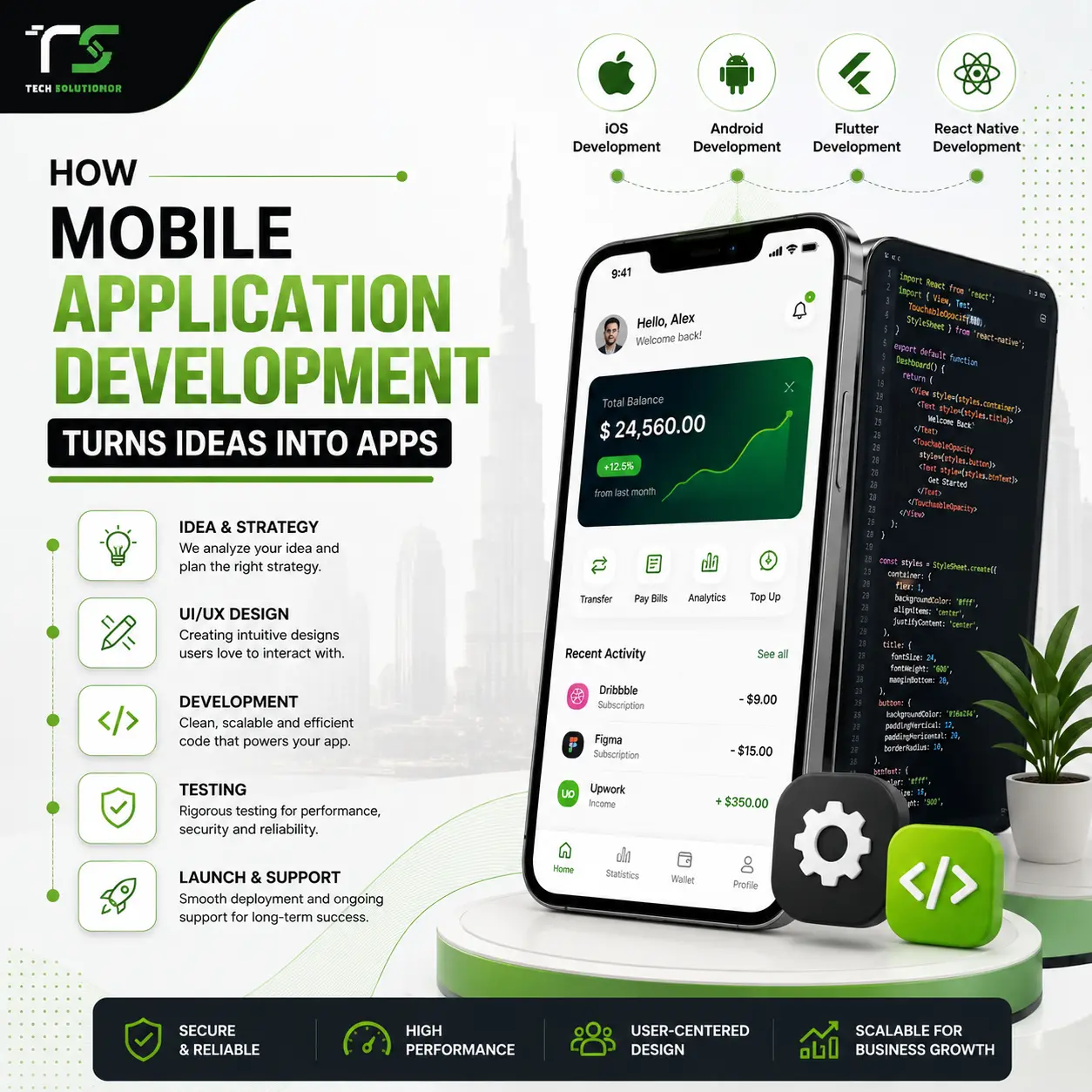
Strip it down and mobile application development is just the process of designing, building, testing, and launching software that runs on phones and tablets, iOS, Android, sometimes both at once. That sounds simple. It isn’t, really.
There’s the strategy work that happens before anyone writes a single line of code. There’s UI and UX design, which honestly decides more about whether people stick around than most business owners expect. Then there’s the actual engineering, the testing that’s supposed to catch problems before your users do, and the maintenance afterward that people almost always forget to budget for.
I’ve noticed something over the years. Clients who treat this like “hire a developer, wait a few months, get an app” tend to be disappointed. Every time. But clients who treat it like an actual process, research first, design before code, testing baked in rather than tacked on, those are the ones whose apps get used instead of quietly deleted a week after launch.
How the App Development Process Actually Works
The process usually starts well before anyone touches a keyboard for real coding. A good team spends genuine time on consultation first, figuring out what the app is actually supposed to do, who it’s for, and what “success” even means for that specific business.
Then comes planning, mapping out the roadmap, followed by UI/UX design, where wireframes and prototypes get tested and picked apart before a single feature gets built. Development comes after that, usually broken into sprints so there’s visible progress along the way instead of one giant black box that vanishes for six months and reappears, hopefully, finished.
Testing runs the whole time, not just at the end, covering performance, security, and how the thing behaves on different devices. Then deployment to the App Store or Google Play. And then, the part everyone forgets, support. An app that launches and then gets left alone tends to fall apart within a year, sometimes faster.
I had a healthcare startup client in Dubai a while back who came to us after their previous developer just… disappeared. Mid-project. No documentation, nothing. We ended up rebuilding chunks of it from scratch, and it cost them close to two months they didn’t have. That’s exactly why I insist on proper documentation and sprint reviews now, with every client, even the ones in a rush who’d rather skip that part.
Native, Cross-Platform, or Hybrid: Choosing the Right Approach
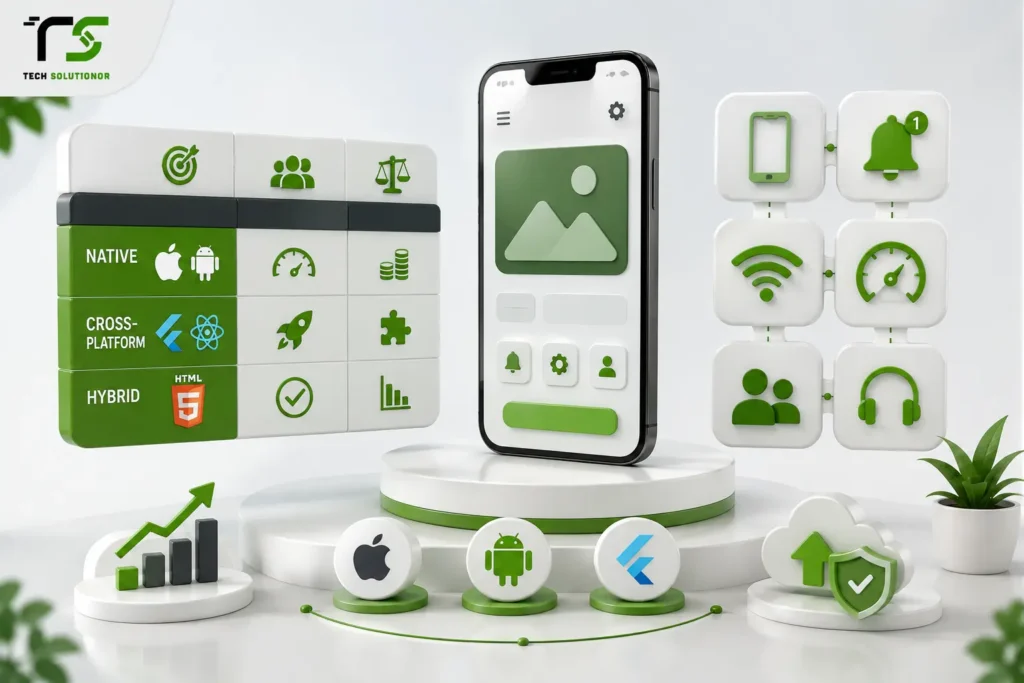
This is probably the question I get asked most, and there’s no single right answer. It really comes down to budget, timeline, and what the app actually needs to do.
| Approach | Best For | Trade-Off |
| Native (Swift for iOS, Kotlin for Android) | Apps needing top performance, heavy graphics, or deep device features | Higher cost, two separate codebases to maintain |
| Cross-platform (Flutter, React Native) | Startups wanting one codebase, faster launch across both platforms | Slightly less access to the newest device features |
| Hybrid (web-based, wrapped in a native shell) | Simple apps, tight budgets, quick MVPs | Weaker performance once features get complex |
For most of the startups I work with, cross-platform frameworks hit the sweet spot between cost and quality, which is part of why demand for a solid mobile app development company in UAE that actually knows these frameworks well has grown so much in the last few years.
Enterprise clients tend to lean native instead, banking apps especially, anything touching sensitive data at scale, even though it costs more upfront. That extra cost usually buys peace of mind they’re not willing to trade away.
Key Benefits of Investing in Mobile Application Development
A well-built app does more than just sit on someone’s phone. It puts your brand in their pocket, quite literally, in a way a website just doesn’t manage the same way. Push notifications let you reach people directly instead of hoping they happen to check their inbox that day. Offline functionality means the app keeps working even when the connection doesn’t, which a website can’t really claim.
Apps also tend to load faster once installed, since most of the heavy lifting already happened during development rather than every single time someone opens it. From what I’ve seen managing app projects for retail and service businesses over the years, the real payoff shows up in retention.
Someone who downloaded your app already showed intent. Keeping them around after that, through decent onboarding and features that actually matter to them, ends up cheaper than chasing a new customer through ads over and over again.
Common Mistakes I See Businesses Make
The biggest one, by a wide margin, is skipping proper research and jumping straight into building. I’ve watched founders sink six figures into an app nobody really asked for, because they never bothered validating the idea with real users first. Right behind that is treating UI/UX like decoration instead of the thing that quietly decides whether people stay or uninstall within a day.
A lot of businesses also try cramming every feature they can imagine into version one, when a focused MVP would actually launch sooner and teach them far more about what users want. Ignoring support after launch is another one I see constantly, apps need updates for new OS versions, security patches, bug fixes, long after the launch excitement fades.
And plenty of teams choose a development partner purely on price, then end up paying for the whole thing twice once the cheap build inevitably needs redoing properly.
Best Practices and Expert Tips for a Successful App
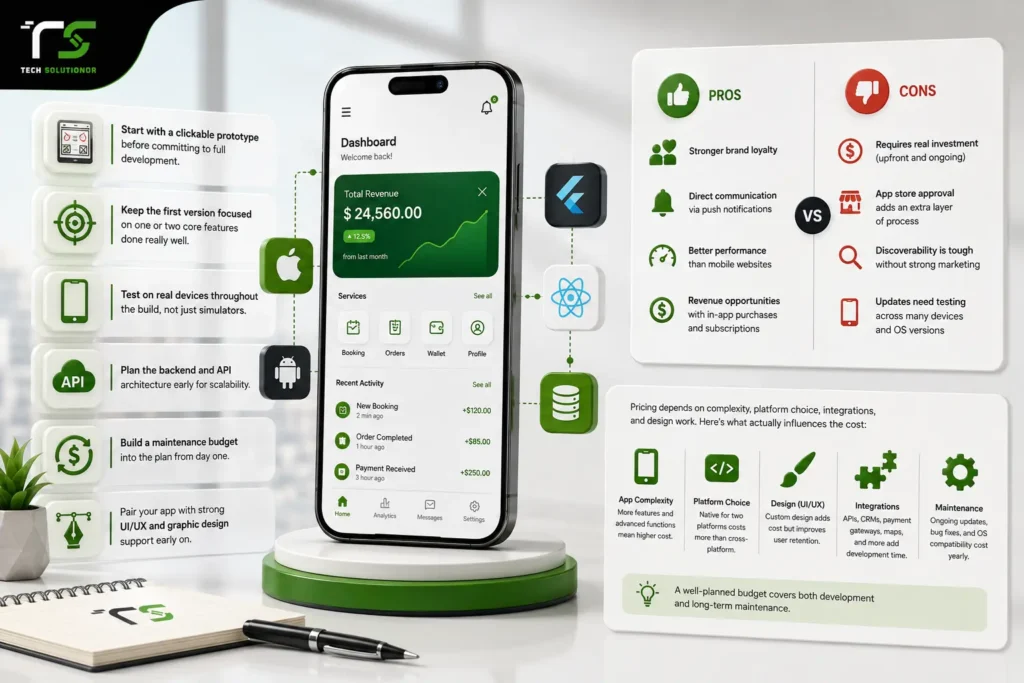
Start with a clickable prototype before committing to full development. It’s a lot cheaper to change a wireframe than to rebuild finished code later. Keep the first version focused on one or two core features done really well, instead of ten features done half-heartedly. Test on real devices throughout the build, not just simulators, because performance quirks show up differently on actual hardware than they ever do in a controlled test environment.
Plan the backend and API architecture early, since retrofitting scalability afterward is genuinely painful, I’ve been through it, it’s not fun for anyone involved. And build a maintenance budget into the plan from day one rather than treating it as a nasty surprise six months after launch.
If your app leans on strong visuals or a distinct brand feel, it’s worth pairing your development team with solid UI/UX and graphic design support early on, rather than bolting it on after the wireframes are already locked in and hard to change.
Pros and Cons of Building a Mobile App
On the upside, a well-built app strengthens brand loyalty, opens a direct line of communication through push notifications, usually performs better than a mobile website, and can unlock revenue through in-app purchases or subscriptions in a way a website can’t cleanly replicate.
On the other hand, it needs real investment, both upfront and ongoing, app store approval brings a whole layer of process you don’t deal with on the web, discoverability is genuinely tough without a real marketing push behind it, and every update needs testing across a growing range of devices and OS versions.
None of that is a reason to skip building an app. It’s just the part nobody mentions in the sales pitch, and I’d rather clients hear it from me now than get blindsided later.
Cost Considerations for Mobile Application Development
Pricing depends heavily on complexity, platform choice, integrations, and how much design work is involved, so rather than quoting numbers that’ll be outdated within months, here’s what actually moves the price.
Simpler apps with basic features on a single platform cost far less than ones needing real-time data, payment processing, or complicated backend logic. Native development on two platforms typically costs more than a single cross-platform build. Custom UI/UX design adds cost upfront but tends to pay for itself through better retention down the line.
Third-party integrations, CRMs, payment gateways, mapping APIs, each add their own chunk of development and testing time. And ongoing maintenance, which gets overlooked in almost every initial budget I’ve seen, usually runs a percentage of the original build cost every single year just to keep things running smoothly.
Industry Trends and Where App Development Is Heading
AI-powered personalization is showing up in more apps now, adjusting content and recommendations based on how people actually behave instead of static, one-size-fits-all rules. Super-apps, the ones bundling several services into a single platform, are gaining ground well beyond the markets that made the idea popular first. Voice interfaces are creeping into more app categories than just assistants.
And low-code tools are speeding up the simpler builds, though they still hit a wall pretty fast once an app needs genuinely custom logic. If you’re thinking about how app strategy fits into your wider online presence, it’s worth reading up on web development vs SEO as well, since a great app paired with weak web visibility still leaves plenty of potential customers never finding you in the first place.
For businesses building more complex internal tools alongside a customer-facing app, dedicated software development support is usually worth exploring too, just to keep everything connected properly on the backend.
UAE-Specific Considerations for Mobile App Development

Building apps for the UAE market for years now has taught me this region has its own expectations, and outsiders miss more of them than you’d think:
- Bilingual UI matters. Arabic and English support isn’t a bonus feature here, it’s basically expected from day one, the same way it matters for Arabic website design in the UAE
- Payment integration needs local options, not just the usual international gateways, since regional preferences differ quite a bit
- Data residency and privacy rules keep tightening, so any app handling personal data needs to stay compliant with UAE regulations
- Mobile-first behavior is unusually strong here, often stronger than desktop usage in markets I’ve worked in elsewhere
- Cultural sensitivity in design and content matters more than teams often assume, especially around imagery and messaging tone
Getting these details right early saves a painful redesign later, and honestly, it affects how well an app actually gets received once real users start using it.
How to Choose the Right App Development Partner
A few honest questions I tell clients to ask before signing with anyone, and honestly, a lot of this overlaps with what I’d tell someone weighing a freelancer against a full development agency too:
- Does the team have a real portfolio of shipped apps, not just polished mockups?
- Do they explain their process clearly, or does it stay vague on timelines?
- Will you actually get documentation and source code ownership at the end?
- Is post-launch support part of the deal, or something they mention only if you ask?
If your app is part of a bigger ecommerce push, it’s worth reviewing your ecommerce development setup and digital marketing strategy at the same time. An app rarely succeeds sitting in isolation from the rest of a business’s digital presence, in my experience it almost never does.
FAQs
1. What is mobile application development?
Mobile application development is the process of designing, building, testing, and launching software for phones and tablets. It covers everything from planning and UI/UX design to coding, testing, deployment on app stores, and ongoing support after launch.
2. How long does mobile app development usually take?
Most standard apps take around eight to sixteen weeks, depending on features and complexity. Enterprise-grade apps with advanced integrations, custom backends, or heavy security requirements can take considerably longer to plan and build properly.
3. Should I choose native or cross-platform app development?
Native suits apps needing top performance or deep device access, while cross-platform frameworks like Flutter suit startups wanting faster, more affordable launches on both iOS and Android. The right choice depends on budget, timeline, and features.
4. How much does it cost to build a mobile app in the UAE?
Costs vary based on complexity, platform choice, design depth, and integrations like payment gateways or CRMs. Simple apps cost less than feature-heavy ones, and ongoing maintenance should always be factored into the overall budget.
5. Do I need a separate app if I already have a mobile-friendly website?
Not always, but an app offers push notifications, offline access, and faster performance that a website can’t match. If engagement, loyalty, or repeat usage matter to your business, an app usually adds real value beyond the website.
Conclusion
Mobile application development isn’t really about writing code that runs on a phone. It’s about turning a real idea into something people trust enough to keep on their home screen. I’ve seen it work beautifully with the right planning, and fall apart when it’s rushed. The businesses that get it right always did the unglamorous parts properly, research, design, testing, support, not just the exciting build phase everyone likes to talk about.
If you’ve got an idea sitting in a notebook somewhere right now, our team can help turn it into a proper mobile application development project, built the right way from day one. Let’s talk through what you’re actually trying to build.