
Business Website Trends That Are Shaping Digital Success
Business Website Trends That Are Shaping Digital Success
Most business owners think about their website exactly once, build it, launch it and then more or less forget it exists for the next three years. That approach worked fine back in 2015. It doesn’t anymore. Your website isn’t a brochure gathering dust on a shelf somewhere.
It’s usually the first place a potential customer goes before they ever call you, email you, or walk through your door and whatever they see in those first few seconds pretty much decides whether they stick around or bounce. Here’s the encouraging part, though: the businesses staying ahead of this curve aren’t all billion-dirham corporations with in-house tech armies.
Plenty are mid-sized retailers in Dubai, clinics in Abu Dhabi, logistics companies in Sharjah, regular businesses that simply decided to invest in professional web development services and actually keep their digital presence current instead of letting it quietly rot. This guide walks through what’s genuinely making a difference right now, why each trend actually matters in practice and what UAE businesses specifically need to think through before jumping in.
AI on Business Websites: Useful or Just Trendy?

There’s a lot of noise around AI and websites these days. Some of it’s real. A good chunk of it is vendors slapping an “AI-powered” sticker on features that have quietly existed for a decade already. Here’s what’s actually changed.
Smart chatbots today are meaningfully different from those scripted popup boxes websites used to run five years ago. Modern AI chat tools can hold context, handle follow-up questions and even complete transactions booking an appointment, processing a return without ever handing things off to a human. For service businesses in Dubai fielding a high volume of repetitive customer questions, that alone can save real staff hours and speed up response time noticeably.
Personalization is the other place AI genuinely earns its spot on a business website. Instead of showing every single visitor the exact same homepage, AI tools can shift what content, products, or offers appear based on what someone’s already looked at, where they came from and what they’re probably hunting for. For an e-commerce brand, that translates pretty directly into a higher average order value. For a service business, it means the right case study or service shows up in front of the right visitor at the right moment.
The practical takeaway: AI features aren’t locked behind enterprise budgets anymore. Most CMS platforms already support this stuff out of the box and the setup pairs naturally with a broader digital marketing strategy so the traffic actually reaching your site converts into something once it’s there.
Mobile-First Design Isn’t What Most Businesses Think It Means
Almost every article about web trends throws around “mobile-first.” What most of them skip is what it actually means in practice and just how many businesses are still getting it wrong. Mobile-first design doesn’t mean “your website also happens to work on a phone.” It means the site was designed for a phone screen first and the desktop version got built up from that foundation afterward.
That distinction matters, because websites designed desktop-first and shrunk down for mobile almost always have friction on a phone, buttons too small to actually tap, text too tiny to read comfortably, forms that take forever to fill in with a thumb. In the UAE, this matters even more than in most markets.
Smartphone penetration here is among the highest anywhere and a huge share of browsing, product research and buying decisions happen entirely on mobile, start to finish. A website that isn’t genuinely built mobile-first is already losing a percentage of visitors before the page has even finished loading.
Page Speed: The Silent Conversion Killer

Google confirmed years back that page speed is a ranking factor. What doesn’t get said often enough is that it’s also a conversion factor one that hits sales directly, not just search visibility.
There’s solid data behind this
a one-second delay in load time can knock conversions down by roughly 7%. For a business pulling in AED 100,000 a month online, that’s around AED 7,000 quietly walking out the door every single month because the site loads slowly. A site that loads in under two seconds consistently beats one taking four seconds not because of some technical nuance, but because people simply don’t wait around anymore.
The usual causes of a slow site are almost always fixable
uncompressed images, too many external scripts firing at once, cheap hosting sitting on servers nowhere near your customers, or a theme and plugin stack that was never built with performance in mind. A proper audit from a development team catches most of these fast and the fixes tend to show up within days, not months. You can see examples of fast-loading sites we’ve built for UAE businesses in our project portfolio.
For UAE businesses specifically, hosting server location genuinely matters. A site hosted in Europe will load slower for a visitor in Dubai than one sitting on a UAE or GCC-based server. Sounds obvious once you say it out loud, but it’s surprising how often it gets overlooked entirely.
UX Design: The Difference Between Visits and Customers
User experience (UX) is one of those terms that gets tossed around loosely until it stops meaning much. In practical terms, it comes down to one question: does a visitor land on your website and immediately know what you do, who it’s for and what to do next?
Sounds simple. It’s remarkable how many business websites fail that basic test anyway. Homepages stuffed with generic stock photos and no clear call to action anywhere. Service pages describing everything in vague, foggy language without answering the actual question the visitor showed up with. Contact forms demanding eight fields of personal information before someone’s even earned the right to a reply.
Good UX design was never really about making a website “look beautiful.” It’s about clearing away every obstacle sitting between a visitor and the action you actually want them to take. For a clinic, that’s booking an appointment. For a retail brand, it’s adding something to a cart. For a consultancy, it’s requesting a proposal. Every extra click, scroll, or form field in that path is a place someone can quietly drop off and a well-designed site keeps that list as short as humanly possible.
This ties directly into e-commerce performance, where UX choices around product pages, checkout flow and category navigation move the revenue needle more than almost anything else on the site.
Website Security Is Now a Business Credibility Signal

Customers notice security, even when they can’t quite articulate that they’re noticing it. A browser flashing “not secure” kills trust instantly, no explanation needed. And a site that looks dated and neglected quietly signals that maybe the business behind it isn’t operating at its best either fair or not, that’s how people read it.
Beyond perception, the actual threats are climbing too. Cyberattacks don’t just go after big corporations anymore. Small and medium UAE businesses get targeted regularly, precisely because attackers assume they’re sitting on valuable customer data with weaker defenses. An outdated WordPress install, an expired SSL certificate, a plugin with a known vulnerability any one of those is basically an open door.
Basic security hygiene every business website needs in 2026
- Valid SSL certificate (this also affects your Google rankings directly, not just visitor trust)
- Regular software and plugin updates
- A web application firewall
- Secure form handling that actually protects customer data
- Regular backups, with restore procedures that have actually been tested, not just assumed to work
For businesses operating in the UAE, the TDRA (Telecommunications and Digital Government Regulatory Authority) has put out guidance around data handling and consumer protection that any business collecting customer data through its website should know about. Compliance here isn’t just a box to tick legally it’s a genuine trust signal to UAE customers who are increasingly aware of their own data rights.
Arabic RTL Design: The UAE-Specific Gap Most Websites Miss
This is exactly where generic web trend articles fall flat, because they’re written for a Western market and quietly assume everyone reading is building an English-only site.
In the UAE, a website properly serving Arabic-speaking customers needs more than a translated version of the English text. Arabic reads right-to-left, which means the entire visual layout, navigation direction, button alignment, even where images and icons sit needs to adapt accordingly. A page that looks clean and well-organized in English can look genuinely broken in Arabic if RTL wasn’t built into the design from the start.
This is a technical build issue, not a translation checkbox. It has to be planned at the very beginning of a web project, not bolted on afterward as an afterthought. Businesses building genuinely RTL-aware bilingual websites reach a noticeably bigger slice of the UAE market than the ones running English-only sites, or worse, sites with Arabic that renders half-broken.
Pairing proper bilingual website design with an actual Arabic and English content strategy closes the loop here, because a technically flawless Arabic page filled with weak content still won’t rank or convert the way it’s supposed to.
SEO Built Into the Website From Day One
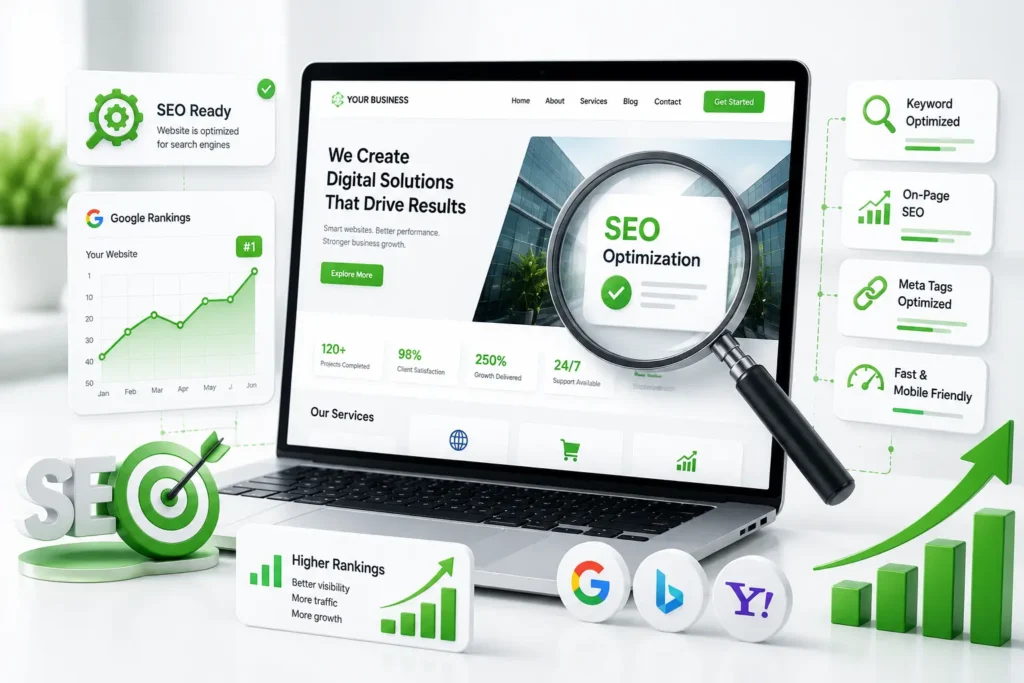
This is the mistake that ends up costing businesses the most time and money, hands down. A website built without SEO architecture baked in from the start almost always needs significant rework later to get right. Page structure, URL logic, heading hierarchy, internal linking, schema markup, page speed all of it needs to be planned during development, not patched in after the fact once someone notices rankings aren’t moving.
A lot of UAE businesses discover this the hard way, roughly six months after launching a new site. They’ve invested in a nice-looking design and now they’re spending extra budget trying to fix the technical foundations underneath just so the site can actually rank at all. Doing it right the first time is, without exception, cheaper than fixing it twice.
This connection between web development and SEO is a big reason businesses benefit from working with one team handling both, rather than a design agency that hands things off to a separate SEO team with no shared process between them. Our full breakdown of SEO investment in Dubai gets into what this actually looks like in terms of cost and timeline.
Progressive Web Apps and What They Mean for UAE E-commerce
A Progressive Web App (PWA), for short, is a website that behaves like a mobile app. It can sit on a phone’s home screen, work offline or on a shaky connection, send push notifications and load almost instantly, all without anyone downloading anything from an app store.
For UAE e-commerce brands and service businesses with repeat customers, this is worth genuinely considering. Asking a customer to download a full app is a high bar and it costs you a lot of drop-off along the way. A PWA gives you most of an app’s benefits: speed, notifications, offline access while keeping the easy accessibility of a regular website.
How much this costs really depends on how the existing site is built. Some platforms handle PWA conversion fairly smoothly. Others need a much bigger rebuild to get there. For businesses weighing this alongside a broader platform decision, our comparison of WordPress vs Shopify vs custom builds covers which approach tends to suit which kind of business.
What Business Website Trends Actually Cost in the UAE
Knowing a trend exists and knowing what it actually costs to implement are two very different things. Here’s a realistic breakdown for UAE businesses.
| Upgrade | Typical Cost Range (AED) | Timeline |
| Full mobile-first redesign | 8,000 – 30,000 | 4–10 weeks |
| Page speed optimization | 1,500 – 5,000 | 1–2 weeks |
| AI chatbot integration | 2,000 – 8,000 | 1–3 weeks |
| Arabic RTL implementation | 3,000 – 12,000 | 2–6 weeks |
| Security audit and hardening | 2,000 – 6,000 | 1–2 weeks |
| PWA conversion | 10,000 – 35,000 | 6–14 weeks |
These figures reflect project complexity specifically in the UAE market. The wide ranges mostly come down to the difference between building on an already well-built platform versus a site that needs serious technical remediation before anything else can happen. Reviewing realistic custom website cost ranges for Dubai before starting any project gives a much clearer picture of what different scopes actually involve.
How Web Development Services in UAE Help Businesses Get This Right
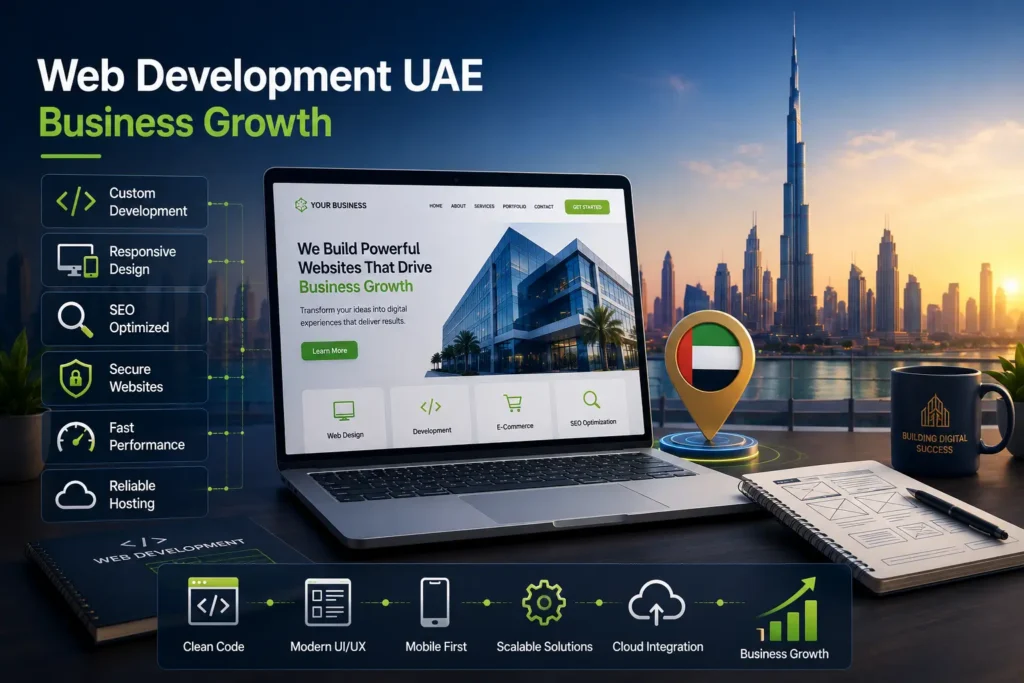
Every trend covered here is technically achievable on its own. What separates a business that implements them well from one that ends up with a half-finished project causing more headaches than it solves usually comes down to execution, plain and simple.
A strong web development partner in the UAE understands this market’s specific context: bilingual design needs, local server preferences, TDRA compliance, the heavily mobile behavior of UAE users and the e-commerce and service-based business models most common here. Generic global advice, applied without that context, tends to miss exactly the nuances that matter most for real performance in this market.
FAQs
What is the most important business website trend in 2026?
Mobile-first design combined with fast loading speed has the biggest direct impact on conversions and search rankings. A site that loads quickly and works well on a phone keeps far more visitors than one that doesn’t, regardless of how it looks on desktop.
How does website speed affect my business in the UAE?
A one-second delay in load time can reduce conversions by around 7%. For UAE businesses with heavy mobile traffic, speed directly affects sales. Faster sites also rank higher in Google, improving organic visibility without extra ad spend.
Do UAE businesses really need Arabic and English versions of their website?
For most consumer-facing businesses, yes. A meaningful share of UAE purchase decisions happen in Arabic. Properly built bilingual websites with genuine RTL design reach significantly more of the UAE market than English-only sites, or sites with poorly implemented Arabic.
What does a website redesign cost in Dubai?
A professional mobile-first redesign in Dubai typically ranges from AED 8,000 to AED 30,000, depending on site size, whether Arabic is required and how much custom functionality is needed. Speed optimization and security upgrades are usually separate add-ons.
Should I rebuild my website or just update the design?
If the existing site has real technical issues, slow speed, poor mobile experience, no SEO foundation, a rebuild is usually more cost-effective than layering updates on a broken base. If the structure is solid, updating design and content is often enough.
Conclusion
A business website in 2026 isn’t a one-time project you check off a list and forget about. It’s a living asset that either keeps working for you quietly in the background, or costs you customers every single day it’s allowed to fall behind. The trends covered here AI personalization, mobile-first design, Arabic RTL support, page speed aren’t some futuristic wish list.
They’re things customers already expect right now and the businesses that have implemented them are already seeing it show up in their traffic, leads and revenue. The UAE market comes with its own specific requirements that make generic global web advice only partly useful here.
Getting bilingual design, local server performance and TDRA compliance right takes working with people who genuinely understand this market, not just people who happen to know how to build websites.
Ready to upgrade your business website? Explore Tech Solutionor’s web development services and see how we build websites that actually perform for UAE businesses.