When Should You Hire an SEO and Digital Marketing Consultant
When Should You Hire an SEO and Digital Marketing Consultant
I still remember the exact moment a client asked me, half-joking, half-desperate: “Why is my competitor’s coffee shop showing up before mine, when I’ve been in business twice as long?” That question, more than any textbook, taught me when a business actually needs to bring in outside help.
After fifteen-plus years of sitting on both sides of this table as an in-house marketer and as an outside consultant, I’ve learned that the timing question matters just as much as the hiring decision itself. Hire too early and you waste money on problems you could’ve solved yourself. Wait too long and you’re paying to fix damage that could’ve been avoided.
If you’re weighing whether it’s the right moment to bring in an SEO and digital marketing consultant, this guide walks through the real signals, not the generic ones you’ll find everywhere else. And if you’re already thinking about outside help, it’s worth understanding what a full digital marketing partnership actually looks like before you commit.
What Does an SEO and Digital Marketing Consultant Actually Do?
Let’s clear up the confusion first, because I get this question in nearly every discovery call. An SEO and digital marketing consultant isn’t just someone who “does SEO.” A genuine consultant looks at your entire online presence, search visibility, paid campaigns, content, social channels, conversion paths and connects the dots between them.
They’re not selling you a single service; they’re diagnosing your business the way a doctor reviews symptoms before writing a prescription. In practice, this means auditing your website’s technical health, researching how your buyers actually search, studying what your competitors rank for and building a roadmap that ties marketing activity to revenue, not just traffic numbers.
A consultant who only talks about rankings and never mentions your sales funnel isn’t doing the job properly.
How the Right Consultant Actually Works With Your Business
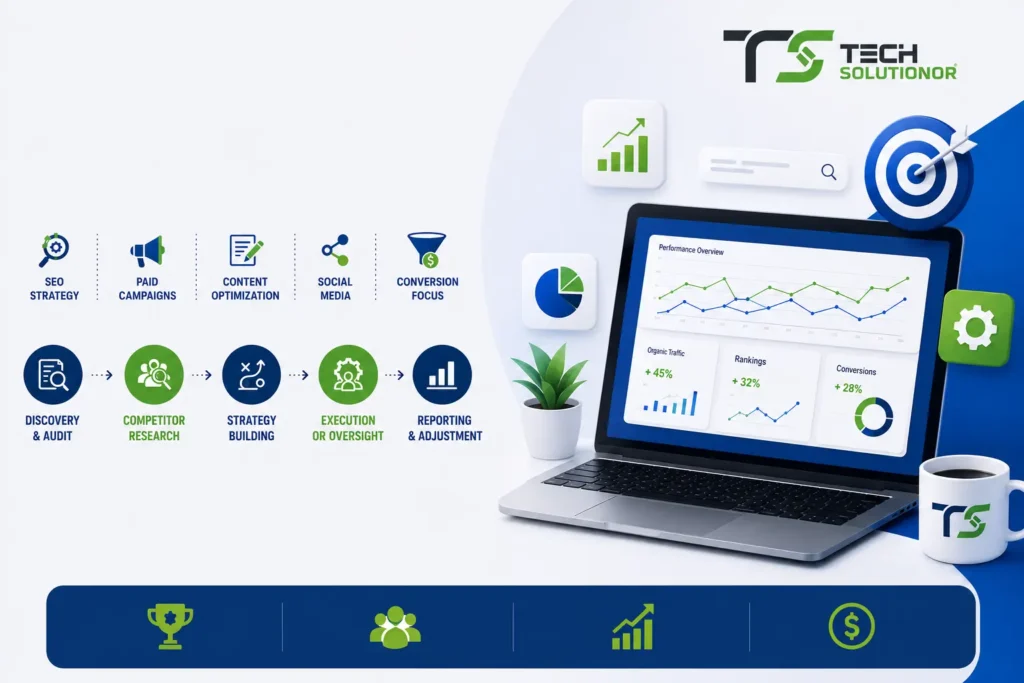
Most business owners picture SEO as something abstract that happens in the background. In reality, a good consultant follows a fairly structured process, even if every engagement looks a little different:
- Discovery and audit: reviewing your website, analytics, current rankings and past marketing spend.
- Competitor and market research: identifying who’s winning your search terms and why.
- Strategy building: mapping keyword opportunities, content gaps and technical fixes into a prioritized plan.
- Execution or oversight: either doing the hands-on work or managing an internal/agency team.
- Reporting and adjustment: tracking real business metrics, not vanity numbers and refining the approach monthly.
I’ve sat through enough of these cycles to say this confidently: the businesses that get the most value are the ones who treat the consultant as a strategic partner, not a vendor they check in with once a quarter.
The Clearest Signs It’s Time to Hire
Here’s where I want to get specific, because vague advice like “hire when you’re ready to grow” doesn’t help anyone make a real decision.
- Your organic traffic has plateaued or dropped for three months or more and you can’t pinpoint why.
- You’re getting traffic but almost no leads or sales, which usually points to a mismatch between your content and buyer intent.
- A Google algorithm update hit your rankings and your team doesn’t have the technical background to diagnose it.
- You’re expanding into a new city, country, or language market and need a localized strategy, especially somewhere like the UAE where search behavior differs from Western markets.
- Your ad spend keeps climbing but ROI is flat, meaning your paid strategy and organic strategy aren’t talking to each other.
- You just don’t have the internal bandwidth, most small teams are stretched too thin to keep up with algorithm changes, new ad formats and content demands all at once.
If two or more of these sound familiar, that’s usually my cue, as a consultant, that a business is past the DIY stage.
Signs You’re Probably Not Ready Yet (And That’s Fine)
Not every business needs a consultant on day one and I’ll be the first to tell a prospective client to wait if the timing’s off.
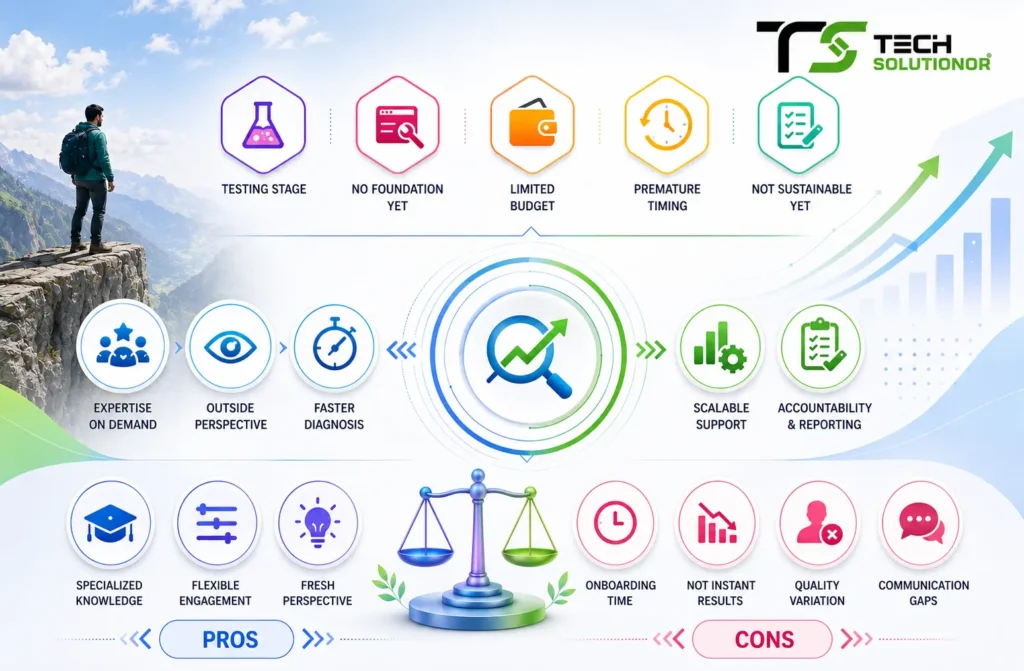
- You’re pre-revenue or testing your business model to fix product-market fit first.
- You have zero content or website foundation yet build the basics before layering strategy on top.
- Your budget can’t sustain at least three to six months of consistent work SEO in particular punishes stop-start efforts.
Being honest about this upfront is part of what separates a trustworthy consultant from someone just chasing a contract.
Benefits of Hiring an SEO and Digital Marketing Consultant
| Benefit | What It Actually Looks Like |
| Specialized expertise on demand | Access to technical SEO, paid media and content skills without hiring five full-time roles |
| Objective outside perspective | A consultant spots blind spots your internal team has gotten used to ignoring |
| Faster problem diagnosis | Years of pattern recognition mean issues get identified in days, not months |
| Scalable engagement | You can dial support up or down based on business needs and budget |
| Accountability and reporting | Clear metrics tied to revenue, not just impressions or clicks |
Where It Gets Tricky: Limitations to Keep in Mind
I’d be doing you a disservice if I only listed upsides. Consultants aren’t magic and there are real trade-offs worth weighing.
Pros
- Brings specialized, current knowledge without the overhead of full-time salaries
- Offers flexibility to scale services based on seasonal or campaign needs
- Provides a fresh, unbiased look at your marketing performance
Cons
- Onboarding takes time; a consultant needs weeks to properly understand your business and market
- Results in SEO specifically are rarely instant, which can frustrate teams expecting quick wins
- Quality varies enormously the industry has plenty of underqualified people calling themselves experts
- Communication gaps can happen if the consultant isn’t integrated closely enough with your team
Common Mistakes Businesses Make When Hiring
Over the years, I’ve watched companies make the same handful of mistakes repeatedly:
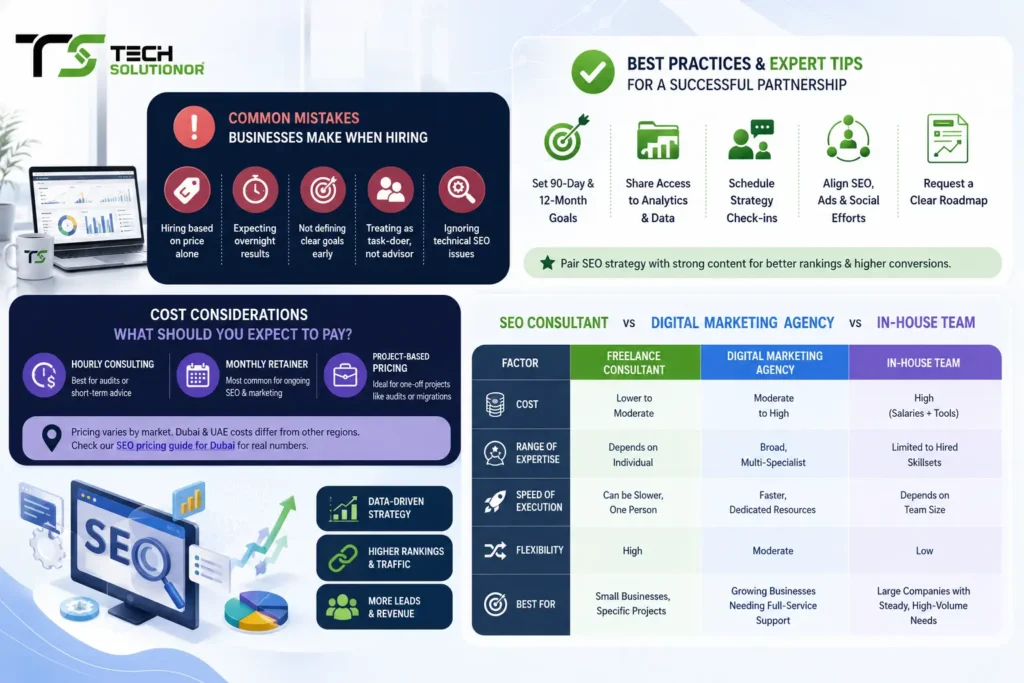
- Hiring based on price alone instead of proven results and case studies
- Expecting overnight rankings and abandoning a strategy after six weeks
- Not defining clear goals before the engagement starts
- Treating the consultant purely as a task-doer instead of involving them in strategic decisions
- Ignoring technical SEO issues (site speed, mobile experience, indexing) while chasing content volume
If you want your investment in search engine optimization to actually pay off, avoiding these traps matters more than any single tactic.
Best Practices and Expert Tips for a Successful Partnership
From my own client relationships, the ones that work best share a few habits:
- Set 90-day and 12-month goals together, not just monthly deliverables
- Give the consultant access to real analytics and past campaign data from day one
- Schedule recurring strategy check-ins, not just automated reports
- Align SEO, paid advertising and social media efforts instead of running them in separate silos
- Ask for a documented content and technical roadmap, not vague promises
One habit I always push clients toward: pair your SEO strategy with strong content writing support. Rankings without genuinely useful content rarely convert and I’ve seen this gap sink otherwise solid campaigns more than once.
Cost Considerations: What Should You Expect to Pay?
Consultant pricing varies widely depending on scope, market and experience level. Broadly, businesses should expect one of these models:
- Hourly consulting: Typically suited for audits or short-term advisory work
- Monthly retainer: The most common model for ongoing SEO and digital marketing management
- Project-based pricing: Used for one-off work like a technical audit or website migration
Budget also shifts depending on your market. Dubai and wider UAE pricing, for instance, tends to reflect the competitiveness of the local digital landscape and costs can differ noticeably from freelancers versus full agencies. If you want a deeper breakdown, our SEO pricing guide for Dubai covers real numbers rather than rough estimates.
SEO Consultant vs Digital Marketing Agency vs In-House Team
| Factor | Freelance Consultant | Digital Marketing Agency | In-House Team |
| Cost | Lower to moderate | Moderate to high | High (salaries + tools) |
| Range of expertise | Depends on individual | Broad, multi-specialist | Limited to hired skillsets |
| Speed of execution | Can be slower, one person | Faster, dedicated resources | Depends on team size |
| Flexibility | High | Moderate | Low |
| Best for | Small businesses, specific projects | Growing businesses needing full-service support | Large companies with steady, high-volume needs |
If you’re torn between these options, our comparison on SEO agencies versus freelancers in Dubai breaks this down further with local context.
UAE-Specific Considerations Worth Knowing
Working with businesses across Dubai and the wider UAE has taught me that this market has its own rhythm. Search behavior here often blends English and Arabic queries, even within the same customer journey, so a consultant unfamiliar with bilingual search patterns will miss real opportunities.
Google Business Profile optimization also carries extra weight locally, since trust signals like reviews and location accuracy influence buyer decisions heavily in a market driven by word-of-mouth and reputation.
There’s also a seasonal factor, many outsiders don’t account for search volume and buyer intent shifts noticeably around Ramadan, summer travel months and the busy Q4 shopping season.
A consultant who understands these local patterns builds campaigns around them instead of applying a one-size-fits-all Western calendar. Regulatory awareness matters too, particularly around advertising claims and data handling under UAE consumer protection rules.
Industry Trends and the Future Outlook
SEO and digital marketing aren’t static and the pace of change has only accelerated. A few shifts worth watching:
- AI-driven search results are changing how content needs to be structured for visibility
- Voice and conversational search are pushing more long-tail, question-based content
- First-party data is becoming more valuable as privacy regulations tighten globally
- Local and multilingual SEO continue growing in importance across the UAE and broader Gulf region
Businesses that partner with a consultant who actively tracks these shifts, rather than relying on outdated playbooks, tend to stay ahead instead of playing catch-up. Our piece on how AI is reshaping SEO and rankings goes deeper into what this means practically for 2026 and beyond.
Client Decision-Making Checklist
Before signing any contract, ask yourself and the prospective consultant these questions:
- Can they show measurable results from businesses in a similar industry or size?
- Do they explain their strategy in plain language, or hide behind jargon?
- Will they provide transparent reporting tied to business outcomes?
- Do they understand your specific market, including local UAE nuances if relevant?
- Are their pricing and contract terms clear, with no vague deliverables?
Digital Marketing Consultant: Why Local Expertise Matters
If your business operates in or targets the UAE, working with a digital marketing consultant brings a practical advantage: familiarity with local competitors, consumer habits and platform preferences that shift by region.
A consultant based elsewhere can still do solid technical work, but the nuance of local intent, cultural context and even preferred payment or trust signals often gets lost without on-the-ground experience. This is one reason many UAE businesses prefer a hybrid approach of global best practices applied through a local lens.
FAQs
1. How do I know if my business really needs an SEO consultant?
If your traffic has stalled, leads have dropped, or you lack time to track algorithm changes, that’s a strong signal. A consultant helps diagnose issues quickly and builds a clear, measurable growth plan tailored to your specific market and goals.
2. What’s the difference between an SEO consultant and a full digital marketing consultant?
An SEO consultant focuses mainly on search rankings and organic traffic. A digital marketing consultant covers broader channels, including paid ads, social media and content, connecting them into one cohesive strategy for overall business growth.
3. How much does hiring a digital marketing consultant typically cost?
Costs vary based on scope, but most Dubai businesses pay through monthly retainers or project-based fees. Pricing depends on experience level, market competitiveness and whether you need ongoing management or a one-time audit.
4. How soon can I expect results after hiring a consultant?
Paid campaigns can show results within weeks, while SEO typically takes three to six months for noticeable movement. Sustainable growth takes longer but tends to be more stable and cost-effective than short-term, ad-only strategies.
5. Can a small business benefit from hiring an SEO and digital marketing consultant?
Yes, especially when growth has plateaued or the owner lacks time for marketing. Consultants offer scalable support, meaning small businesses get expert-level strategy without the cost of hiring multiple full-time marketing specialists.
Conclusion
Deciding when to hire an SEO and digital marketing consultant isn’t about following a rigid rulebook. It’s about honestly assessing where your business stands today, whether internally you have the time and skill to keep pace with an industry that changes monthly and whether the cost of waiting is higher than the cost of getting help.
In my experience, the businesses that thrive are the ones that treat this decision as a strategic investment rather than a last resort. If you’re standing at that crossroads right now, take the checklist above seriously, ask hard questions of anyone you consider hiring and remember that great marketing strategy usually goes hand in hand with strong web development and a well-rounded digital marketing approach working together, not in isolation.