The Biggest Challenges an International SEO Expert Can Solve
The Biggest Challenges an International SEO Expert Can Solve
Fifteen-plus years in SEO, and here’s the honest bit: the projects that still keep me up at night aren’t the local ones. They’re the multi-country launches. A client wants to rank in five markets at once, and somewhere in the pitch meeting, someone assumes it works like ranking in one market, just done five times over. It doesn’t work like that. Not even close. I learned that the hard way early on, watching a genuinely well-built site tank across three regions at the same time, because of one small hreflang mistake that sat there for weeks before anyone caught it.
That’s really the whole reason an international SEO expert is its own thing, rather than just “an SEO person who also handles other countries.” The problems are different. The tools are different. Honestly, even what “success” means shifts depending on which market you’re staring at on a given Tuesday. If you’re trying to figure out what actually goes wrong when businesses expand globally, this is the unfiltered version, the stuff I wish someone had handed me years ago instead of letting me learn it project by painful project.
What International SEO Actually Means

Strip away the jargon, and international SEO is just the practice of getting a website to rank well across more than one country, language, or region. Sounds simple on paper. It isn’t, once you realize it touches nearly every layer of a site, URL structure, hreflang tags, localization, server location, even how currency gets displayed.
Most people hear “international SEO” and think of a translation. That’s maybe ten percent of it, if that. The rest is technical architecture and cultural nuance, plus the fact that Google, Bing, and regional players like Yandex or Baidu don’t all behave the same way depending on where you’re pointing them.
How an International SEO Expert Actually Works
It usually starts with an audit, checking whether the site’s built on subdirectories, subdomains, or separate country-code domains. That one decision, made early, quietly shapes everything downstream. Then comes the market research part, figuring out how people actually search in each region, because keyword volume and phrasing almost never translate cleanly across languages. They just don’t.
Hreflang comes next, and this is honestly where I see the most damage from otherwise competent, well-meaning teams. Get one tag wrong and search engines either ignore your signals entirely, or worse, start showing the wrong language version to the wrong audience. Weeks can go by before anyone even notices the traffic drop.
I had an ecommerce client a couple of years back, expanding out of the UAE into Saudi Arabia and Egypt. Their old agency had basically copy-pasted the same Arabic content across all three country pages, on the logic that “Arabic is Arabic.” Google read it as duplicate content and quietly suppressed two of the three regions.
We ended up rebuilding the localization from scratch, dialect, currency, product framing, the whole thing, before rankings came back. It cost them about four months they didn’t need to lose, purely because nobody got the groundwork right the first time.
Key Challenges an International SEO Expert Solves
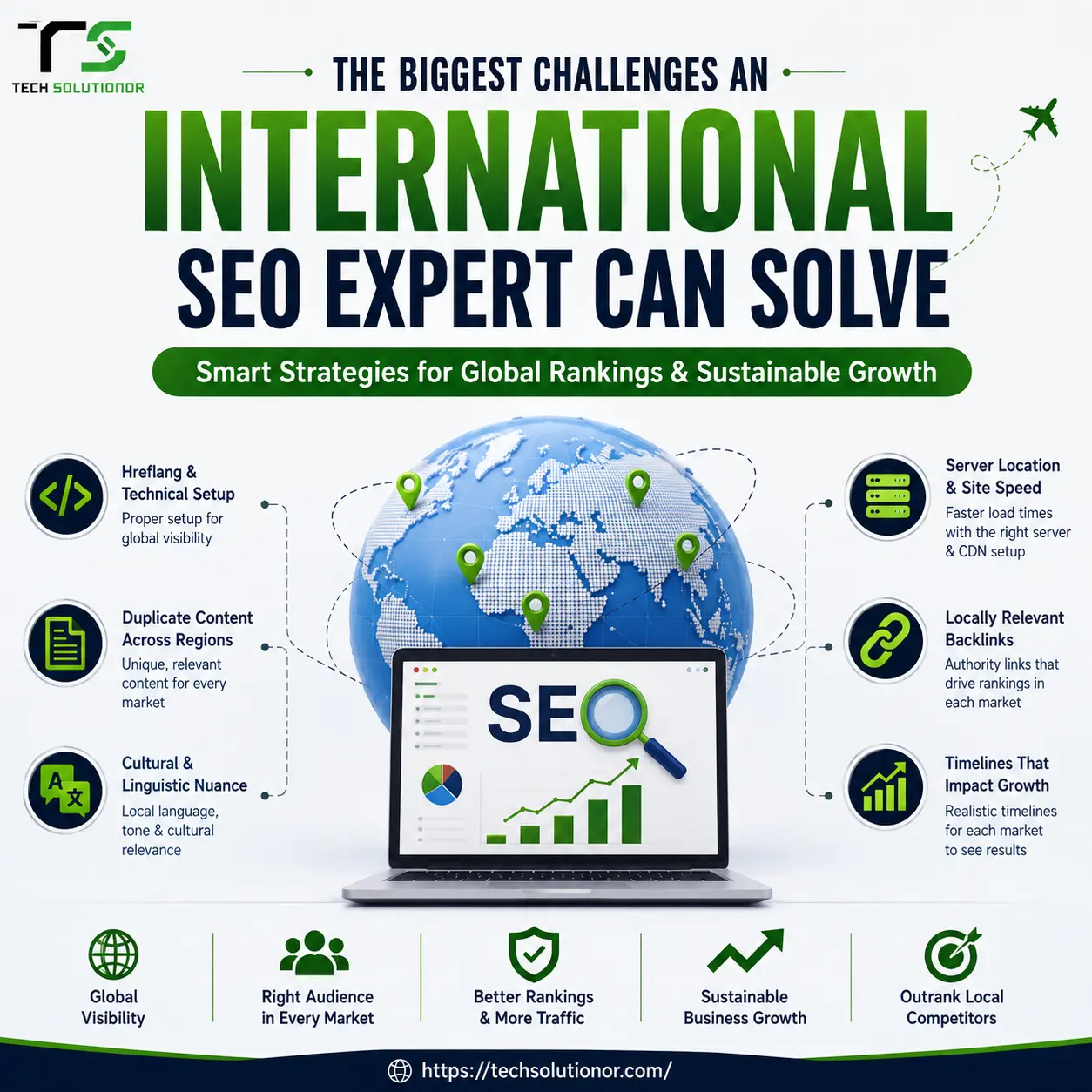
- Hreflang and technical setup. Getting this right across dozens of language and region combinations is, no exaggeration, one of the trickiest technical puzzles in SEO. Mess it up and you either get ignored or actively penalized for confusing search engines.
- Duplicate content across regions. Near-identical pages across country versions make search engines shrug and pick one, sometimes the wrong one. A skilled expert rebuilds content so each region actually reads like it was written for that region, because it was.
- Cultural and linguistic nuance. Literal translation kills tone, kills idiom, kills intent, all at once sometimes. Phrasing that sings in Egyptian Arabic can land flat, even stiff, in Gulf Arabic, and yes, technically it’s “the same language.”
- Server location and site speed. Host in one region, and users on the other side of the planet feel it, slow loads, worse rankings, fewer conversions. CDNs fix this, but only if someone thinks about it before launch, not after.
- Backlinks that matter locally. A link from a big authority site in one country doesn’t automatically carry weight somewhere else. Building something that’s genuinely relevant per market takes real, boots-on-the-ground knowledge, not a recycled outreach list.
Timelines nobody warned you about. New regions rarely move at the same pace as your home market. Worth reading about how long SEO typically takes to show results, because international timelines usually stretch even further per added market.
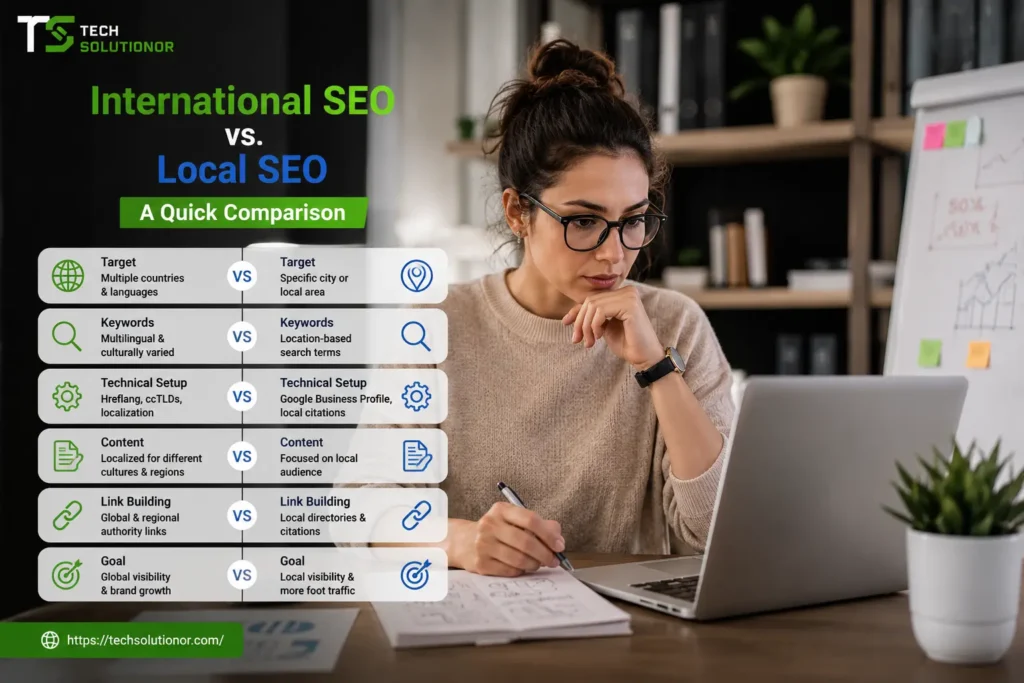
International SEO vs Local SEO: A Quick Comparison
| Factor | Local SEO | International SEO |
| Primary focus | Single market, often single language | Multiple markets, languages, or regions |
| Technical complexity | Moderate | High, hreflang, URL structure, hosting |
| Content strategy | One localized voice | Distinct voice per market or dialect |
| Backlink strategy | Local citations and directories | Region-specific authority building |
| Measurement | Single set of rankings and traffic | Tracked separately, market by market |
Neither one’s easier, really. They’re just different problems wearing the same acronym. Most businesses expanding beyond home turf need both, working together, not one instead of the other.
Benefits of Working With an International SEO Expert
Done right, this unlocks organic visibility in markets you couldn’t reach through ads alone, without the recurring bill that comes with paid traffic. It also protects what you’ve already built, because a sloppy international rollout can quietly hurt your home-market rankings too, not just the new ones. And unlike ads, it compounds. It keeps earning long after the project itself wraps up.
Common Mistakes Businesses Make Expanding Internationally
By far the biggest one? Treating translation as the whole strategy instead of one small piece of it. Right behind that, picking the wrong URL structure early on and then facing a brutal migration to undo it later. Skipping hreflang, or getting it wrong, is another one that quietly bleeds visibility for months before anyone notices the pattern.
I also watch companies try to launch in four markets at once instead of proving out one first, which spreads everyone thin and makes it nearly impossible to tell what’s actually working. And plenty of teams forget that content writing for a new market needs an actual local voice, not a grammatically correct translation of the old one.
Best Practices and Expert Tips for International SEO
Get the technical architecture right before a single word of localized content gets written, that order matters more than people expect. Do keyword research natively, in the actual language, rather than translating your home-market list and hoping it holds up.
It won’t, not fully. Build backlinks with intention, don’t assume your domestic profile means anything abroad. Track rankings market by market, never blended, because blended numbers hide exactly the thing you need to catch early. And get real native speakers to review anything customer-facing before it goes live.
Pros and Cons of Expanding SEO Internationally
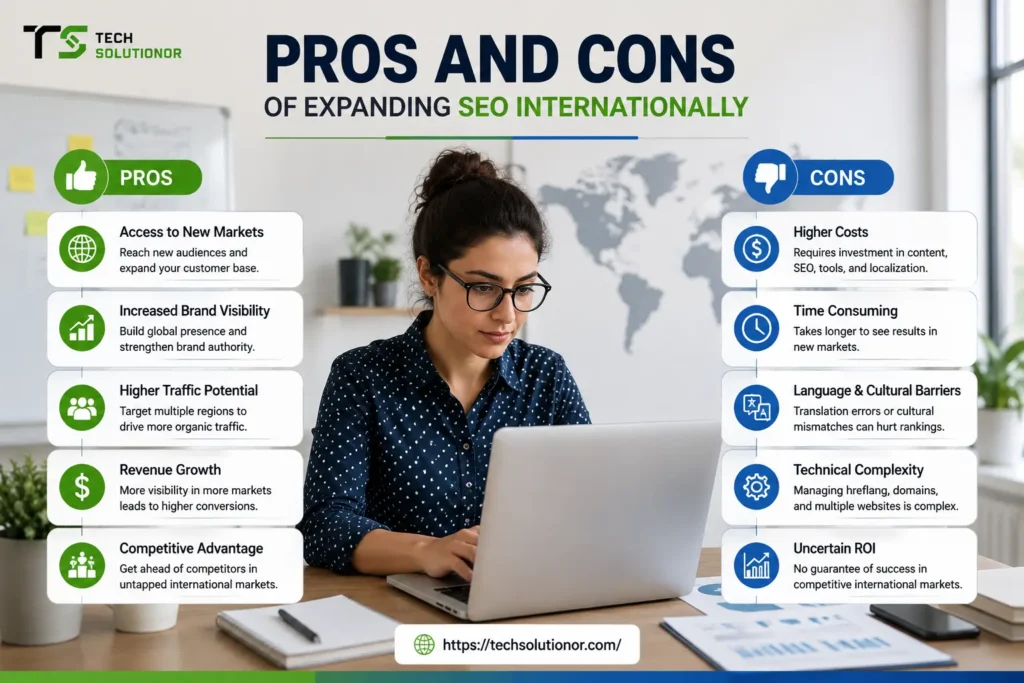
On the upside, it opens up entire new customer bases without an ongoing ad bill, builds equity that compounds over time, and can surface opportunities competitors haven’t even noticed in less crowded regional markets.
On the flip side, it needs real technical skill most in-house teams simply don’t have on hand, mistakes can hit multiple markets simultaneously instead of just one, and results take longer, full stop. None of that makes it a bad idea. It just means it needs someone who actually knows what they’re doing.
Cost Considerations for International SEO Services
Pricing really comes down to how many markets and languages you’re touching. More markets, more localized content, more technical setup, more ongoing monitoring, the cost scales with that, naturally. A bigger migration, say moving from subdomains to subdirectories, adds a one-time cost that tends to pay for itself through cleaner management later.
Native content costs more than machine translation, but it avoids the ranking damage that thin, low-quality localization tends to cause. And working with a best SEO agency in Dubai that already knows the regional landscape usually saves money overall, mostly by skipping the expensive trial-and-error phase.
Industry Trends Shaping International SEO
AI translation tools keep getting better, sure, but they still can’t replace a real native speaker reviewing customer-facing copy. Search engines are also getting noticeably sharper at spotting thin, duplicated content across regional versions of a site, which makes real localization more important, not less.
Worth reading how SEO stacks up against Google Ads on cost and ROI if you’re weighing channels for a new market, since that math shifts once multiple regions are in play. And it’s worth understanding how AI is reshaping search rankings before anyone builds a long-term strategy around one single platform.
UAE-Specific Considerations for International SEO
Running these campaigns out of the UAE for years now has taught me this market sits somewhere pretty unique:
- Dubai businesses often expand regionally first, Saudi Arabia, Egypt, the wider GCC, before going global, and that needs real Arabic dialect nuance most generic strategies just miss
- Bilingual search is the default here. English and Arabic queries coexist for the same person, often in the same session
- Government and licensing content sometimes needs specific compliance language, especially in finance and healthcare
- Mobile search dominates even harder here than in a lot of Western markets I’ve worked in
- Trust signals carry more weight in Gulf markets, reviews, local registration, a visible local presence, all of it feeds into both rankings and conversion
Businesses leaving the UAE for their next market almost always underestimate how different it’ll feel, even a neighboring one that looks similar on paper.
How to Choose the Right International SEO Expert

A few blunt questions worth asking before you hire anyone for this:
- Have they actually run hreflang across multiple live sites, or just talked about it in a sales call?
- Do they use real native speakers for content, or lean entirely on translation software?
- Can they show you rankings tracked separately per market, not one blended number that hides the messy parts?
- Do they actually understand the regulatory or cultural quirks of where you’re headed?
If this expansion’s part of a bigger digital push, it’s worth looking at your digital marketing strategy and, if you’re selling across borders, your ecommerce development setup too, at the same time, not after.
FAQs
1. What does an international SEO expert actually do?
An international SEO expert optimizes websites to rank across multiple countries, languages, or regions. This includes hreflang setup, localized content strategy, technical architecture, and region-specific link building, going far beyond simple translation of existing content.
2. How is international SEO different from regular SEO?
Regular SEO targets one market and language, while international SEO manages multiple regions simultaneously. It requires additional technical work like hreflang tags, URL structuring, and native-language content to avoid duplicate content issues across country versions.
3. How long does international SEO take to show results?
Timelines vary by market and competition, but most businesses see initial movement within three to four months per region. Full results, considering multiple markets and language-specific content, typically take six months or longer to fully materialize.
4. Do I need separate websites for each country I’m targeting?
Not necessarily. Subdirectories often work well and are easier to manage than separate domains, though the right structure depends on your business size, resources, and how distinct each market’s needs are from one another.
5. Why is Dubai a good base for international SEO expansion?
Dubai’s bilingual market and central location make it a strong testing ground for regional strategies before expanding further into the GCC or beyond. Businesses here often refine multilingual and multi-market approaches before scaling globally.
Conclusion
International SEO isn’t local SEO with a few extra steps bolted on. It’s genuinely its own thing, with its own technical traps, its own cultural landmines, and its own timeline. I’ve watched businesses lose months over one bad hreflang tag, and I’ve watched others slide into three or four new markets without much drama at all, because someone did the groundwork properly the first time. That’s really the whole difference. Not talent, not budget necessarily. Just whether the people involved understood the actual challenges of working across borders, not SEO in general.
If you’re thinking about taking your business past your home market, our team can help you skip the expensive mistakes and build an international SEO expert strategy that actually holds up once things get complicated. Let’s talk about where you’re headed next.