
Can a Website Content Writer Reduce Your Bounce Rate?
Can a Website Content Writer Reduce Your Bounce Rate?
Fifteen-plus years doing SEO and content work and I still remember the exact spreadsheet that made me obsess over bounce rate. A client’s homepage was pulling decent traffic, genuinely good numbers from the ads team, but people were leaving in under ten seconds. No scroll. No click. Just gone.
Turned out the copy read like a legal disclaimer, dense, stiff, zero personality to it at all. We rewrote it. Bounce rate dropped almost a third in six weeks. Nothing else changed. Not the design, not the ads. Just the words.
That’s really the honest answer to the question people keep asking me. Can a website content writer actually move that number? Yes. Often faster than a redesign or a new ad campaign would, if I’m being blunt about it.
Words are usually the first thing a visitor actually processes and if those words don’t match what someone expected or needed, they’re gone before anything else on the page even gets a chance to matter.
What Bounce Rate Actually Tells You

Bounce rate measures the percentage of visitors who land on a page and leave without doing anything else, no click, no scroll worth counting, nothing. High bounce rate isn’t automatically bad, by the way.
Someone who reads a full blog post and leaves satisfied is still technically “bounced.” But pair that with a short time on page and that’s usually a sign the content just didn’t deliver what the visitor came looking for.
Why Content Is Usually the Real Culprit
Design gets blamed a lot and sometimes fairly. But more often than not, the actual issue sits in the words themselves. A headline promising one thing while the body delivers something else entirely. A wall of text with no breathing room anywhere.
Copy that talks about the business instead of answering the visitor’s actual question. I’ve audited dozens of “underperforming” pages over the years and honestly, content mismatch shows up far more often than any technical flaw does.
How a Website Content Writer Actually Reduces Bounce Rate
A skilled writer matches content to search intent first, before worrying about style at all. If someone searches “best CRM for small teams,” landing them on a generic “about our software” page feels like a bait and switch, even when nobody meant it that way. Getting that match right alone fixes a surprising chunk of bounce problems, more than people expect.
Structure matters just as much as the words themselves, maybe more. Short paragraphs, clear subheadings, scannable formatting, all of it lets visitors find what they need fast instead of hunting through dense blocks of text.
And tone plays a bigger role than most business owners expect. Copy that sounds human and direct keeps people reading longer than copy that sounds like a corporate memo nobody asked to receive.
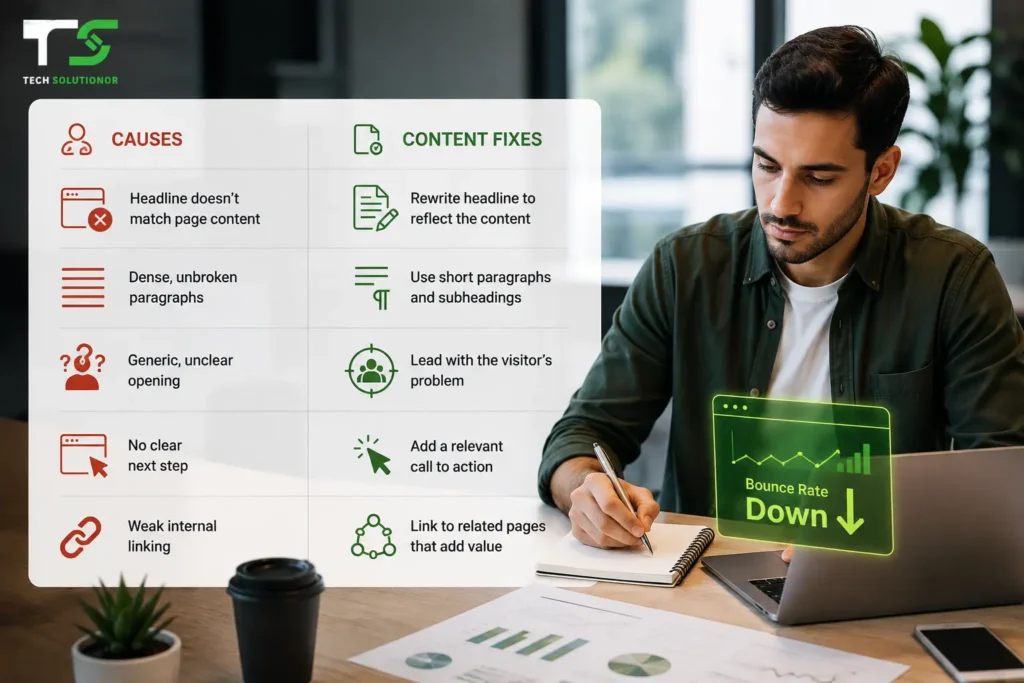
Common Bounce Rate Causes and Content Fixes
| Cause | Content-Level Fix |
| Headline doesn’t match page content | Rewrite headline to reflect what’s actually on the page |
| Dense, unbroken paragraphs | Break into shorter sections with clear subheadings |
| Generic, unclear opening | Lead with the visitor’s problem, not the company’s history |
| No clear next step | Add a specific, relevant call to action |
| Weak internal linking | Guide readers to related pages that match their intent |
Benefits Beyond Just Lowering Bounce Rate
Better content doesn’t just keep people on a page longer, it changes how they perceive the business entirely, sometimes without them even noticing why. Clear, well-structured copy builds trust faster, which tends to translate into more inquiries and conversions, not just prettier analytics.
Paired with strong graphic design, well-written copy makes a page feel finished instead of half-built. It also supports SEO more directly than people assume, since search engines pick up on engagement signals, like time on page, when deciding how to rank content over time and that ties closely into any broader digital marketing strategy a business is running anyway.
Common Mistakes Businesses Make With Website Content

The biggest one, easily, is writing for the business instead of the visitor. Leading with company history or a mission statement instead of addressing what the reader actually needs right now. Plenty of sites also mismatch headlines and meta descriptions against the actual page content, which drives clicks, sure, but guarantees an instant bounce the second people realize it’s not what they searched for.
I also see businesses ignore mobile readability entirely. Paragraphs that look fine on a desktop turn into intimidating walls of text on a phone screen, which is where most traffic actually lands these days, whether businesses plan for that or not.
And a lot of teams skip internal linking altogether, missing an easy way to keep visitors moving through the site instead of just leaving after one page and never coming back.
Best Practices for Content That Keeps People Reading
Open with the visitor’s problem, not a company introduction, within the first two sentences, ideally. Keep paragraphs short, three or four lines at most, especially for mobile readers who make up most of your traffic anyway. Match every headline honestly to what the page actually delivers, no exceptions, none.
Use subheadings generously so visitors can scan before committing to read in full. And link naturally to related pages so there’s always an obvious next step instead of a dead end that quietly pushes people away.
Pros and Cons of Investing in Professional Content Writing
On the upside, professional content improves engagement metrics, builds credibility faster than generic copy ever manages to and supports long-term SEO performance through better on-page signals. It also tends to convert better, since clear, intent-matched copy guides visitors naturally toward taking action instead of leaving them guessing what to do next.
On the other hand, it requires real upfront investment and ongoing updates as search intent and competitors shift around it and poorly briefed writers can still produce content that misses the mark entirely if the strategy behind it was weak to begin with.
None of this makes content writing optional. It just means it needs proper strategy behind it, not just decent grammar and a spell-checker.
Cost Considerations for Website Content Writing
Pricing depends on scope, page count, research depth and how technical the subject matter actually is. A handful of core landing pages costs far less than a full site rewrite or an ongoing blog strategy stretched across months.
Working with an experienced provider among established content writing agencies in Dubai who understand local search behavior often costs more than a generic freelance writer, but tends to save money by getting intent and tone right the first time instead of paying for repeated rewrites later.
Industry Trends Shaping Website Content Right Now
AI tools are speeding up first drafts across the industry, no question there. But search engines are getting sharper at spotting thin, generic content that doesn’t actually serve the reader and that gap is only widening. Genuine expertise and first-hand insight are becoming more valuable, not less, as a direct result.
Worth reading how AI is changing SEO and search rankings, since content quality and search visibility are more tightly tangled together than ever right now. It’s also worth understanding how web development and SEO work together, because even the best content still needs a solid technical foundation underneath it to actually perform.
UAE-Specific Considerations for Website Content
Writing for UAE audiences for years now has taught me this market has its own expectations, ones a generic content approach usually misses entirely:
- Bilingual visitors are common and content that only works in English quietly loses a meaningful chunk of the audience without anyone realizing it
- Trust signals matter more here, credentials, local relevance, clear contact information, all of it affects whether visitors stay or leave within seconds
- Mobile reading dominates even more heavily than in a lot of other markets, making short paragraphs genuinely non-negotiable, not just a nice-to-have
- Cultural tone matters, content that feels too aggressive or too casual can misread badly depending on who’s actually reading it
Getting these details right keeps visitors engaged instead of bouncing straight back to search results within seconds of landing.
How to Choose the Right Content Writing Partner
A few honest questions worth asking before hiring anyone for this work:
- Do they research search intent before writing or just start typing immediately and hope for the best?
- Can they show real examples of content improving engagement, not just polished samples with no results attached?
- Do they understand your specific industry and audience or just general writing skill on its own?
- Will they revise content based on actual performance data once it’s live or call the job done at delivery?
If your content strategy is part of a bigger digital push, it’s worth reviewing your SEO plan and your web development setup at the same time, since even genuinely great content struggles to perform on a slow or poorly structured site underneath it.
FAQs
1. Can content really lower bounce rate on its own?
Yes, often significantly. Content that matches search intent, uses clear structure and speaks directly to the visitor’s problem keeps people reading longer, which naturally reduces bounce rate without needing any design or technical changes.
2. What’s a good bounce rate for a website?
It varies by page type, blog posts often see 60-80%, while landing pages should aim lower, around 40-60%. Context matters more than the raw number, since a satisfied reader can still technically “bounce.”
3. How long does it take to see bounce rate improve after a content rewrite?
Most sites see measurable change within two to six weeks, depending on traffic volume and how significant the rewrite was. Search engines also need time to recognize improved engagement signals before rankings reflect the change too.
4. Does AI-written content hurt bounce rate?
Not automatically, but generic, unedited AI content often feels hollow to readers, which can hurt engagement. Content reviewed and refined by an experienced writer, even when AI-assisted, performs noticeably better than fully automated output.
5. Should every page on a website be professionally written?
High-traffic and conversion-focused pages, homepages, service pages, key landing pages, benefit the most. Lower-priority pages can sometimes wait, but any page driving real traffic deserves content that actually matches what visitors are searching for.
Conclusion
Bounce rate rarely lies, honestly. When people leave fast, something on the page didn’t match what they came looking for and more often than design or speed, that something is the words sitting right there on the screen. I’ve watched a single content rewrite move engagement numbers more than months of technical tweaking ever did, simply because it finally spoke to what visitors actually needed to hear at that moment.
If your site’s traffic isn’t sticking around long enough to convert, our team can help figure out exactly where the content’s losing people. Let’s talk through what’s actually happening on your pages.