Ecommerce Website Development Dubai: How to Launch an Online Store (2026)
Ecommerce Website Development Dubai: How to Launch an Online Store (2026)
A few years ago, a Dubai-based home goods retailer came to us after their first online store attempt fell apart. They’d hired a freelancer to set up a quick WooCommerce site, never properly configured the payment gateway and lost three weeks of Ramadan sales because customers couldn’t check out using Apple Pay. We rebuilt their store from the ground up and within two months their conversion rate tripled, not because of flashy design, but because the basics finally worked the way UAE shoppers expect.
That story sums up most of what goes wrong with ecommerce website development Dubai retailers attempt without proper planning. This guide walks through what we’ve learned building online stores for UAE businesses: platform choice, payment gateways, costs and the mistakes that quietly kill launches before they get going.
Why Now Is the Right Time to Launch an Online Store in Dubai

The Gulf region’s ecommerce boom didn’t slow down after the pandemic pushed everyone online, it kept accelerating. UAE shoppers now expect to buy everything from groceries to furniture without leaving their phones and retailers who haven’t built a serious online store Dubai presence are losing ground to competitors who have.
Businesses that treated their website as an afterthought in 2021 are the same ones scrambling to catch up in 2026, while early movers have already built loyal repeat-customer bases online. If you’re a UAE retailer still running purely on a physical location or a basic Instagram shop, this is the moment to build something more permanent.
Choosing Your Platform: Shopify, WooCommerce, or Custom
This decision shapes everything that follows in your ecommerce website development and it’s the first thing we walk every client through.
- Shopify development UAE: projects suit retailers who want a fast launch with minimal technical overhead. Shopify handles hosting, security and backend complexity for you. The tradeoff is monthly fees and some customization limits unless you add custom app development.
- WooCommerce Dubai: builds make sense if you already run on WordPress, want full ownership of your hosting or need flexibility Shopify doesn’t easily provide. It’s more hands-on to maintain, but gives more control over long-term costs since you’re not paying ongoing fees per sale.
- Custom-built stores: earn their cost when your model doesn’t fit either platform: complex B2B pricing, unusual inventory logic or ERP/CRM integrations. We’ve built custom ecommerce platforms for UAE clients exactly when this was the case, though it’s rarely the right starting point for a first store.
For most retailers launching their first store, Shopify or WooCommerce will get you live faster and cheaper. Custom development earns its cost once you’ve outgrown what either platform can comfortably handle.
UAE Payment Gateways: Telr, Pay Tabs and What Actually Matters

This is where we see the most ecommerce website development projects quietly fail and it rarely gets the attention it deserves during planning. Telr and Pay Tabs are the two payment gateways most UAE ecommerce solutions UAE businesses rely on and for good reason: both are built specifically for the regional market, support AED transactions natively and integrate cleanly with Shopify, WooCommerce and custom checkout flows.
Beyond the gateway itself, your checkout needs to support the payment methods UAE shoppers actually expect: Apple Pay, Google Pay and increasingly buy-now-pay-later options like Tabby and Tamara, which have become standard expectations across UAE retail.
The mistake we see most often, including with that home goods retailer, is treating payment gateway setup as a checkbox item handled in an afternoon, rather than testing every payment path before launch. A failed transaction at checkout doesn’t just cost you that sale; it teaches the customer not to trust your store next time.
What Ecommerce Website Development Actually Costs in Dubai
Pricing varies based on platform and complexity, but here’s what we typically see across real UAE projects. A standard Shopify or WooCommerce store with a clean theme, payment gateway integration and basic product catalog setup generally runs AED 15,000–35,000.
Stores with more advanced functionality, such as multi-currency support, loyalty programs or bilingual Arabic-English layouts, typically land between AED 35,000–70,000. Fully custom-built ecommerce platforms with ERP integration or high-volume catalog management can exceed AED 100,000.
If you’re also weighing this against a broader website rebuild, it’s worth reviewing general website development costs in Dubai, since ecommerce and corporate site budgets often get planned together.
Step-by-Step: Launching Your Online Store
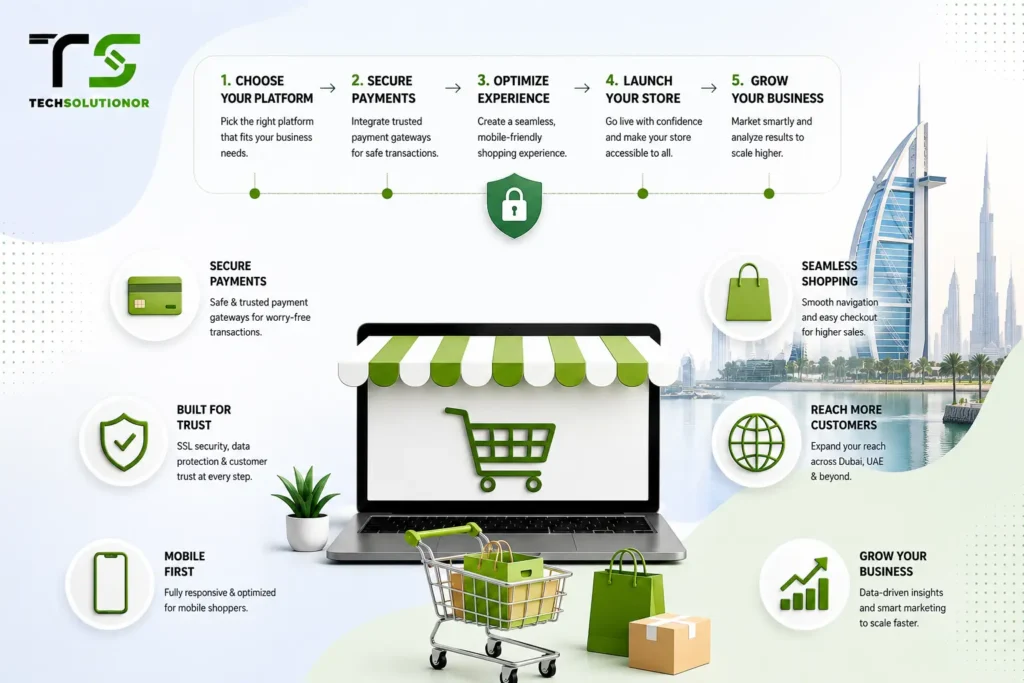
Once you’ve settled the platform and payment questions, the rest of your ecommerce website development follows a fairly predictable sequence.
- Define your product catalog and pricing first: Before any design starts, nail down exactly what you’re selling, how variants work and whether you need wholesale or tiered pricing.
- Choose your platform based on actual needs: not trends. Revisit the Shopify vs WooCommerce vs custom decision honestly, based on catalog size and growth plans.
- Stress-test your payment gateway early: not the week before launch. Run real test transactions through Telr or Pay Tabs, across every device and payment method.
- Build mobile first: Most UAE ecommerce traffic comes from phones and a desktop-first build that “also works on mobile” almost always converts worse.
- Plan SEO before launch, not after: Product pages and URL structure are easier to get right at launch than to fix later. Our SEO pricing guide for Dubai breaks down realistic monthly costs.
- Soft-launch before going loud: Test with a small audience, watch for checkout friction, then push marketing once the store holds up under real traffic.
Why Local Experience Matters for UAE Ecommerce
A lot of generic ecommerce website development advice online assumes a US or European market and it shows in ways that matter: ignoring Arabic RTL layout requirements, missing UAE VAT display obligations or building checkout flows around payment methods that aren’t actually common here. We’ve built and launched online stores across UAE retail, F&B and B2B sectors for over a decade and lessons from projects like that home goods retailer shape how we scope every new build today. You can see real examples in our project portfolio and learn more about our team’s background on our about page.
Once your store is live, driving consistent traffic to it is a separate discipline from building it. Our digital marketing team typically steps in at that stage, running campaigns tailored to UAE shopping behavior rather than generic global templates. If your store will sit alongside a broader corporate website, it’s also worth reading our breakdown of what makes a strong web development partner in this market.
Frequently Asked Questions (FAQs)
Q: Should I choose Shopify or WooCommerce for my Dubai online store?
Shopify suits fast, low-maintenance launches with predictable monthly fees. WooCommerce suits businesses wanting full control over hosting and customization, especially if already using WordPress for their main site.
Q: Which payment gateway is best for UAE ecommerce stores?
Telr and PayTabs are both strong choices built specifically for the UAE market. The right one depends on your platform, transaction fees and which buy-now-pay-later options you want integrated.
Q: How long does it take to launch an ecommerce website in Dubai?
A standard Shopify or WooCommerce store typically takes 6 to 10 weeks from planning to launch. Custom-built platforms with complex integrations can take 12 to 20 weeks depending on scope.
Q: Do I need Arabic language support on my online store?
It depends on your target audience, but for most UAE retail businesses, bilingual Arabic-English support significantly expands your reachable customer base and is worth budgeting for from the start.
Q: What’s the biggest mistake UAE retailers make when launching online stores?
Treating payment gateway setup and mobile optimization as afterthoughts. Both directly affect whether customers can actually complete a purchase and fixing them post-launch costs more than building them right initially.
Conclusion
Successful ecommerce website development in Dubai isn’t complicated in theory, but the details (the right platform, a properly tested payment gateway, mobile-first design and SEO built in from day one) are exactly where most first attempts go wrong. The post-pandemic shift to online shopping across the Gulf region isn’t slowing down and UAE retailers who get these fundamentals right from the start consistently outperform those racing to fix problems after launch.
Launch your UAE online store with Tech Solutionor, free eCommerce consultation available.