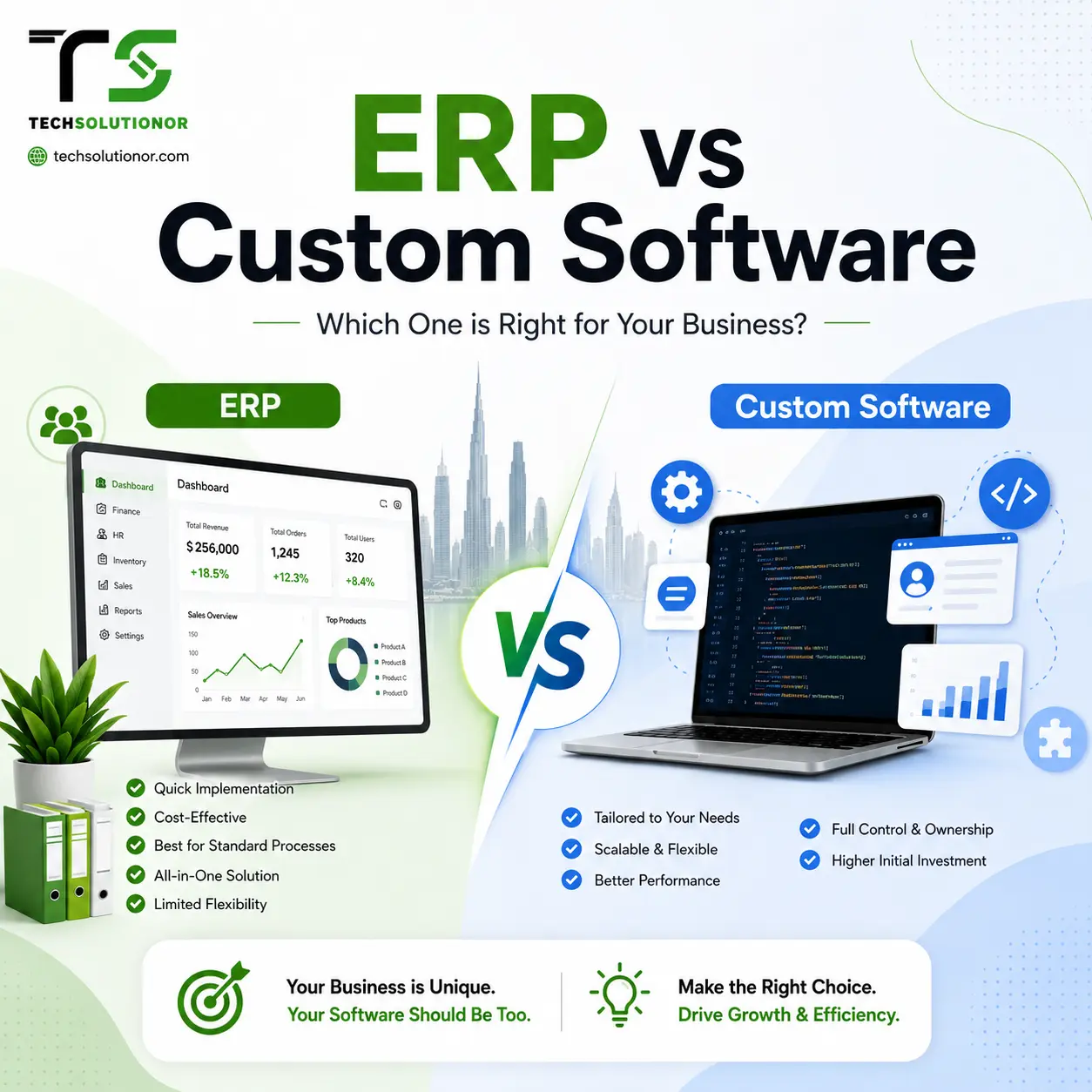
ERP vs Custom Software: What’s Right for Your Dubai Company?
ERP vs Custom Software: What’s Right for Your Dubai Company?
A logistics company in Jebel Ali calls us every few months with some version of the same problem. They bought an off-the-shelf ERP system three years ago, paid for the “full implementation,” and today half their team still runs critical workflows in Excel because the system simply doesn’t match how their business actually operates.
They’re not alone. We hear a version of this story from trading firms in Deira, retail chains expanding across emirates and SMEs that grew faster than the software they bought to support that growth. This is the real question behind ERP vs custom software in Dubai: not which one is “better” in the abstract, but which one actually fits the way your business runs.
Having built custom systems and platforms for UAE companies over the past decade, our team has seen exactly where each option earns its cost and where it quietly becomes the more expensive mistake. You can see examples of past project work and learn more about our team if you want to understand the kind of experience behind this comparison before reading further.
What ERP Software Actually Solves (and Where It Falls Short)
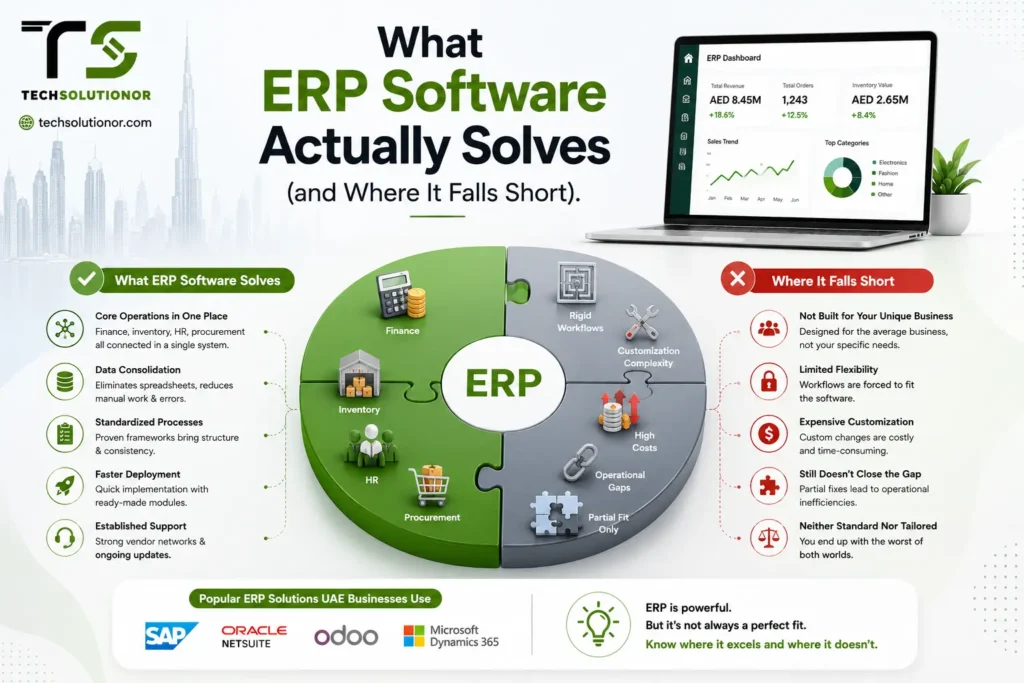
ERP software UAE businesses typically adopt SAP, Oracle NetSuite, Odoo, Microsoft Dynamics is built to standardize core operations: finance, inventory, HR and procurement, all inside one connected system. For a trading company managing multiple warehouses or a retail chain tracking stock across branches, that consolidation alone can eliminate years of disconnected spreadsheets and manual reconciliation. The appeal is real: faster deployment, established support networks and a proven structure that doesn’t require building anything from zero.
The catch is that ERP platforms are built for the average business in your industry, not your specific business. A logistics company with a unique route-optimization process, or a retail chain with a loyalty program that doesn’t map to any standard module, ends up either forcing their workflow to match the software, or paying for expensive customization layered on top of a system that wasn’t designed for it.
That customization cost adds up fast and it often still doesn’t fully close the gap you end up with a system that’s neither fully standard nor fully tailored, which is its own kind of operational headache.
What Custom Software Solves That ERP Can’t
Custom software development Dubai companies invest in exists for exactly that gap when the business process is the competitive advantage, not something to standardize away. A trading company with a pricing model built on years of supplier relationships, or a logistics operation with a dispatch system tuned to UAE traffic patterns and customs requirements, needs software built around how they actually work.
The tradeoff is upfront cost and timeline. Custom systems take longer to scope and build than installing an existing ERP module. But for businesses where the core workflow is genuinely unique, that investment pays back through fewer workarounds, less staff frustration and software that scales the way the business actually grows, not the way a vendor’s roadmap assumes it will.
ERP vs Custom Software: Side-by-Side Comparison
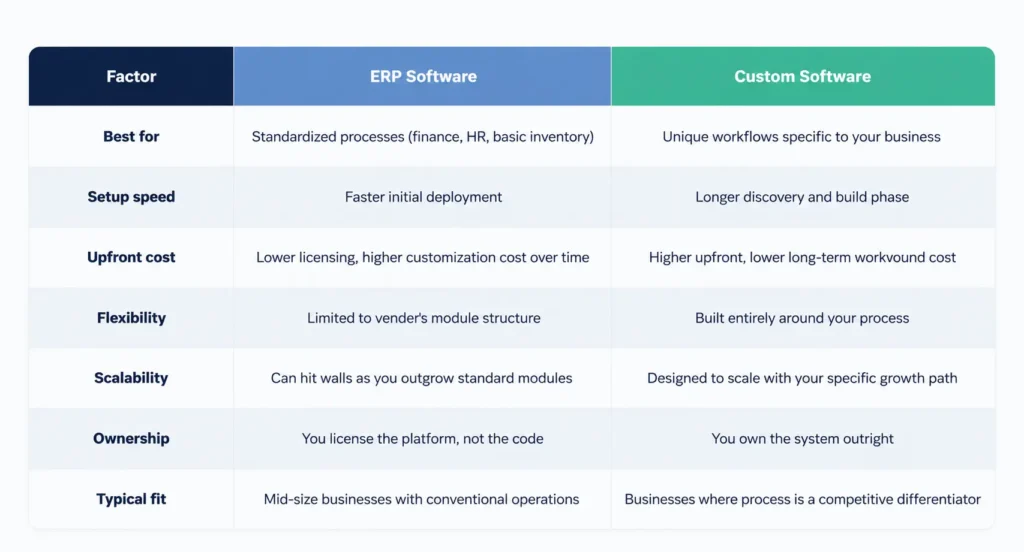
Most UAE businesses focus on price and features when evaluating software, but a few things matter just as much in the long run.
- Who actually owns your data: matters more than people realize at signup time. Once years of customer records, inventory history, and financial data sit inside a system, switching becomes painful regardless of which type of software you originally chose. Ask this question before you commit, not after.
- Support quality during a crisis: is the real test of any software decision. Anyone can answer questions when things are working fine — what matters is how fast you get help when an order fails to process or a report won’t generate during month-end closing.
- How well the software fits your team’s actual workflow: often gets overlooked during demos, where everything looks clean and simple. The real test comes weeks later, once your staff is using it daily and discovering the small friction points that demos never show.
- Future growth plans should shape the decision today: not be an afterthought. A system that works fine for ten employees can struggle badly at fifty, and rebuilding or migrating later almost always costs more than planning for scale from the start.
- Hidden costs rarely show up in the first quote: Training time, data migration, third-party integrations, and ongoing support are often left out of an initial price, only to surface as separate invoices once the project is already underway.
Getting these right matters more than the brand name on the software itself.
Real Dubai Business Scenarios: Which One Actually Fits
Logistics and freight forwarding
A freight company managing UAE-to-GCC shipments usually has dispatch logic, customs documentation flows and driver-tracking needs that don’t map cleanly to any ERP’s logistics module. This is a strong candidate for custom software built specifically around their route and compliance requirements.
Trading and import-export
A mid-size trading firm with straightforward inventory, invoicing and supplier management across a handful of product categories is often better served by a configured ERP system; the standardization actually helps here, especially for VAT compliance and multi–currency handling.
Retail chains
This is where it gets interesting. Core inventory and POS functions fit ERP well, but loyalty programs, app integration and personalized customer experiences increasingly require custom CRM layered on top, or built independently. Many growing UAE retail brands end up running a hybrid ERP for back-office operations, custom web platforms for the customer-facing layer that actually differentiates them.
Retail brands selling online face the same decision again at the storefront level: a generic ecommerce template can run product listings and checkout, but loyalty integration, custom pricing tiers and personalized recommendations usually need development work that goes beyond what an out-of-the-box store builder supports.
The ROI Question: What Custom Software Actually Returns
When you weigh ERP vs custom software purely on ROI, the comparison isn’t about replacing ERP outright, it’s about measuring what manual workarounds currently cost. If your team spends ten hours a week reconciling data between systems that don’t talk to each other, that’s a recurring cost with no end date.
Custom software built to close that specific gap pays for itself the moment those hours disappear and once the backend is solid, the same logic applies to making sure customers can actually find you; our digital marketing team often gets looped in once a custom system frees up the operational bandwidth to focus on growth.
We’ve found the businesses that get the strongest ROI from custom software are the ones that can name the exact workaround they’re trying to eliminate, rather than asking for “something better” in general terms. If you’ve outgrown your current website’s backend systems too, it’s worth reviewing website rebuild costs alongside your software investment, since the two often get scoped together.
How to Decide: A Practical Framework
Ask three questions before choosing either path. First, is your core process genuinely unique, or close enough to industry-standard that an ERP module already handles it well? Second, how much is your team currently losing in manual workarounds, hours, or errors caused by software that doesn’t fit? Third, do you need this system to scale into something nobody has built yet, or are you solving a problem that’s already well understood?
If your answers point to standard operations with predictable growth, ERP is usually the faster, lower-risk path. If your answers point to a unique process that’s central to how you compete, custom software that handles it properly will get you further than forcing a generic platform to behave like something it isn’t and if that system needs a usable interface for staff or customers, our UI/UX design team typically works alongside development rather than as an afterthought.
For businesses scoping their first project, it also helps to understand app development costs in the UAE market, since many custom software and mobile app projects share planning and budgeting logic.
Frequently Asked Questions (FAQs)
Q: Is ERP software always cheaper than custom software in the UAE?
Not necessarily. ERP licensing looks cheaper upfront, but ongoing customization, module add-ons, and workaround costs over time often close that price gap significantly, sometimes making custom software the smarter long-term investment.
Q: Can ERP and custom software work together?
Yes. Many UAE businesses run ERP for back-office functions like finance and HR, while using custom software or CRM for customer-facing features, unique workflows, or operational needs that standard ERP modules simply don’t support well.
Q: How long does custom software development take in Dubai?
Most custom projects take 8 to 20+ weeks, depending on complexity, number of integrations, and how many workflows need to be built entirely from scratch rather than adapted from existing templates or frameworks.
Q: Which is better for a growing retail chain in the UAE?
Often a hybrid approach works best: ERP handles inventory and finance reliably, while custom software or CRM manages loyalty programs, app integration, and customer-specific features that differentiate the brand from competitors.
Q: What’s the biggest mistake UAE businesses make with ERP?
Buying a full ERP suite before properly mapping actual workflows, then discovering months later that core business processes don’t match any available module, leading to costly customization or a frustrating, incomplete implementation.
Conclusion
Choosing between ERP vs custom software isn’t really a technology decision, it’s a decision about which parts of your business should run like everyone else’s and which parts are the reason customers choose you over a competitor.
UAE logistics, trading and retail businesses that get this right typically don’t pick one path entirely; they standardize what’s standard and build custom software around what actually sets them apart.
Need custom software built for your UAE business? Talk to Tech Solutionor’s development team today.