
Best Website Design Practices Turn Visitors into Customers
Best Website Design Practices Turn Visitors into Customers
You know what’s quietly frustrating? Watching a business spend thirty thousand dirhams on Google Ads, generate solid traffic month after month and still close almost nothing. The ads work fine. The targeting is decent. The product is genuinely good. But the website is doing the opposite of what a website is supposed to do. Visitors land, look around for a few seconds and leave. Conversion rate sitting somewhere around half a percent when it should be two, three, four times higher.
This isn’t an unusual situation. A huge share of UAE businesses have websites that look presentable but don’t actually sell anything. The best website design isn’t the prettiest design or the most modern-looking one. It’s the one that moves a specific type of visitor toward a specific action in the least amount of time and with the least amount of friction. Everything else is secondary.
This guide covers what actually makes a difference in website design for conversions, with specific attention to what the UAE market requires that generic web design advice tends to miss. Our web development team works with UAE businesses across retail, healthcare, real estate and services and the principles here come from watching what actually works in this specific market, not just theory.
Why the Best Website Design Is More Than Just Good Looks
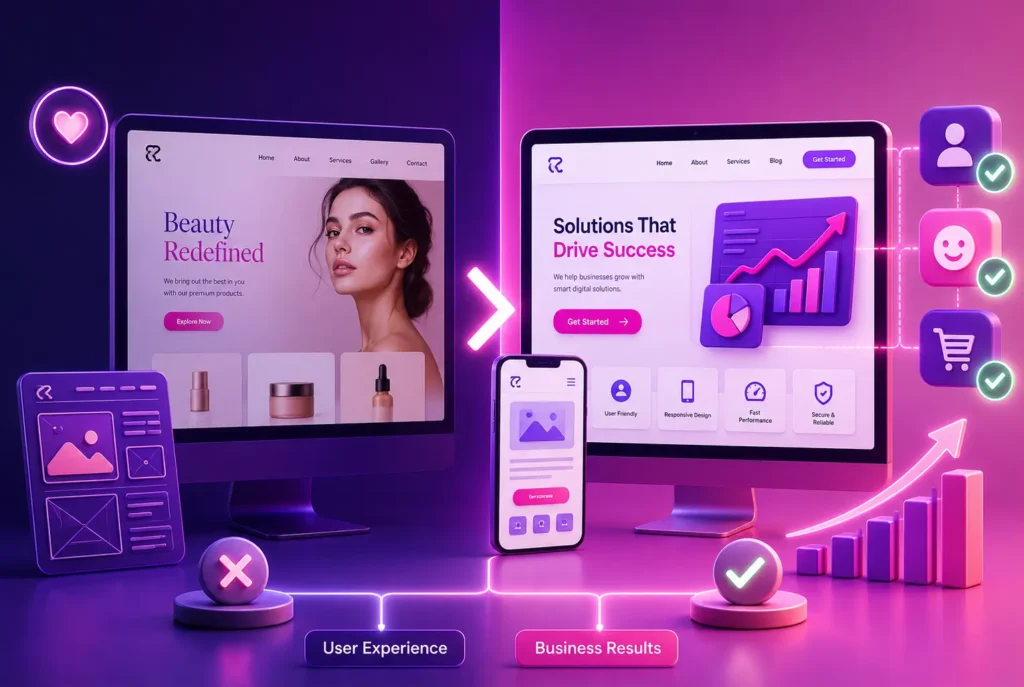
Design awards don’t pay salaries. A beautiful website that confuses visitors, loads slowly on a phone, or leaves people unsure of what to do next is a liability disguised as an asset. The distinction between a presentable website and a high-converting one is almost entirely about purpose and clarity, not aesthetics.
Here’s the test we run on every page:
If someone lands on this page with zero prior knowledge of this business, do they know within five seconds what the company does, whether it’s relevant to them and what to do next? Most pages fail at least one of those three. Many fail all three.
The best website design makes those three things impossible to miss. Not because the font is pretty or the color palette is sophisticated, but because every layout decision was made with a specific visitor in mind and a specific outcome in view.
First Impressions Happen Faster Than You Think
People form an opinion about a website in about 50 milliseconds. That’s before they’ve read a word. Before they’ve scrolled at all. Visual first impressions are based on layout density, color contrast, whether the page feels organized or chaotic and whether it matches what the visitor expected when they clicked the link.
What this means practically: clutter is expensive. Every element on the page above the fold, the visible area before any scrolling, is either earning its place or working against the first impression. Homepages with too many competing elements, popups that fire immediately, background videos that slow loading and headlines so abstract they say nothing specific all erode the first impression before the actual content gets a chance to do anything.
The best performing homepages we’ve seen in the UAE market tend to be simpler than the business owner initially wants them to be. One strong headline that says specifically what the company does and for whom. A clear secondary line that explains the main benefit.
A primary call to action that’s visible without scrolling. Supporting imagery that shows the actual product or service rather than a generic business stock photo. That’s it. The fancy stuff can come lower on the page, after the visitor has already decided to stay.
Why Speed Is a Design Decision, Not a Technical One

Most web designers treat page speed as something the developer handles separately from design. In reality, many design decisions directly cause slow pages and slow pages are one of the highest-impact conversion killers in existence.
A one-second delay in page load time is connected to roughly a 7% drop in conversions. For a business doing AED 50,000 a month in online revenue, that could translate to AED 3,500 walking out the door every month. Not from bad products, not from poor ads, just from a page that takes too long to load.
Design decisions that commonly kill page speed include: full-screen background videos on mobile, large uncompressed hero images, too many custom fonts loading, heavy animations running on every scroll and loading external widgets like review embeds that weren’t optimized for performance.
None of this means you can’t have a good-looking site. It means the visual decisions need to be made with performance in mind from the start. A web development agency in Dubai that separates design from performance optimization at the build stage is setting up problems that are expensive to fix later.
Navigation: The Thing That Keeps Getting Overcomplicated
There’s a principle in UX called “don’t make me think,” and navigation is where most websites make people think too hard. Drop-down menus with six levels. Footer links duplicating header links. Menu items labeled in company-specific jargon that means nothing to a first-time visitor. A mobile hamburger menu that opens and reveals fifteen options with no visual hierarchy.
The businesses with the best-converting websites in the UAE tend to keep navigation ruthlessly simple. Five to seven main items maximum. Labels that use the words real customers use, not internal brand language. A consistent “contact us” or “get a quote” option visible at all times. No dead ends, meaning every page has a natural next step.
For UAE ecommerce businesses specifically, category navigation carries a lot of conversion weight. A customer who can’t find what they’re looking for in two or three taps on a mobile phone will leave. The navigation structure should be built around how customers think about products, not around how the business categorizes them internally. The ecommerce setup and the design need to share the same logic from the start.
Calls to Action: What Most Businesses Get Wrong

A call to action (CTA) is any element on a page that asks a visitor to do something. Book a call. Add to cart. Get a quote. Download the guide. Most business websites either have no clear CTA above the fold, have a CTA that’s too vague to motivate action, or have so many competing CTAs that the visitor doesn’t know which one to choose.
Vague CTAs are a specific problem. “Learn more” tells a visitor nothing about what happens when they click. “Get started” is slightly better but still abstract. “Book a free 30-minute consultation” is specific, low-risk and tells the visitor exactly what they’re signing up for. Specificity builds confidence. Confidence drives clicks.
For UAE businesses, there’s a cultural element worth considering here too. Arabic-speaking customers often respond better to direct, respectful language that signals expertise and reliability rather than the casual, urgency-driven copy that converts well in Western markets.
“Limited time offer” pressure tactics don’t always land the same way in this market as they do in the US or UK. This is one of the areas where genuinely localizing a website goes beyond just translating text.
Trust Signals: What UAE Visitors Look For Before They Buy
Trust is the invisible gatekeeper on every website. A visitor who doesn’t trust the business behind the site won’t buy, book or fill in a form, no matter how clean the design is or how competitive the pricing looks. The best website design builds trust actively rather than assuming visitors will extend it automatically.
In the UAE, trust signals have some specific characteristics. A visible UAE trade license number, or at least a local physical address and local contact number, carries significantly more weight than generic international “verified business” badges. Customer reviews with Arabic names alongside English names signal that the business genuinely serves the local market. Real photos of the team, the office, or the product being made or delivered outperform stock photography by a considerable margin in this market.
For professional services businesses in Dubai, DIFC, or Abu Dhabi, logos of clients or partner organizations carry heavy trust weight. For healthcare providers, professional certifications and DHA-recognized practitioners need to be visible and easy to find. For ecommerce, a clear returns policy and transparent delivery timelines are trust signals that directly affect checkout completion rates.
None of these elements need to be visually dominant. They just need to exist and be findable without effort.
Arabic and English Design: Getting the Balance Right
This is the section that almost every web design article skips because it was written for a market where everyone speaks the same language and reads the same direction. For a UAE business website, it’s genuinely important.
Arabic content on a website isn’t just a translation issue. It’s a layout issue, a typography issue and a visual hierarchy issue all at once. Arabic reads right to left. A layout optimized for English will look wrong in Arabic if RTL has simply been switched on without redesigning the actual layout for it. Navigation that works left-to-right needs to mirror. Image placement that balances an English layout frequently doesn’t balance the Arabic equivalent.
Building bilingual design properly from the start costs more than adding translation later. It’s worth the cost for any UAE business with meaningful Arabic-speaking customer traffic, because a broken Arabic layout signals to that segment that the website wasn’t built for them, which is exactly the wrong signal to send in a market where this represents a substantial share of the purchasing population.
Pairing bilingual website design with proper Arabic and English content rounds out the approach. A correctly built Arabic layout filled with translated-from-English copy that doesn’t read naturally in Arabic still underperforms. Both the structure and the language need to work.
Website Design That Works for SEO and Conversions Together

There’s a tension that comes up in web design conversations: optimize for search engines or optimize for conversions? In practice, the best website design serves both, because the factors that make Google trust a site and the factors that make human visitors trust a site overlap significantly.
Page speed matters to Google and to visitors. Clear heading structure helps Google understand the page and helps visitors scan for what they need. Content that thoroughly answers the questions a visitor arrived with satisfies search intent and keeps people on the page longer. Trust signals that tell Google a site is legitimate also tell visitors the same thing.
Where they diverge is around things like keyword placement, which matters for search visibility but shouldn’t dominate copy decisions and technical structure, which affects crawlability without being visible to visitors at all. Getting both right simultaneously is what distinguishes a well-built website from one that’s been SEO-optimized at the expense of user experience or designed beautifully with no thought given to how search engines will read it.
Our SEO cost guide for Dubai covers what ongoing search investment looks like after a site is built, which is useful context when planning a full digital presence rather than just a design project.
What Good Website Design Costs in the UAE
Realistic pricing is something most web design articles avoid, which leaves business owners going into conversations with agencies completely unprepared for what they’re likely to hear.
| Project Type | Typical Range (AED) | What’s Included |
| Small business website (5 to 8 pages) | 6,000 to 18,000 | Custom design, mobile-first, basic SEO structure |
| Mid-size business website (10 to 20 pages) | 15,000 to 45,000 | Custom UX, bilingual, conversion-focused design |
| Ecommerce website | 18,000 to 80,000 | Product catalog, checkout, payment gateway, RTL |
| Website redesign | 8,000 to 35,000 | UX audit, redesign, speed, conversion optimization |
These ranges reflect real UAE project complexity. What pushes cost up is bilingual RTL requirement, the number of unique page templates needed, integration with booking or payment systems and how much custom functionality is involved versus adapting existing tools.
Our breakdown of custom website costs in Dubai gives a more detailed picture of what drives the difference between a AED 10,000 project and a AED 40,000 one, which is worth reading before scoping any serious web project. And if the platform decision (WordPress vs Shopify vs fully custom) is still open, our platform comparison guide walks through when each one makes sense.
Common Website Design Mistakes That Kill Conversions
A few things keep showing up on UAE business websites that quietly cost sales every single day.
- No clear CTA above the fold, leaving visitors with nothing obvious to do after they’ve formed their first impression
- Contact forms with too many fields, which increases the psychological cost of reaching out and reduces form completions significantly
- Testimonials buried on a separate page, rather than placed near the primary conversion point on the homepage or service pages
- Product images that look stock and generic, rather than showing the actual product, team or service in context
- Mobile menus that don’t work properly, requiring pinch-zooming or horizontal scrolling to use on a phone
- No local trust signals, making UAE visitors uncertain whether the business actually operates locally
What the Best Converting Websites Do
- Start with one clear message above the fold that tells visitors what you do, for whom and why
- Design for mobile first, then adapt for desktop
- Make the primary CTA specific and visible without scrolling
- Use real photos wherever possible instead of stock images
- Place testimonials and trust signals near conversion points
- Keep navigation simple with language real customers use
- Build bilingual layouts properly if Arabic-speaking customers matter to your business
- Make contact as easy as possible: visible phone number, short form, WhatsApp option
FAQs
Q: What makes a website convert visitors into customers?
A clear value proposition above the fold, specific calls to action, fast load time, visible trust signals and a design that removes friction at every step. Converting visitors is mostly about answering their questions quickly and making the next action obvious and easy.
Q: How important is mobile design for UAE business websites?
Extremely important. UAE has among the highest smartphone penetration globally and the majority of website visits, product research and purchase decisions happen on mobile. A site that performs poorly on mobile is losing a significant share of potential customers before they even read your offer.
Q: Should my UAE business website include Arabic content?
For most consumer-facing businesses, yes. Arabic-speaking customers represent a substantial share of UAE purchasing power. Proper bilingual websites with genuine RTL layouts perform significantly better with this audience than translated text dropped into an English-designed layout.
Q: How much does a professionally designed website cost in Dubai?
Small business websites typically range from AED 6,000 to AED 18,000. Mid-size business sites range from AED 15,000 to AED 45,000. Ecommerce with Arabic and payment integration can reach AED 80,000 or more depending on catalog size and functionality required.
Q: What’s the most common reason business websites don’t convert?
The most common issue is unclear messaging combined with no visible call to action above the fold. Visitors land, can’t immediately understand what the business does or what to do next and leave within seconds. Good design fixes this before addressing any other conversion factor.
Conclusion
A well-designed website in 2026 isn’t a luxury or a vanity project. For most UAE businesses, it’s the difference between a digital presence that generates revenue and one that just costs money to maintain. The best website design is the one that helps a specific type of visitor understand what you offer, trust that you’re legitimate and take the next step easily, on any device, in any language your customers actually use.
That outcome doesn’t come from following global trends blindly or building whatever looks impressive in a portfolio screenshot. It comes from designing with a real customer journey in mind, backed by an understanding of what UAE audiences specifically expect and respond to.
Ready to build a website that actually converts? Start with Tech Solutionor’s web development services and see what a conversion-focused approach to UAE web design looks like in practice.