
Why Hire Professional Mobile App Developers for Your Business
Why Hire Professional Mobile App Developers for Your Business
Think about the last app you deleted within ten minutes of downloading it. The loading spinner that just never stopped. The checkout button that did nothing on the first tap. The onboarding screen that made zero sense, so you gave up before you’d even tried the thing. You left and honestly, you never went back. Now flip that around your business has an app and that exact scene might be playing out right now with your own customers. They showed up, got frustrated and left. Quietly, without ever complaining to anyone.
That’s really the whole business case for hiring professional mobile app developers and it’s a lot more concrete than people usually frame it. It’s not about “technology” in some abstract sense. It’s about whether your digital product leaves a good first impression or a bad one, whether it loads fast enough to keep someone’s attention and whether it actually does the one thing your customer came there to do. A poorly built app doesn’t just underperform quietly in the background, it actively damages the brand it was supposed to be building up.
We work with UAE businesses across retail, logistics, healthcare and hospitality, helping them build apps that genuinely serve their customers through our app development services. What follows is an honest look at why professional developers matter, what they actually spend their time doing, what it costs and where the real limitations sit because any guide that pretends there are no downsides isn’t worth reading.
What Professional Mobile App Developers Actually Do
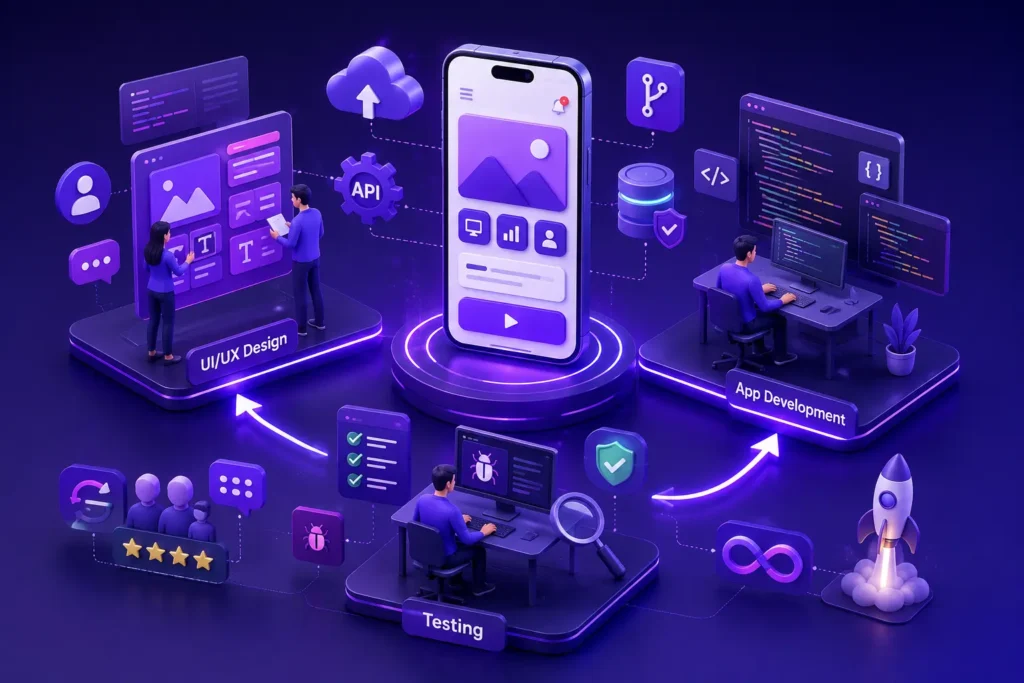
The easy answer is “they build apps.” The real answer is a fair bit more involved than that.
A professional app developer doesn’t open with code. They open with questions. What business problem is this app actually solving? Who’s the primary user and what do they need to get done in under three taps? What existing systems inventory management, booking platforms, payment processors does this thing need to talk to? What does “this worked” even look like by month six?
Those questions shape everything downstream. Architecture decisions made in week one quietly decide how easy or painful it is to add features in year two. UI decisions made before any real user testing decide whether you end up with four-star reviews or a pile of one-star complaints about confusing screens. Getting this right takes the kind of judgment that only comes from having built apps before, watched things break and learned where the usual assumptions fall apart.
Past the initial build, professional developers also handle App Store and Google Play submission which comes with its own maze of compliance requirements and can stall for weeks if it’s done wrong the first time. They manage version updates, performance monitoring, crash reporting and all the ongoing maintenance an app needs once it’s actually live and being used.
Why Not Just Use a No-Code App Builder?
This deserves a straight answer, because plenty of businesses seriously consider this route first and for some of them, honestly, it’s the right call.
No-code app builders work well for internal tools that customers never see, very simple single-purpose utilities, validating a prototype before committing to a full build and micro-businesses that genuinely can’t justify a bigger development spend yet.
They usually fall short the moment you need custom logic that doesn’t fit the template, want the app talking to your existing backend systems, care about performance on older or lower-end devices, operate in a regulated industry with real compliance requirements, or want something that doesn’t look like every third app built on the same platform.
The practical test is simple, really: can the no-code tool build everything your app needs, without duct-taping workarounds together? If yes, great, that might genuinely be your starting point. If the honest answer involves the phrase “almost, but…” that “but” is exactly the workaround that’ll frustrate users, keep growing over time and eventually force a rebuild anyway.
Pros and Cons of Hiring Professional Mobile App Developers

Let’s be straight about both sides here, because a guide that skips the downsides is basically a sales pitch wearing a guide’s clothing.
Pros:
- Custom functionality built around exactly what your business needs, not whatever a template happens to offer
- Scalable architecture that doesn’t need a full rebuild the moment your user base actually grows
- Proper security implementation that handles user data responsibly which matters legally and reputationally, not just technically
- App Store compliance handled by someone who already knows the rules and can navigate a rejection without it eating months
- Post-launch support from a team that already understands how the thing was actually built
- Cross-platform options (Flutter, React Native) that let you launch on both iOS and Android from one codebase, cutting cost without gutting performance
Cons:
- Higher upfront investment compared to no-code tools or a junior freelancer working solo
- A longer timeline for a properly built app versus a rushed one which is a feature, not a flaw, but can feel frustrating when there’s real market pressure to launch yesterday
- Communication overhead if you’re working with an external team and expectations weren’t nailed down clearly upfront
- Ongoing dependency on that team for maintenance, unless knowledge transfer is planned for from the start
- Scope creep risk if requirements aren’t locked before development kicks off every feature added mid-project costs more time and more money
Understanding both sides honestly is what lets you make a decision that actually fits your situation, instead of one driven by either enthusiasm or fear.
Native vs Cross-Platform Development: Which One Is Right for Your Business
This comes up in almost every single app conversation we have and the right answer genuinely depends on what the app needs to do there’s no universal winner here.
| Factor | Native (iOS or Android separately) | Cross-Platform (Flutter, React Native) |
| Performance | Highest, direct access to device hardware | Very strong for most use cases |
| Development cost | Higher, two separate codebases | Lower, one codebase for both platforms |
| Look and feel | Perfectly matched to each platform | Excellent, near-native on most modern devices |
| Time to market | Longer | Faster |
| Best for | Apps with complex device-specific needs (camera, health data, AR) | Most business apps, e-commerce, booking, delivery, fintech |
For most of the UAE businesses we work with, cross-platform development using Flutter hits the right balance of quality, cost and timeline. Native makes more sense when the app leans heavily on device-specific hardware or platform APIs that cross-platform frameworks just don’t reach as cleanly.
If platform choice is still an open question alongside broader digital decisions, our web development services page walks through when each approach makes sense for different business types.
What Makes a UAE Business App Different From a Generic One
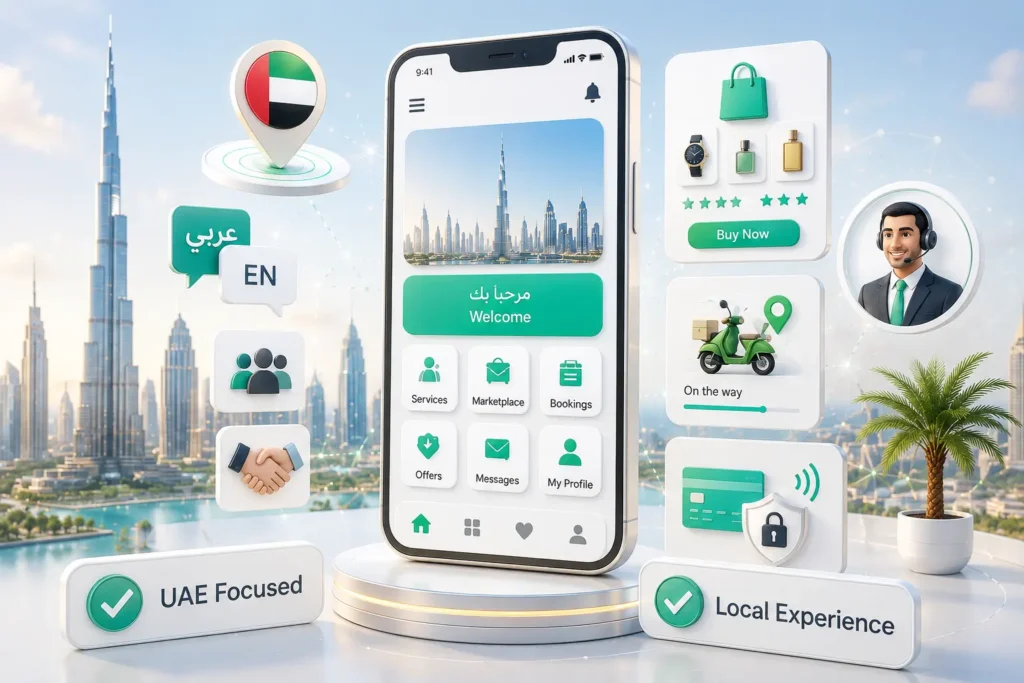
This is exactly where working with a team that actually understands the UAE market matters more than general app-building competence ever will.
Arabic RTL support isn’t optional
An app serving Emirati and Arabic-speaking users needs right-to-left layout support built in from day one, not bolted on later. It touches navigation direction, text alignment, button placement, even icon direction. Apps with broken Arabic layouts lose that entire user segment almost instantly, no second chance.
UAE payment integrations are specific
Connecting to Telr, PayTabs, or Network International takes integration work a team based mainly in Western markets may simply never have done before. Assuming Stripe covers everything here is a surprisingly common mistake and it usually delays launch by weeks.
WhatsApp integration is expected, not a bonus
UAE users generally expect to be able to reach a business through WhatsApp right from inside an app. It’s so standard here that leaving it out reads as a missing feature, not a neutral design choice. Getting users to the app in the first place also ties into a broader digital marketing strategy, particularly the paid app-install campaigns that have become increasingly common for UAE product launches.
Data compliance genuinely matters
The UAE has rolled out clearer data protection guidelines and apps collecting user data need to handle storage, consent and access controls in ways that line up with local regulatory expectations, not whatever the team happened to build for a different market.
None of these are technically hard to build, to be clear. They’re just the things that get missed by teams who haven’t built for this market before and they tend to show up as one-star reviews rather than obvious technical failures.
How App Development Connects to Your Broader Digital Strategy
An app doesn’t really exist in isolation. The businesses getting the most out of their mobile investment tend to treat it as one layer of a connected digital presence, not some standalone side project.
An e-commerce app needs to sync with the same inventory system the website already runs on. A booking app for a clinic needs to plug into the scheduling software staff are already using day to day. A logistics app needs to talk to the same tracking backend that customers see on the website. Plan these connections from the start and the app delivers genuine operational value. Retrofit them later and they’re usually expensive, fragile and a headache to maintain.
That’s part of why our team approaches app projects alongside e-commerce development and software development conversations, rather than treating the app as its own isolated silo. The architecture choices made for one surface quietly shape what’s even possible on the others.
Once an app is actually live, getting people to find and download it is a whole separate challenge tied to SEO and app store optimization something that frequently gets left out of the development scope entirely and only gets noticed once it’s already a problem post-launch. Our SEO cost guide for Dubai covers what that investment tends to look like alongside app development.
Common Mistakes Businesses Make When Hiring App Developers
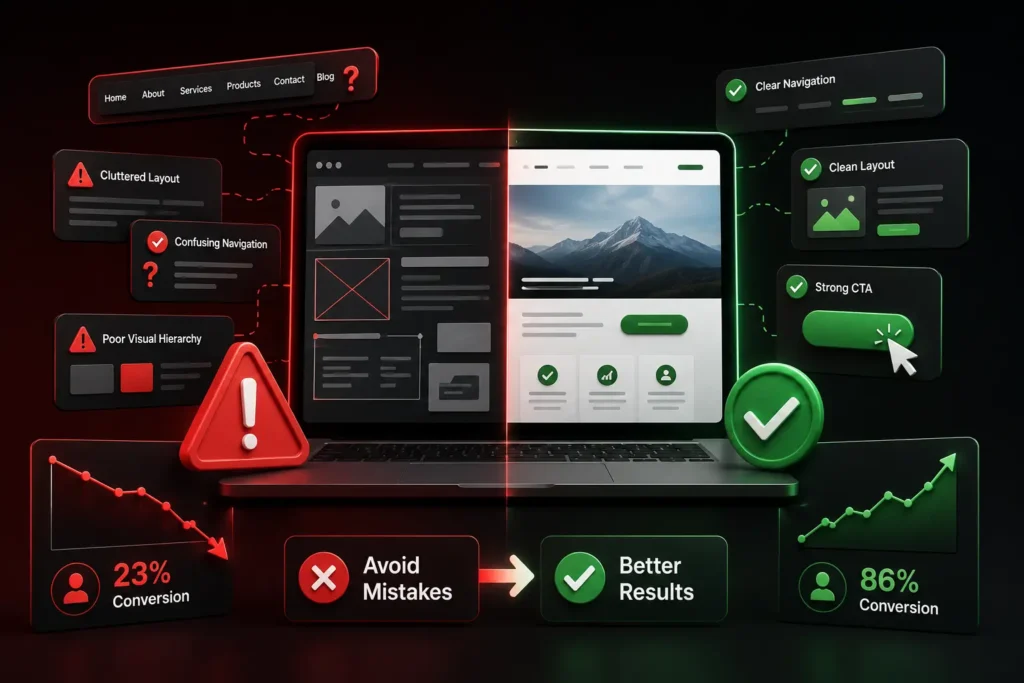
A few patterns keep showing up across businesses that ended up with an app that just didn’t deliver what they’d expected.
- Approving a quote before requirements are actually documented: A vague brief produces a vague scope and everything that falls “outside” that scope costs extra later. Getting requirements written down before anything is signed protects both sides.
- Choosing based on price alone: The lowest quote in your inbox is usually low for a reason either scope’s been quietly trimmed to make the number look good, or corners get cut somewhere during the build to hit that price.
- Not planning for post-launch maintenance: An app that isn’t maintained breaks as operating systems update around it. iOS and Android both push major OS updates yearly and apps that fall behind stop working the way they should.
- Skipping user testing entirely: Shipping straight to the App Store without real people testing the actual flows first almost always surfaces problems after launch that would’ve been far cheaper to catch beforehand.
- Treating the launch as the finish line: Launch is genuinely the start of the product’s life, not the end of the project.
How to Evaluate an App Development Team Before You Hire
A few questions cut straight through a polished pitch and reveal whether a team can actually deliver what they’re promising.
Ask to see apps they’ve built that are live right now in the App Store or Google Play and go download them yourself. Not screenshots in a deck. The actual app, on an actual phone in your hand. Notice how it loads, how it feels to use, whether the UI makes sense without someone explaining it to you first.
Ask what happens if the app gets rejected during App Store submission. A team that’s been through this before has a clear process for handling it. A team that hasn’t will be learning that process on your timeline and your budget.
Ask what’s actually included after launch. Maintenance, bug fixes, OS compatibility updates and how all of that gets handled matters just as much as the build itself.
Our project portfolio and team background give a clear picture of the work we’ve actually done and who’s behind it which we think matters before any business commits to a development engagement.
FAQs
How much does it cost to hire professional mobile app developers in the UAE?
Typical UAE app development ranges from AED 25,000 for simple apps to AED 300,000 or more for complex builds with custom backends, payment integration and Arabic support. Cross-platform development using Flutter generally reduces cost compared to building separate iOS and Android versions.
How long does it take to build a mobile app in Dubai?
Simple apps typically take 8 to 14 weeks. Mid-complexity business apps take 14 to 24 weeks. Complex apps with custom features, multilingual support and third-party integrations can take 6 to 9 months from planning through a stable launch.
Should I choose a freelancer or a development company for my app?
Freelancers suit small, well-defined projects with limited budgets. Development companies bring design, testing, project management and post-launch support under one roof, reducing coordination burden and risk for business-critical apps that need ongoing support.
What’s the difference between native and cross-platform mobile apps?
Native apps are built separately for iOS and Android using platform-specific tools, offering maximum performance. Cross-platform apps (Flutter, React Native) use one codebase for both platforms, reducing cost and time. Most UAE business apps perform excellently with cross-platform development.
What should I look for before hiring mobile app developers?
Review live apps they’ve built, not just portfolio screenshots. Ask how they handle App Store rejections, what’s included post-launch and whether they have real experience with UAE payment gateways and Arabic language support. Clear scope documentation before signing anything is essential.
Conclusion
Hiring professional mobile app developers isn’t really a decision about whether your business “deserves” a nice-looking digital product. It’s a decision about whether the app you’re investing in will actually work for your customers, connect properly with your existing systems, pass App Store review without drama and hold up over time as the platforms underneath it keep shifting.
In the UAE specifically, that also means working with a team that genuinely understands Arabic RTL requirements, local payment integrations, WhatsApp expectations and UAE data compliance because none of these are optional extras here. They’re just what the market expects, full stop.
The businesses that get the best return from their app investments are the ones that take the planning phase seriously, get requirements written down before a single line of code gets written and choose a development team based on evidence of real past work rather than how polished the pitch deck looked.
Ready to build something that actually works? Explore Tech Solutionor’s app development services and see how we approach digital products built specifically for the UAE market.