Shopify vs WooCommerce vs Magento: Which Is Best in 2026?
Shopify vs WooCommerce vs Magento: Which Is Best in 2026?
WooCommerce is best for content-driven stores with WordPress already in place.
Magento (Adobe Commerce) is best for enterprise operations with large catalogues, B2B complexity, and dedicated development budgets.
But that one-line answer is where most comparison guides stop and where most businesses make the wrong decision. The right platform is not the most popular one. It is the one that fits where your business actually is right now, and where it needs to go in the next three years.
At TechSolutionor, we have built ecommerce stores on all three platforms for clients across Dubai and the wider UAE market. This guide gives you a direct, no-fluff comparison across cost, SEO, scalability, ease of use, and UAE-specific requirements — so you can make the right call before spending a dirham.
Market Position — Where Each Platform Stands in 2026
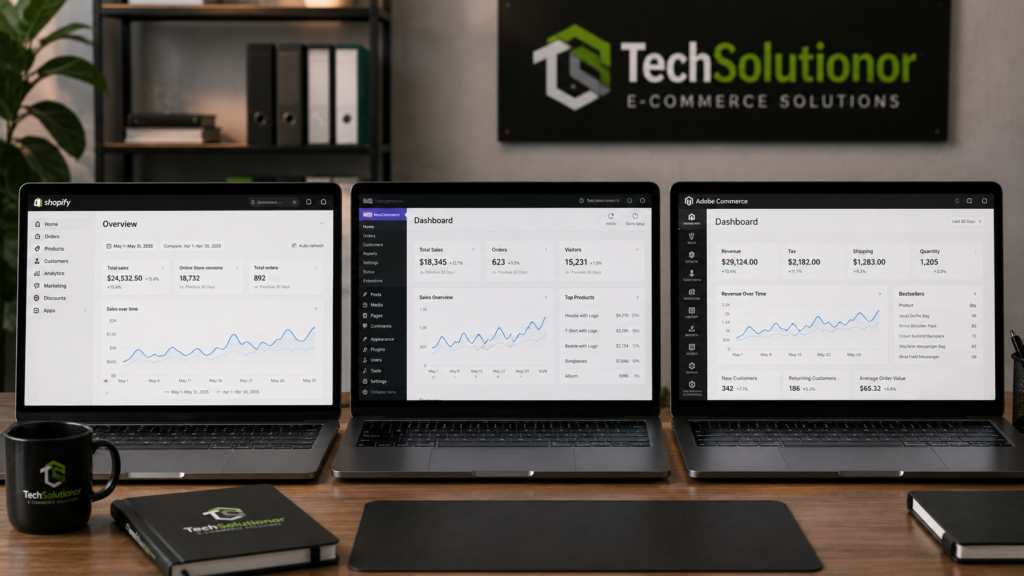
Understanding the market context helps frame the comparison correctly. These three platforms combined hold over 50% of global ecommerce market share — but they serve fundamentally different business profiles.
- Shopify powers over 6 million stores globally. It is the fastest-growing ecommerce platform by revenue per store and dominates the mid-market DTC segment. Shopify Plus handles enterprise volumes for brands scaling beyond AED 5M/year in online revenue.
- WooCommerce leads in raw store count — millions of WordPress sites use the free plugin. It powers content-first businesses where SEO and blogging are central to the growth model.
- Magento / Adobe Commerce dominates enterprise transaction volume. Open Source is free; Adobe Commerce Cloud starts at approximately AED 80,000/year and scales to AED 1.6M+/year for large enterprises. It is the platform of choice for complex B2B, multi-store, and multi-currency operations.
Shopify vs WooCommerce vs Magento — Full Platform Comparison 2026
| Factor | Shopify | WooCommerce | Magento |
|---|---|---|---|
| Hosting | Fully managed (SaaS) | Self-hosted (you manage) | Self-hosted / Adobe Cloud |
| Setup Time | Hours to days | Days to weeks | Weeks to months |
| Technical Skill Required | None — fully visual | WordPress knowledge needed | Dedicated developer team |
| Monthly Platform Cost | AED 106–8,460/month (Basic to Plus) | Free plugin — hosting AED 100–500/month | Open Source free — Adobe Commerce AED 22,000–165,000+/year |
| Transaction Fees | 0.5–2% without Shopify Payments | None | None |
| Customization | Good — within platform limits | Excellent — full code access | Maximum — built for complexity |
| SEO Control | Good — improving rapidly | Excellent — full WordPress SEO stack | Excellent — full technical control |
| Scalability | High — managed infrastructure scales automatically | Medium — requires server investment to scale | Very High — built for enterprise scale |
| App / Plugin Ecosystem | 8,000+ Shopify apps | 59,000+ WordPress plugins | 4,000+ Magento extensions |
| Arabic / RTL Support | Good — themes available, some limitations | Excellent — full theme control | Excellent — built for multilingual |
| UAE Payment Gateway Support | Good — PayTabs, Telr, Network International via apps | Good — via plugins | Excellent — deep custom integration |
| Best For | SMEs, DTC brands, fast-launch stores | Content-first stores, WordPress sites, budget-conscious | Enterprise, B2B, large catalogues, multi-store |
Cost Comparison — Total Cost of Ownership in 2026
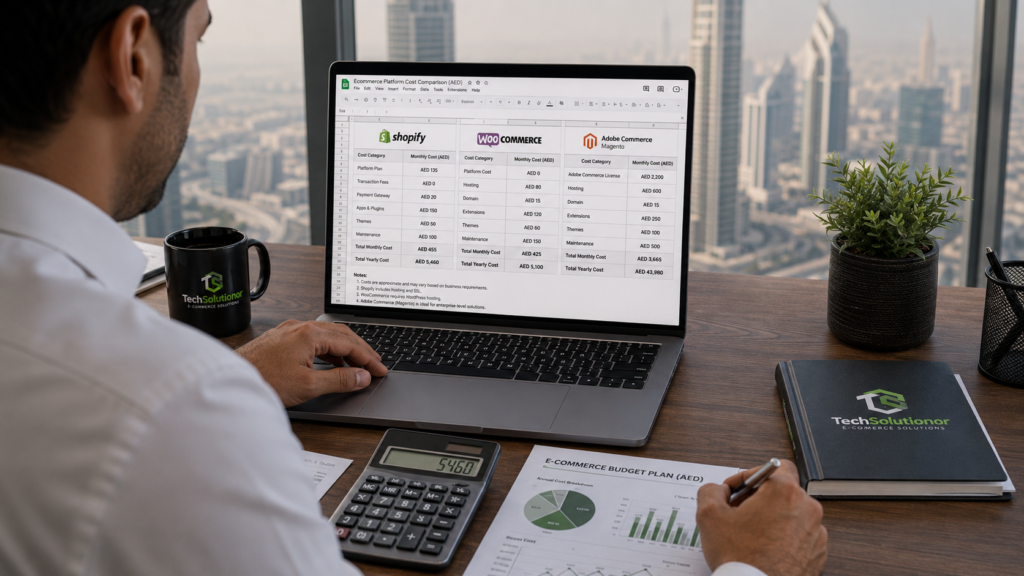
The headline platform cost is rarely the real cost. Here is an honest total cost of ownership breakdown for each platform at mid-market scale.
| Cost Item | Shopify (AED/year) | WooCommerce (AED/year) | Magento Open Source (AED/year) |
|---|---|---|---|
| Platform / License | AED 3,700–8,400 (Basic–Advanced) | Free | Free |
| Hosting | Included | AED 1,500–6,000 | AED 6,000–25,000 |
| Theme / Design | AED 1,100–4,000 (one-time) | AED 0–2,200 (one-time) | AED 2,200–15,000+ (one-time) |
| Apps / Plugins | AED 3,700–18,000/year | AED 1,500–7,300/year | AED 3,700–18,000/year |
| Development / Maintenance | AED 3,700–18,000/year | AED 7,300–36,700/year | AED 36,700–183,000+/year |
| Security / SSL | Included | AED 0–1,100/year | AED 1,100–5,500/year |
| Estimated Year-1 Total | AED 15,000–55,000 | AED 12,000–55,000 | AED 55,000–250,000+ |
The key insight: Shopify and WooCommerce have similar total cost of ownership at mid-market scale but the cost composition is different. Shopify costs are predictable and managed. WooCommerce costs are variable and depend heavily on your development and maintenance investment. Magento’s total cost of ownership is significantly higher and only makes economic sense at enterprise revenue scale or B2B complexity.
SEO Comparison — Which Platform Ranks Better in 2026?
This is one of the most important decision factors for Dubai businesses investing in organic search alongside their store build.
Shopify SEO in 2026
Shopify has significantly improved its SEO capabilities since 2024. Built-in SEO tools, automatic sitemap generation, structured data, and the ability to customize meta titles and descriptions aligned with Google SEO best practices. The main limitations: URL structure is partially fixed (the /products/ and /collections/ folder structure cannot be removed), and blog functionality is more limited than WordPress. For most mid-size stores with a straightforward content strategy, Shopify SEO is more than adequate in 2026.
WooCommerce SEO in 2026
WooCommerce inherits the full WordPress SEO stack — making it the strongest SEO platform of the three. Combined with Rank Math or Yoast SEO, you get full control over URL structure, schema markup, breadcrumbs, XML sitemaps, and canonical tags. For content-driven ecommerce businesses where blog content and category page SEO are the primary traffic channels, WooCommerce consistently outperforms Shopify on organic search over a 12-month horizon.
Magento SEO in 2026
Magento provides full technical SEO control — including complete URL customization, advanced layered navigation handling (critical for large catalogues), and deep schema markup capability. For enterprise stores with thousands of product pages, Magento’s SEO architecture handles complexity that Shopify and WooCommerce struggle with at scale. The trade-off: SEO on Magento requires experienced developer involvement to implement correctly. Out of the box, Magento is not SEO-optimized — it is SEO-capable.
If SEO is a core growth channel for your store, our ecommerce development team builds every store with SEO architecture baked in from the start — regardless of platform. We also run full ecommerce SEO campaigns post-launch.
UAE-Specific Considerations — What Changes for Dubai Businesses
Most global platform comparisons ignore the factors that matter specifically in the UAE market. Here is what actually changes for Dubai-based ecommerce businesses:

Arabic RTL and Bilingual Support
- Shopify: Arabic RTL themes are available but limited — full bilingual stores sometimes require custom theme development or third-party translation apps that add AED 2,000–8,000/year in cost. Works well for English-primary stores adding Arabic secondarily.
- WooCommerce: Full RTL support via WordPress theme and plugin system. The most flexible bilingual implementation of the three — Arabic-first design is achievable without significant additional cost.
- Magento: Enterprise-grade multilingual and multi-store capability. The strongest option for businesses that need separate Arabic and English storefronts under one admin system.
UAE Payment Gateway Integration
All three platforms support UAE payment gateways — PayTabs, Telr, Network International, Noon Pay — but the integration depth varies. Shopify handles most via official or community apps. WooCommerce uses plugins. Magento allows the deepest custom payment integration for complex scenarios like instalment plans, BNPL (buy now pay later), or government payment portals. For standard UAE ecommerce payment needs, all three are sufficient.
PDPL Compliance
The UAE Personal Data Protection Law requires proper consent management, data storage controls, and deletion workflows. Shopify’s managed infrastructure handles most compliance requirements automatically. WooCommerce and Magento — being self-hosted — place PDPL compliance responsibility on the store owner and require explicit implementation by your development team.
Real-World Case Study — Three Clients, Three Platforms, Three Different Outcomes
At TechSolutionor, we recommend the platform that fits the business — not the one that is easiest for us to build. Here is how three real Dubai clients ended up on different platforms.

Client A — Fashion Accessories Brand — Shopify
A Dubai-based fashion startup needed to launch quickly, had no in-house technical team, and wanted to focus entirely on marketing and product. We built their store on Shopify in 3 weeks for AED 18,000. They were generating revenue before their first month of marketing spend. Today they run AED 1.2M/year in online revenue with zero developer dependency for day-to-day operations.
Client B — Home Decor Store with Active Blog — WooCommerce
A Dubai home decor brand was already running a high-traffic interior design blog on WordPress — 12,000 monthly organic visitors. Moving to Shopify would have broken their blog architecture and lost significant SEO equity. We built their WooCommerce store inside their existing WordPress installation. The blog’s organic traffic now feeds directly into product pages. Their cost-per-acquisition from organic search is AED 0 — the store pays for itself through content the client was already producing.
Client C — B2B Industrial Supplier — Magento Open Source
A UAE-based industrial supplier needed a store with 40,000+ SKUs, tiered B2B pricing (different prices for different customer groups), Arabic and English storefronts under one admin, and custom ERP integration. Neither Shopify nor WooCommerce could handle this complexity at reasonable cost. We built on Magento Open Source — a 14-week project at AED 280,000. The platform handles their full operational complexity without compromise.
You can view more of our ecommerce development work across platforms and industries.
2026 Trends Affecting the Platform Decision
AI Integration Is Now a Platform Differentiator
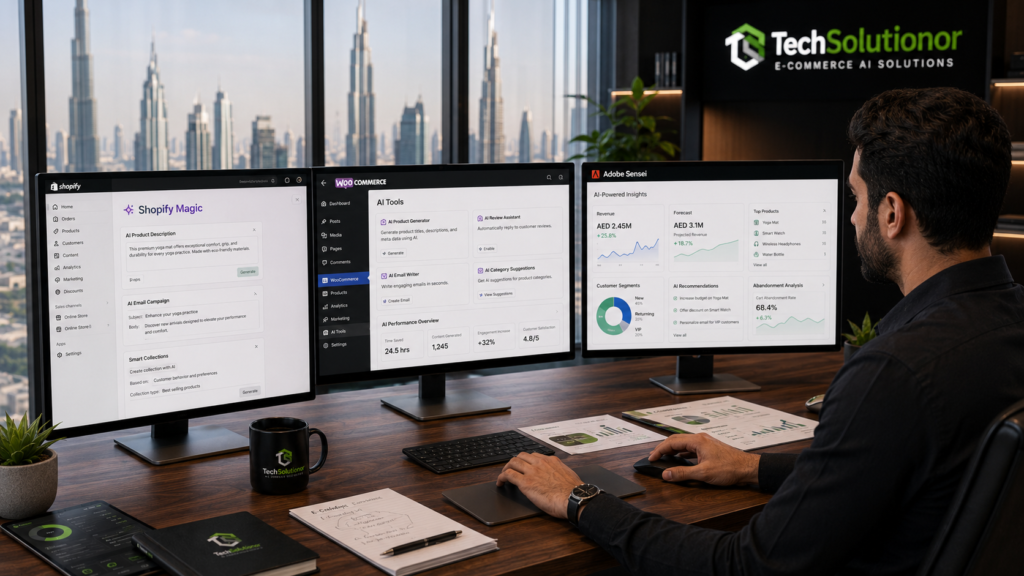
All three platforms are integrating AI — but at different depths. Shopify Magic provides AI-powered product descriptions, inventory insights, and customer segmentation natively. Woo Commerce supports AI through plugins — quality and performance vary. Magento’s Adobe Sensei delivers enterprise-level predictive analytics and personalization at scale. For most SMEs in Dubai, Shopify’s native AI features deliver the best out-of-the-box value in 2026.
Headless Commerce Is Growing
Headless architecture — decoupling the frontend from the ecommerce backend — is becoming more common for high-performance UAE stores. Shopify’s Hydrogen framework and Magento’s API-first architecture both support headless builds. Woo Commerce supports headless via the REST API but with less native tooling. For most Dubai businesses, headless is not yet necessary — but understanding your platform’s headless capability matters if you are planning a 3–5 year scaling roadmap.
Core Web Vitals Are a Revenue Issue, Not Just an SEO Issue
Slow ecommerce stores lose revenue — not just rankings. Studies consistently show that every 1-second delay in load time reduces conversion rate by 7%. Shopify’s managed infrastructure delivers consistent Core Web Vitals performance without server management. WooCommerce performance is hosting-dependent — a cheap shared host will deliver poor vitals regardless of how well the code is optimized. Magento requires dedicated server infrastructure to perform well. For more on this: Why You Need Both Web Development & SEO in 2026.
Which Platform Should You Choose — Decision Framework
| Your Situation | Best Platform | Why |
|---|---|---|
| Launching fast, no tech team, under AED 5M/year revenue | Shopify | Fastest to market, zero maintenance burden, predictable costs |
| Already on WordPress with strong blog traffic | WooCommerce | Preserves SEO equity, leverages existing content architecture |
| Content-driven store where blogging is primary acquisition | WooCommerce | Best SEO control, full WordPress content ecosystem |
| Budget under AED 15,000 for full store build | WooCommerce | Lowest total cost of ownership at entry level |
| 10,000+ SKUs, B2B pricing tiers, multi-store | Magento | Only platform that handles this complexity natively |
| Scaling above AED 10M/year online revenue | Shopify Plus or Magento | Shopify Plus for managed simplicity, Magento for operational complexity |
| Arabic-first bilingual store | WooCommerce or Magento | Both offer stronger native RTL and multilingual control than Shopify |
| Need ERP, CRM, or custom API integration | Magento or WooCommerce | Open-source platforms allow deeper custom integration than Shopify |
Frequently Asked Questions
Which is better — Shopify, WooCommerce or Magento in 2026?
Shopify is best for most small to mid-size businesses. WooCommerce is best for content-driven WordPress stores. Magento is best for enterprise operations with large catalogues and B2B complexity.
There is no universally best platform — the right choice depends on your revenue scale, technical resources, content strategy, and operational complexity. A Dubai fashion brand launching its first store and a UAE industrial supplier with 40,000 SKUs need completely different platforms. The decision framework above maps your situation to the right choice.
Is Shopify or WooCommerce better for SEO in 2026?
WooCommerce has stronger SEO control — but Shopify’s SEO is more than adequate for most businesses and continues improving.
WooCommerce inherits the full WordPress SEO stack — complete URL control, advanced schema, and seamless integration with Rank Math or Yoast. Shopify’s main limitation is the fixed /products/ URL structure. For content-driven stores where blogging is the primary SEO channel, WooCommerce consistently outperforms Shopify over 12 months. For product-first stores where on-site SEO is secondary to paid acquisition, Shopify’s built-in SEO is sufficient.
How much does it cost to build a Shopify store in Dubai?
A professionally built Shopify store in Dubai costs AED 8,000–50,000 depending on design complexity, custom features, and integrations.
Basic Shopify stores with a premium theme and standard setup run AED 8,000–15,000. Custom-designed Shopify stores with UAE payment gateway integration, Arabic RTL, and custom functionality run AED 20,000–50,000+. The Shopify platform subscription (AED 106–8,460/month) is separate from the build cost. Our Shopify development team builds UAE-optimized stores with Arabic support and local payment gateway integration.
Is Magento still worth it in 2026?
Yes — for enterprise businesses with genuine complexity. No — for SMEs who do not need it.
Magento Open Source remains a powerful, free platform for businesses with large catalogues, B2B pricing complexity, and multi-store requirements. The cost of ownership is significantly higher than Shopify or WooCommerce — development, hosting, and maintenance require a dedicated technical investment. For businesses below AED 5M/year in online revenue without significant operational complexity, Magento’s overhead outweighs its capabilities. Our Magento development team builds and maintains enterprise ecommerce platforms for UAE clients.
Which ecommerce platform is best for Arabic websites in Dubai?
WooCommerce or Magento offer the strongest Arabic RTL support. Shopify works but with more limitations on full bilingual implementation.
For Arabic-first or fully bilingual stores in Dubai, WooCommerce provides the most flexible RTL implementation at the most accessible cost. Magento is the enterprise choice for businesses needing separate Arabic and English storefronts under one admin. Shopify Arabic support has improved significantly but still requires workarounds for fully custom bilingual experiences. Read our full guide: Arabic Website Design & Multi-Language Guide Dubai 2026.
Can I migrate from WooCommerce to Shopify in 2026?
Yes — but migration requires careful SEO planning to avoid losing organic rankings during the transition.
Platform migrations between WooCommerce, Shopify, and Magento are common and manageable when executed correctly. The technical migration covers product data, customer records, and order history. The SEO migration — preserving URL structures, redirects, and canonical tags — is where most businesses lose organic traffic if not handled properly. A well-executed migration takes 8–16 weeks. Done poorly, it can cost months of organic traffic recovery.

Not Sure Which Platform Is Right for You?
The wrong platform choice costs more to fix than it cost to build in the first place. Before you commit budget to any ecommerce build, talk to a team that has built on all three — and will tell you honestly which one fits your specific situation.
At TechSolutionor, we scope every ecommerce project with a platform recommendation based on your revenue scale, content strategy, technical resources, and UAE market requirements — before any development begins.
Contact our team for a platform consultation →
Ready to build? Hire us directly and we will deliver a scoped proposal with platform recommendation within 48 hours.