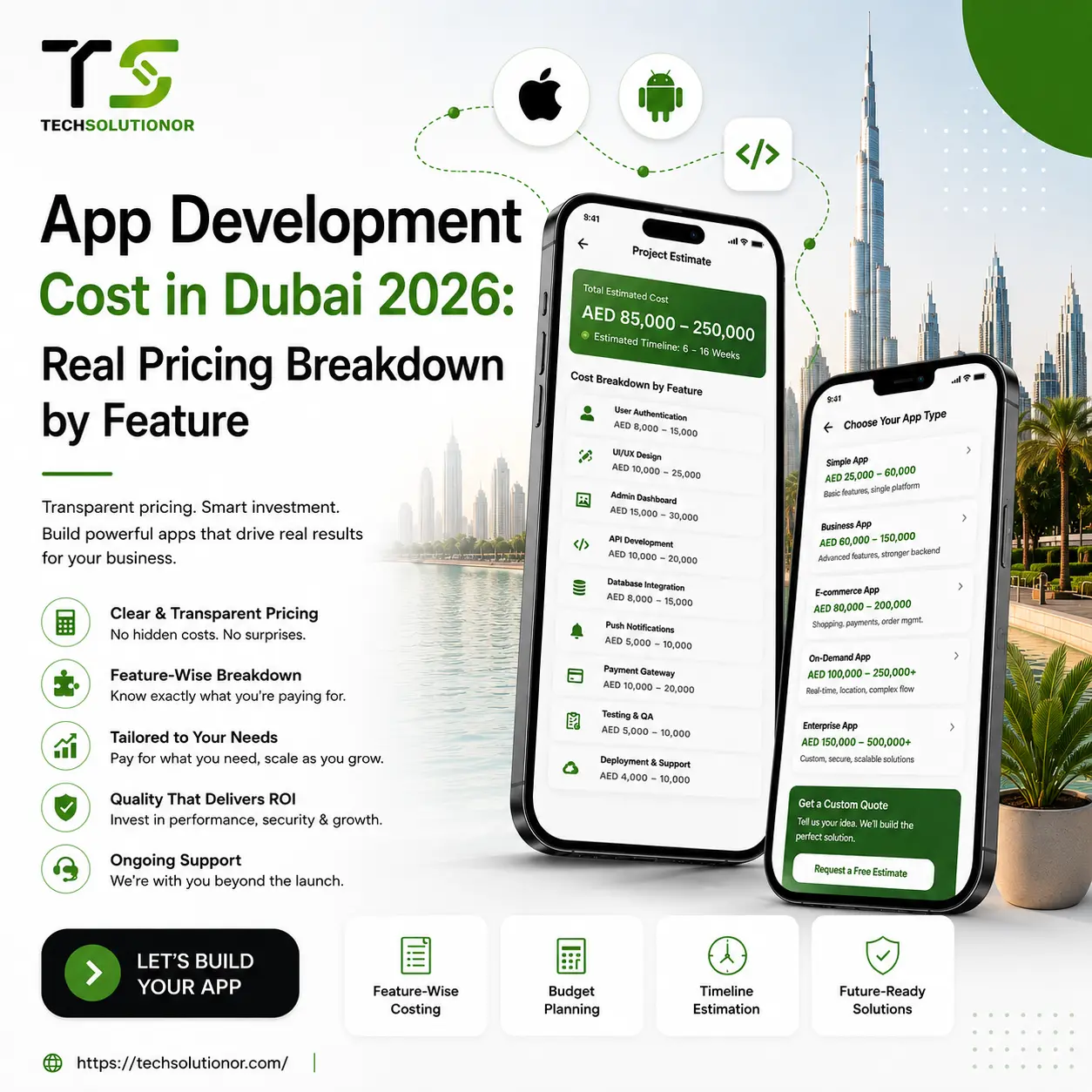
App Development Cost in Dubai 2026: Real Pricing Breakdown by Feature
App Development Cost in Dubai 2026: Real Pricing Breakdown by Feature
Walk into any busy mall in Dubai and watch how people order food, book a table, or check if an item is in stock. Almost nobody calls the store anymore – they open an app. If your restaurant or retail brand doesn’t have one, you’re handing your customer relationship to whichever delivery aggregator or marketplace happens to control the screen instead.
We’ve spent the last decade building digital products for businesses across the UAE and over that time mobile app development in Dubai has shifted from “nice to have” to table-stakes for F&B and retail. This is a practical look at why your brand needs its own app, what it actually costs, which platform makes sense and what kind of return you should realistically expect.
The Real Problem With Relying on Third-Party Platforms
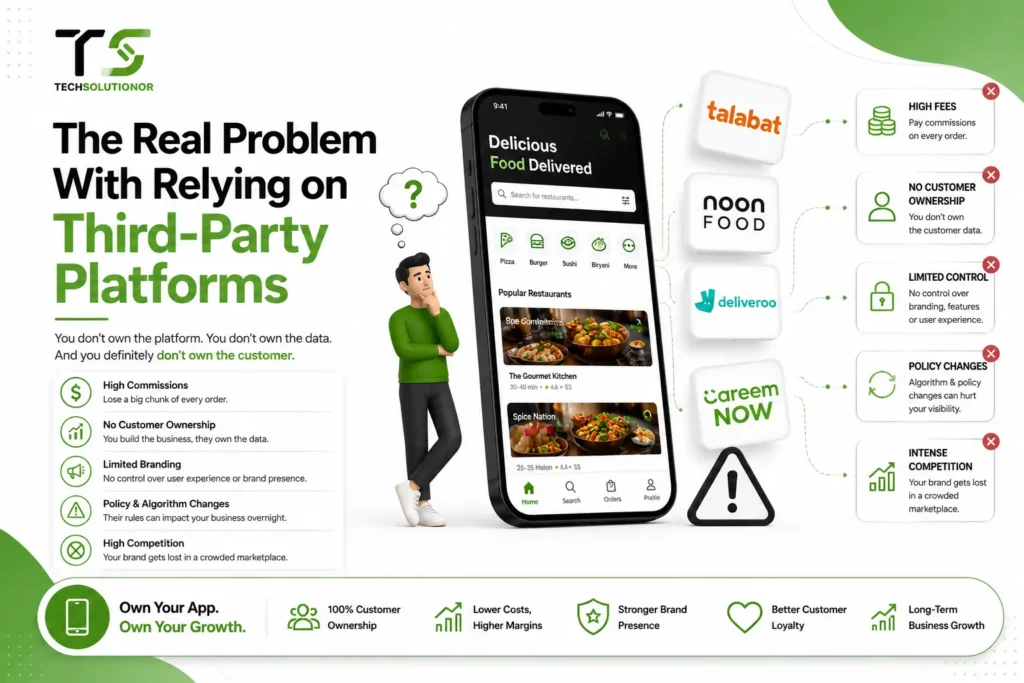
Most UAE restaurants today run their entire digital presence through delivery apps like Talabat or Deliveroo, or through a generic POS system with no direct customer relationship attached. That works until you look at the math. Aggregator commissions in the UAE typically run between 20-30% per order – not a marketing cost, but a structural tax on every single transaction, forever.
An app development company in Dubai that’s done this before will tell you the same thing we tell our clients: the goal isn’t to compete with Talabat on their turf. It’s to build a direct channel where repeat customers order through you, where you own the data and where loyalty points, push notifications and exclusive offers belong to your brand instead of disappearing into someone else’s algorithm.
Once you’ve got your own ordering or booking flow, the aggregator becomes one channel among several, not your only lifeline.
iOS, Android, or Both? The Platform Decision UAE Brands Actually Face
This is one of the first real decisions every business owner runs into, and it’s worth getting right before development starts.
The UAE iOS vs Android split isn’t identical to other markets. Dubai and Abu Dhabi have notably higher iPhone penetration among the demographic that spends on dining out and retail shopping, while Android remains dominant in price-sensitive segments and across the wider GCC delivery workforce.
Here’s how the platform options actually compare for UAE F&B and retail brands:
| Factor | iOS Only | Android Only | Both (Cross-Platform) |
| UAE audience reach | Strong with higher-income diners and shoppers | Strong with price-sensitive and delivery-workforce segments | Covers both customer groups fully |
| Development cost | Moderate (native build) | Moderate (native build) | Lower than building two separate native apps |
| Time to launch | Faster for one platform | Faster for one platform | Slightly longer than one platform, much faster than two native builds |
| Risk of stalling | Low, but misses a large customer segment | Low, but misses a large customer segment | Avoids the common “iOS first, Android later” stall |
| Best fit | Premium dine-in brands targeting iPhone-heavy areas | Budget retail or delivery-driver-facing apps | Most F&B and retail brands serving the general UAE market |
For most F&B and retail brands, an iOS Android app for Dubai audiences needs to launch on both platforms from day one – not iOS first with Android “later,” which is how many UAE app projects quietly stall.
This is where cross-platform frameworks like Flutter earn their place. Building once and deploying to both iOS and Android cuts development time and cost significantly compared to native builds on each platform separately, with minimal compromise on performance for most restaurant and retail use cases.
We’ve written a deeper breakdown of how Flutter app development works for Dubai businesses if you want the technical detail behind that decision.
What Mobile App Development Actually Costs in Dubai
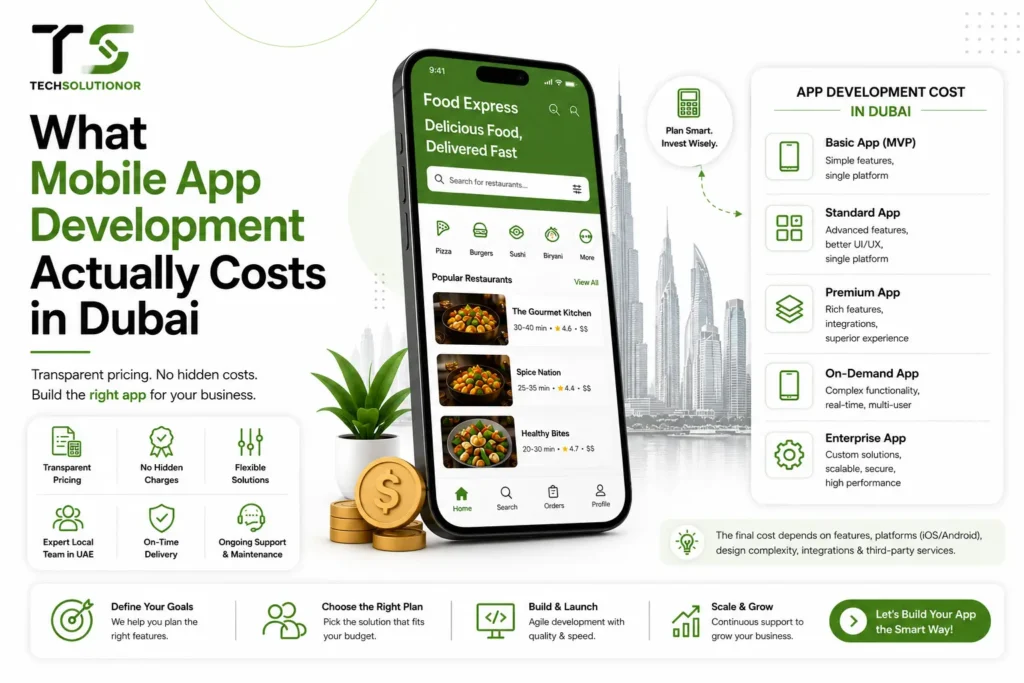
This is the question every business owner asks first and the honest answer is: it depends on what you’re actually building – but here are the real ranges.
A basic ordering or booking app with a clean menu, cart and payment integration typically falls in the AED 45,000 to 90,000 range. A mid-tier app with loyalty programs, push notifications, multi-location support and admin dashboards usually lands between AED 90,000 to 180,000. Enterprise-level apps with AI-driven personalization or complex inventory sync across retail branches can run AED 200,000 and up.
App development cost in Dubai is driven primarily by five factors: platform choice, feature complexity, Arabic-English bilingual support (UAE customers expect this as standard), payment gateway integration with regional providers and ongoing maintenance after launch. We cover this in much more depth in our complete guide to app development costs in Dubai for 2026, including the hidden costs that catch first-time app buyers off guard.
One thing we tell every client during scoping: get an itemized specification before agreeing to any number. A vague quote almost always turns into a budget surprise three months into the build.
On-Demand Features That Actually Drive ROI for F&B and Retail
Not every feature is worth building. Based on the apps we’ve shipped for UAE clients, a handful of features consistently move the needle for restaurant and retail brands specifically.
- For restaurants: Real-time order tracking, table reservations with automated reminders and a loyalty point system tied to push notifications for repeat-order incentives. UAE diners respond strongly to time-limited offers delivered directly to their phone – far more than generic email marketing achieves.
- For retail: In-app stock checking by location, wishlist-to-cart conversion flows and integrated click-and-collect. If your retail brand already runs an online store, pairing your app with your existing ecommerce platform rather than building two disconnected systems saves development cost and avoids inventory sync headaches later.
- For logistics-heavy brands: Live driver tracking and route optimization are no longer premium features – UAE customers expect them as a baseline standard in 2026.
- The common thread: The feature has to remove friction from a moment the customer already cares about. Features built because they look impressive in a demo, rather than because customers actually need them, are the most common source of wasted app budget we see.
Dubai Specific Examples Worth Learning From
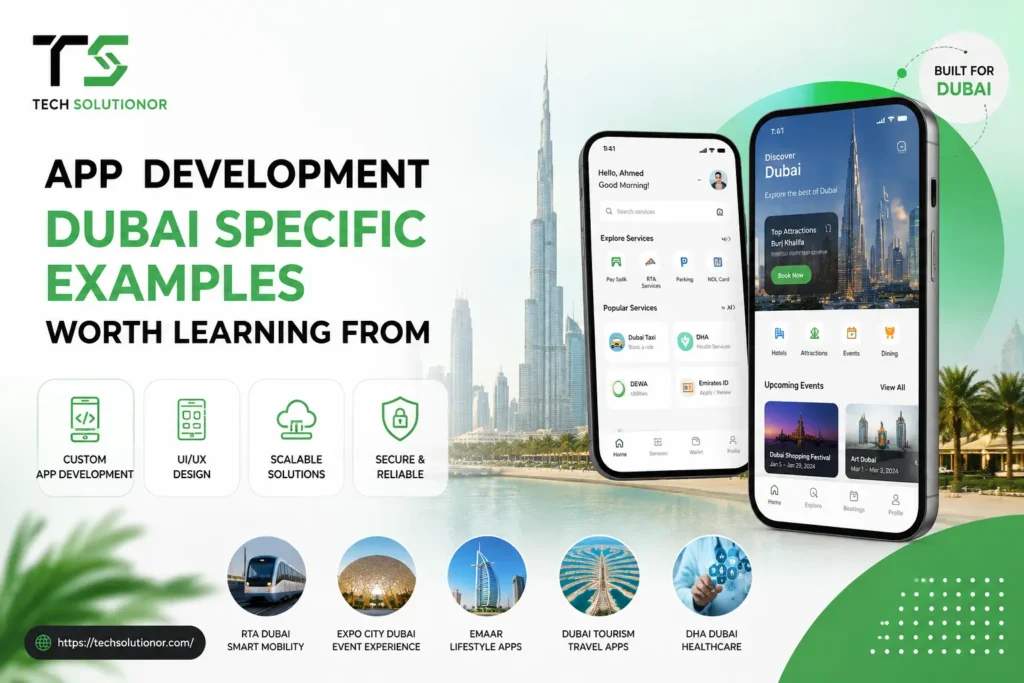
A mid-sized UAE F&B chain with five branches across Dubai and Sharjah typically sees its highest app ROI not from new customer acquisition, but from increasing order frequency among existing customers through loyalty mechanics and push-notification-driven promotions during slow periods.
For retail, the strongest results tend to come from brands that integrate their app tightly with the in-store experience – QR-code loyalty scanning at checkout, app-exclusive in-store discounts and staff trained to mention the app at the point of sale. The app becomes a retention tool tied to the physical store, not a separate digital project running in parallel.
For logistics-adjacent businesses, the ROI case is usually about cost avoidance – every order that moves from a 25% commission aggregator to your own app is margin recovered, not new revenue created. Over a year, that adds up faster than most owners expect.
Why Local Experience Matters More Than You’d Think
A lot of generic app development advice online is written for the US or European market and it shows up in subtle but costly mistakes: ignoring Arabic RTL layout requirements, underestimating how much UAE customers expect WhatsApp integration, or missing UAE-specific payment gateway and data compliance requirements.
We’ve built and shipped apps across F&B, retail, healthcare and logistics for UAE businesses for over a decade, working across native iOS (Swift), Android and Flutter depending on what each project actually needed. You can see examples in our project portfolio and our team’s background is detailed on our about page.
If your app project also needs supporting design work – app store screenshots, onboarding illustrations, or a consistent visual identity across web and mobile – our UI/UX and graphic design team typically works alongside development rather than as a separate handoff, which avoids the mismatch that derails a lot of first-time app projects.
Once your app is live, getting it discovered matters as much as building it well – our SEO team and digital marketing team both work on app store optimization and launch campaigns for clients who want their app found, not just built.
Is a Custom App Right for Your Business Right Now?
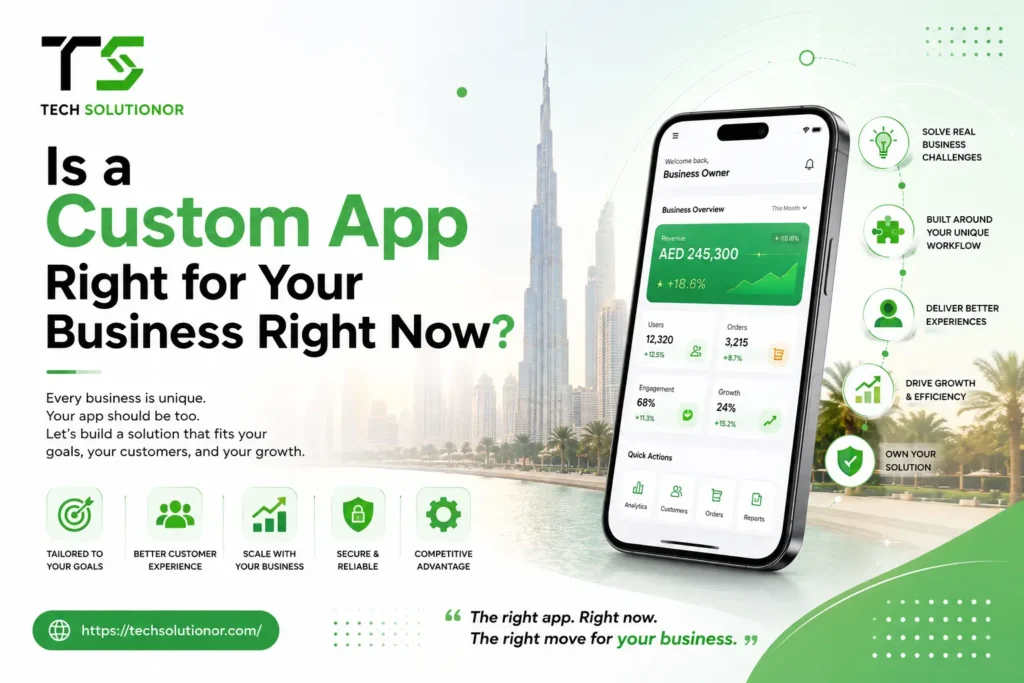
Not every business needs an app on day one. A single-location café with low repeat-customer volume might be better served by a well-built ordering website first. But if you have multiple locations, you’re paying aggregator commissions eating into margin every month, you have customers who already shop with you repeatedly, or you’re planning to scale across emirates in the next 12-18 months, an app development company in Dubai is worth a serious conversation.
The businesses that get the most value from their app treat it as a core growth strategy, not a side project – budgeting for ongoing maintenance, not just the initial build and being honest about which features will actually drive repeat usage.
FAQs
Q: How much does mobile app development cost in Dubai?
Basic apps start around AED 45,000, mid-tier apps with loyalty features run AED 90,000 to 180,000 and enterprise apps exceed AED 200,000.
Q: Should my restaurant be built for iOS, Android, or both?
Both, ideally. Dubai’s market splits heavily between iPhone and Android users, so launching cross-platform from day one matters.
Q: Is Flutter a good choice for UAE business apps?
Yes, Flutter builds once for both platforms, reducing cost and development time without major performance compromises for most businesses.
Q: How long does it take to build a custom app?
A basic app typically takes 8 to 12 weeks; mid-tier or enterprise apps with complex features can take 4 to 6 months.
Q: Will my own app really reduce delivery aggregator costs?
Yes, every order shifted from a 20-30% commission platform to your own app directly recovers margin and builds loyalty.
Conclusion
Building your own app isn’t about chasing a trend, it’s about owning the relationship with customers who already want to order from you, book with you, or shop with you again. Every month you rely solely on aggregators or generic platforms is another month of margin and customer data going to someone else’s business instead of yours.
The UAE market has matured to a point where a well-built app pays for itself through retention, not just acquisition. Whether you run a single restaurant thinking about your first ordering app, or a multi-branch retail brand ready to bring loyalty and stock visibility in-house, the right approach starts with a clear scope, a realistic budget and a team that understands how UAE customers actually use their phones.
Planning to build an app? Get a free consultation from Tech Solutionor – Dubai’s top app development company.